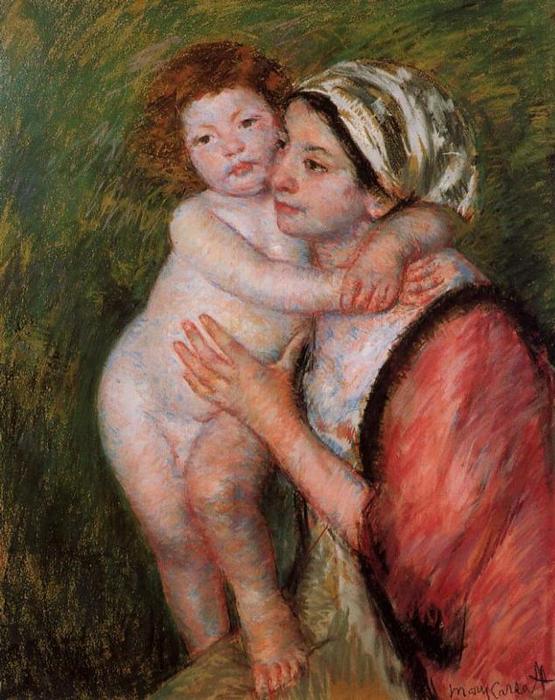
The painting
Mother and Child by
Mary Stevenson Cassatt is a beautiful depiction of a mother holding her baby in her arms. Created in 1908, this oil on canvas piece measures 90 x 116 cm and showcases Cassatt's mastery of the Impressionist style. The woman appears to be wearing a red dress, which adds a pop of color to the scene, while the baby is positioned close to her chest, seemingly nursing from her.
Impressionism and its Influence
Mary Stevenson Cassatt's work was heavily influenced by the Impressionist movement, which emphasized painterly qualities and strong color over realistic values. This style, led by artists like
André Derain and
Henri Matisse, began around 1904 and continued beyond 1910. As seen in
Fauvism Art Movement, the use of bold colors and emotive brushstrokes characterized this period. Cassatt's
Mother and Child embodies these principles, with its soft, warm tones and intimate portrayal of a tender moment.
Artistic Techniques and Symbolism
The play of light and shadow in
Mother and Child is reminiscent of the techniques used by artists like
Bertrand Redon in his painting Ophelia, as seen on
ArtsDot.com. The incidence of light on the human eye produces visual impressions, making it a fundamental factor in the technical representation of the work. According to
Light in painting, this element has a great aesthetic value and can determine the composition of the work.
- Soft, warm tones characterize the painting
- Intimate portrayal of a tender moment between mother and child
- Influence of Impressionist movement and Fauvism
Handmade oil paintings reproductions of
Mother and Child can be found on
ArtsDot.com, allowing art enthusiasts to appreciate Cassatt's masterpiece in their own homes. The
Courtauld Institute of Art in London is also home to notable works, such as
Pierre-Auguste Renoir's
La Loge, which showcases the artist's ability to capture the essence of modern life.
The significance of
Mother and Child lies in its beautiful representation of a universal theme, one that transcends time and cultural boundaries. As seen in
Modernism, the search for new means of cultural expression led to experimentation and innovation in art, resulting in timeless masterpieces like Cassatt's
Mother and Child.