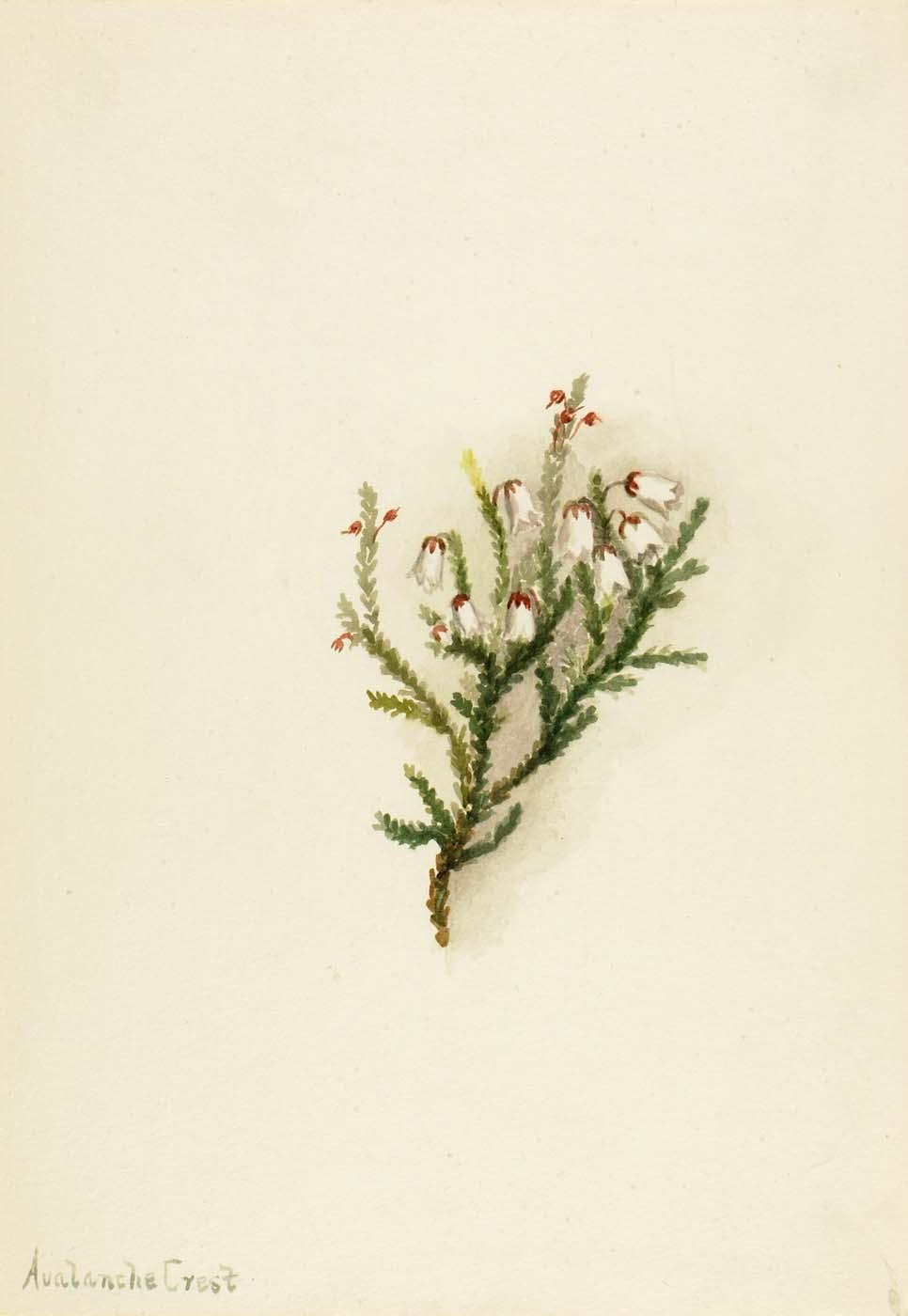
Mary Vaux Walcott was a talented American artist known for her exquisite watercolor paintings of flowers and plants. One of her notable works is
Cassiope (Cassiope mertensiana), a beautiful and delicate painting that showcases her skill and attention to detail. This piece is part of the collection at the
Smithsonian American Art Museum in the United States.
The Painting
Cassiope (Cassiope mertensiana) is a watercolor painting that measures 25 x 18 cm. It was created in 1905 and features a single stem of the Cassiope flower, also known as
Cassiope mertensiana. The painting is characterized by its simplicity and elegance, with a focus on the intricate details of the plant. The artist's use of soft colors and delicate brushstrokes brings the subject to life, creating a sense of serenity and calm.
Artistic Style
Mary Vaux Walcott's artistic style is notable for its precision and sensitivity. Her paintings are not just beautiful works of art, but also accurate representations of the natural world. In
Cassiope (Cassiope mertensiana), she captures the subtle nuances of light and shadow, creating a sense of depth and dimensionality. The painting is a testament to her skill as an artist and her ability to convey the beauty of nature through her work.
Cassiope (Cassiope mertensiana) is a remarkable painting that showcases
Mary Vaux Walcott's skill as an artist and her ability to capture the beauty of nature. This delicate watercolor is a must-see for anyone who appreciates the art of botanical illustration.
The painting's small size, measuring only 25 x 18 cm, belies its significance and impact. It is a testament to the artist's attention to detail and her ability to convey the beauty of the natural world through her work.
In conclusion,
Cassiope (Cassiope mertensiana) is a beautiful and delicate painting that showcases
Mary Vaux Walcott's skill as an artist. It is a must-see for anyone who appreciates the art of botanical illustration and the beauty of nature.