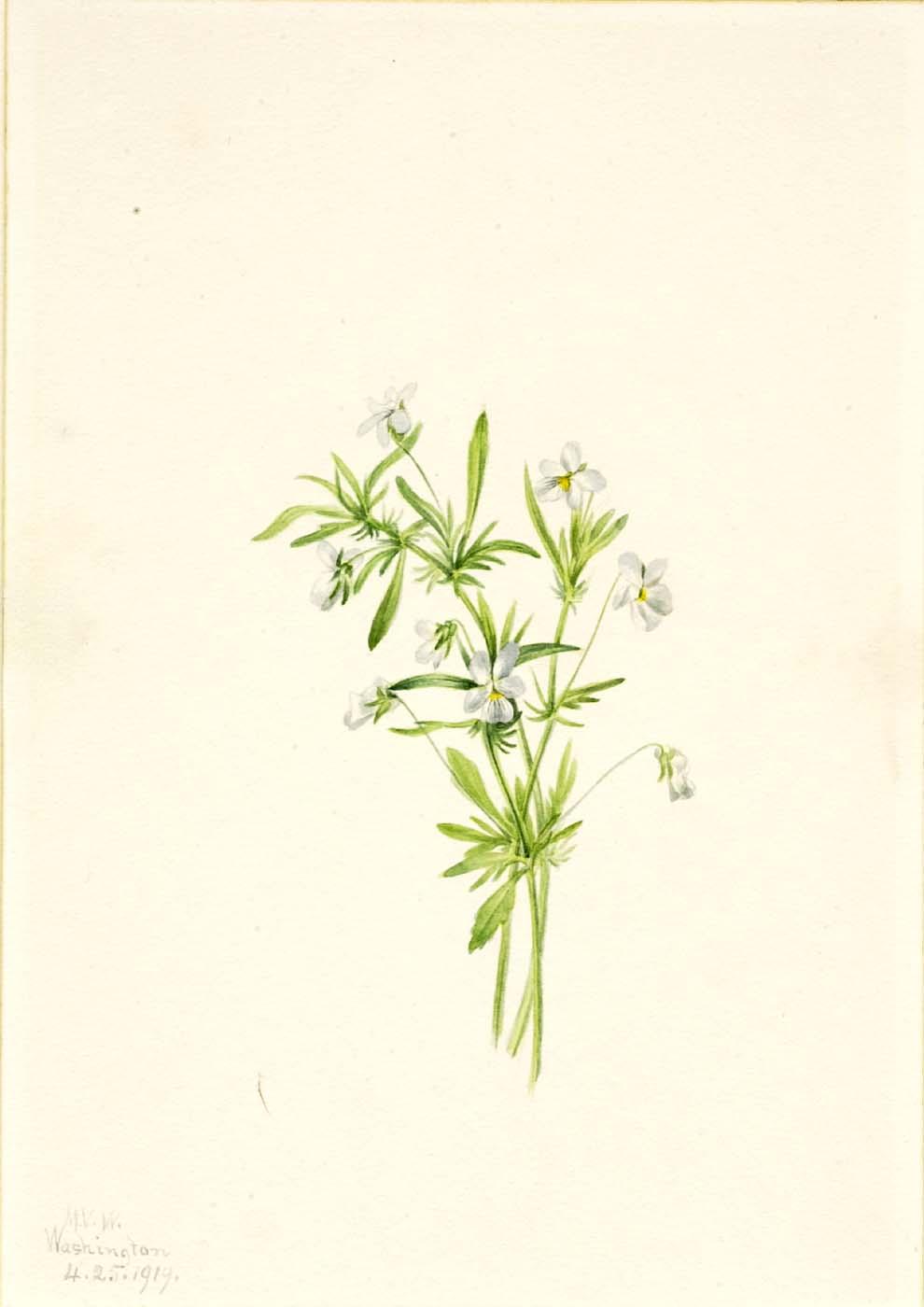
Field Violet (Viola rafinesquii) by Mary Vaux Walcott: A Botanical Masterpiece
This exquisite watercolor painting, Field Violet (Viola rafinesquii), created in 1919 by American artist Mary Vaux Walcott, is a testament to the beauty and precision of botanical illustration. Housed within the Smithsonian American Art Museum's collection, this artwork offers a captivating glimpse into the natural world through the skilled eye of a dedicated naturalist and artist.
Subject & Style: A Scientific Approach to Beauty
The subject of the painting is the Viola rafinesquii, commonly known as the Field Violet. Walcott’s style leans heavily towards scientific illustration or naturalism. Rather than focusing on expressive brushwork or dramatic composition, she prioritized accuracy and detail in her depiction of the flower. The artwork presents a close-up view of a small cluster of violets, showcasing their delicate petals, intricate leaf structures, and subtle color variations. This approach reflects Walcott's commitment to documenting plant life with scientific rigor while simultaneously capturing its inherent beauty.
Technique & Materials: Watercolor Precision
Walcott’s mastery lies in her skillful use of watercolor as a medium. The painting demonstrates the artist’s ability to layer translucent washes, creating depth and volume within the delicate floral forms. Fine, precise lines define each element – petals, leaves, stems – with meticulous detail. This technique allows for subtle gradations of color and light, enhancing the realism of the depiction. The use of watercolor paper further contributes to the artwork's overall texture and visual appeal.
Historical Context & Walcott’s Legacy: "The Audubon of Botany"
Mary Vaux Walcott (1860-1940) was a remarkable figure, often referred to as “the Audubon of Botany” for her dedication to documenting North American wildflowers through watercolor. Her work emerged during a period when botanical illustration played a crucial role in scientific understanding and exploration. Walcott’s extensive travels throughout the Canadian Rockies, often undertaken with her husband, paleontologist Charles Doolittle Walcott, provided ample opportunity to study and paint various plant species. She published five volumes of North American Wild Flowers, showcasing hundreds of her illustrations and contributing significantly to botanical knowledge.
Emotional Impact & Artistic Significance
While primarily a scientific record, Field Violet (Viola rafinesquii) evokes a sense of quiet contemplation and appreciation for the natural world. The painting’s clarity and detail invite viewers to examine the intricate beauty often overlooked in everyday life. Walcott's work transcends mere documentation; it is an artistic celebration of nature's elegance, demonstrating her ability to combine scientific accuracy with aesthetic sensitivity. This piece stands as a valuable contribution to American art and botanical illustration, offering a timeless glimpse into the delicate wonders of the plant kingdom.