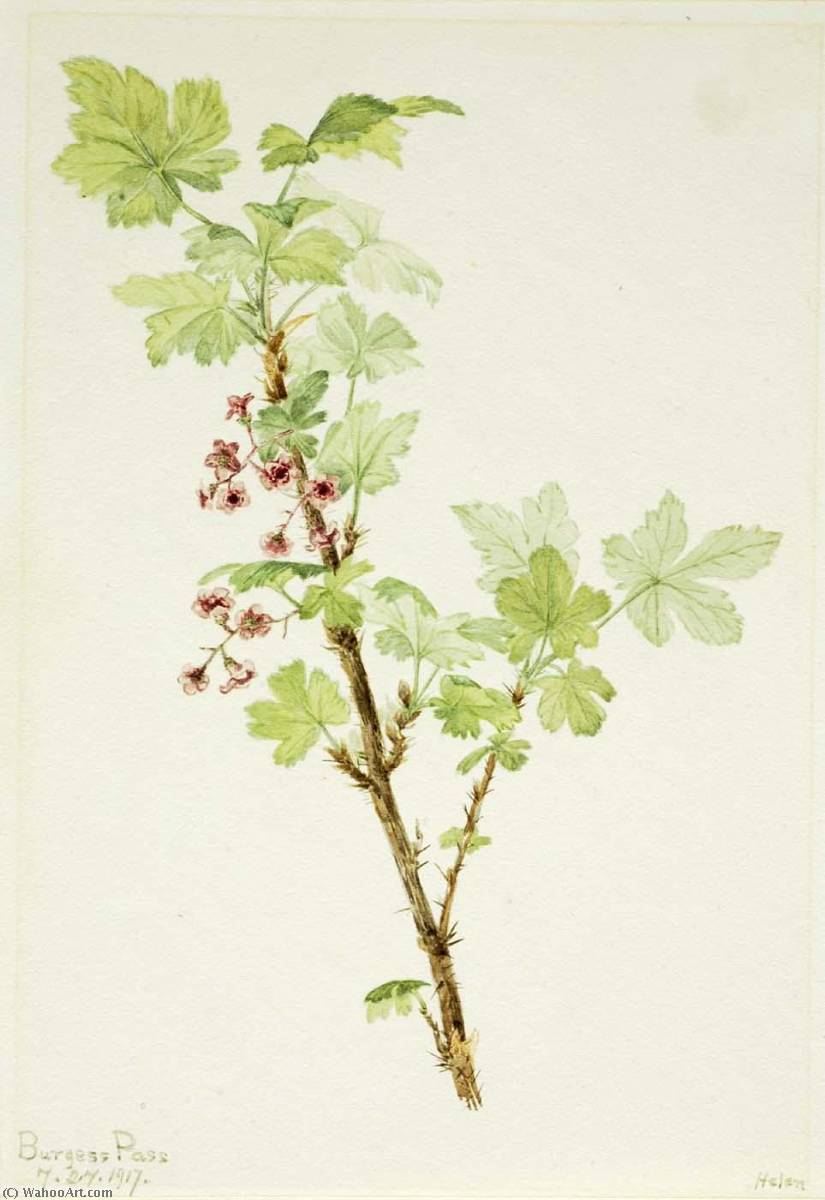
Prickly Currant (Ribes lacustre): A Botanical Masterpiece
Mary Vaux Walcott's "Prickly Currant (Ribes lacustre)," painted in 1919, is a captivating watercolor study that exemplifies the artist’s meticulous observation of the natural world. Housed within the Smithsonian American Art Museum, this piece measures 25 x 18 cm and offers a close-up view of the plant's intricate details, showcasing the vibrant colors and delicate textures characteristic of wild flora.
The Artist's Style and Technique
Walcott’s artistic style is defined by her remarkable attention to detail and her ability to capture the essence of botanical subjects. She was renowned as "the Audubon of Botany," a testament to her skill in documenting North American wildflowers with scientific accuracy and aesthetic beauty. Her preferred medium, watercolor, allowed for a delicate and subtle rendering of forms, perfectly suited for depicting the intricate details of plants and flowers. The “Prickly Currant” demonstrates this mastery; the painting’s soft edges and blended colors are achieved through layering washes of color and precise brushstrokes, creating a sense of depth and volume.
Botanical Accuracy and Historical Context
This artwork is more than just a beautiful image; it's a valuable contribution to botanical science. During the late 19th and early 20th centuries, detailed botanical illustrations were crucial for scientific documentation and identification. Walcott’s work aligns with this tradition, providing an accurate representation of *Ribes lacustre*, also known as prickly currant or bristly black currant. Her dedication to accuracy stemmed from her extensive fieldwork in the Canadian Rockies, where she meticulously observed and documented plant life alongside her husband, paleontologist Charles Doolittle Walcott. The Smithsonian’s publication of her illustrations across five volumes, "North American Wild Flowers," further cemented her legacy as a significant contributor to botanical knowledge.
Symbolism and Emotional Impact
While primarily a scientific study, “Prickly Currant” evokes a sense of quiet beauty and appreciation for the natural world. The vibrant red berries against the lush green leaves create a visually striking contrast, symbolizing resilience and vitality. Walcott’s skill in capturing the plant's delicate structure invites viewers to pause and appreciate the intricate details often overlooked in everyday life. The painting resonates with a feeling of tranquility and reverence for nature, reflecting the artist’s deep connection to the wilderness.
Other Notable Works by Mary Vaux Walcott
Explore more of Mary Vaux Walcott's botanical artistry through these additional works:
- Northern Bedstraw (Galium boreale)
- Jacob's Ladder (Polemonium viscosum)
- Siberian Onion (Allium sibericum)
These pieces, along with "Prickly Currant," can be found on ArtsDot.com, offering handmade oil painting reproductions of these remarkable artworks.