A Moment of Reverent Devotion: Unpacking the Majesty of Grünewald’s Nativity
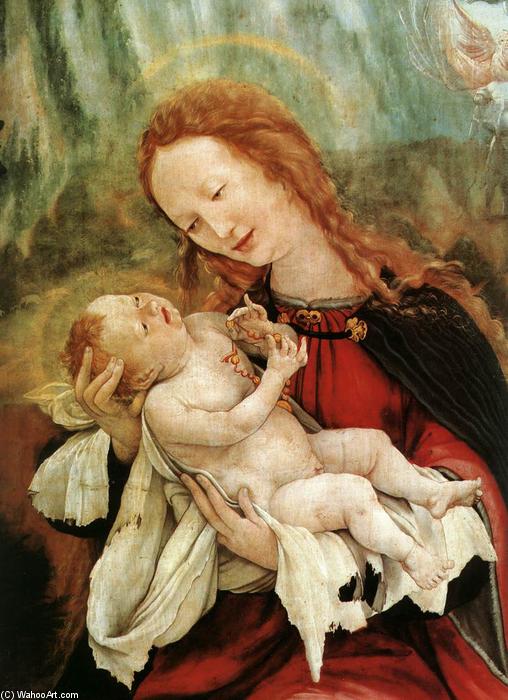
Matthias Grünewald's "Nativity (detail)," a fragment from his monumental Isenheim Altarpiece, isn’t merely a depiction of a biblical scene; it’s a profound distillation of Northern Renaissance spirituality and emotional intensity. Completed around 1515, this panel offers a glimpse into the heart of Grünewald’s artistic vision – a world saturated with both earthly realism and divine grace. It's a work that transcends its small scale, radiating an almost overwhelming sense of solemnity and quiet contemplation.
The painting immediately draws the eye to Mary, rendered with remarkable tenderness and vulnerability. Her posture is subtly curved, conveying a deep inwardness as she cradles the infant Jesus. The rich crimson robe, a deliberate choice in this context, symbolizes her role as Mother of God – a vibrant hue against the cooler tones of the background landscape, creating a visual hierarchy that emphasizes her central importance. The delicate folds of the fabric, meticulously rendered with Grünewald’s signature attention to detail, speak volumes about his mastery of texture and form. The baby Jesus, swathed in simple white linens, embodies purity and innocence, while his gaze is fixed upward, suggesting an awareness of the divine presence.
The Language of Northern Renaissance Art
Grünewald’s style firmly anchors this scene within the traditions of late medieval German art. Unlike the idealized figures prevalent in Italian Renaissance painting, Grünewald embraced a more direct and emotionally charged approach. He eschewed smooth surfaces and polished finishes, opting instead for rougher textures and a dramatic use of light and shadow – *chiaroscuro* – to heighten the sense of realism and drama. This technique is particularly evident in the rendering of Mary’s face, where subtle shifts in tone create a palpable sense of emotion. The background landscape, though simplified, contributes significantly to the overall mood, evoking a sense of both serenity and foreboding.
The Isenheim Altarpiece, of which this detail is part, was originally intended for the Hospital of Saint Anthony in Unterlinden, Alsace – a hospital dedicated to treating tuberculosis patients. The altarpiece’s complex design and powerful imagery were specifically tailored to provide spiritual solace to those suffering from a debilitating illness. The inclusion of scenes depicting St. Anthony and St. Sebastian, both victims of disease, underscores the theme of human vulnerability and divine mercy. Grünewald's work reflects this context, imbuing the Nativity scene with an added layer of pathos – a reminder that even in moments of profound joy, suffering and mortality are ever-present realities.
Symbolism and Spiritual Depth
Beyond its immediate visual appeal, “Nativity (detail)” is rich in symbolic meaning. The halo above Mary’s head isn't merely decorative; it signifies her holiness and connection to the divine realm. The presence of the landscape – a stylized representation of the world – suggests that the birth of Jesus marks a new era, one of hope and redemption. The carefully chosen colors—the vibrant red of Mary’s robe, the cool blues and greens of the background—contribute to the painting's overall emotional impact. The scene is not simply illustrating a biblical story; it’s inviting viewers to contemplate fundamental questions about faith, suffering, and salvation.
A Legacy Enduring Through Reproduction
Today, reproductions of “Nativity (detail)” offer art lovers the opportunity to experience Grünewald's genius firsthand. Whether displayed in a private home or a public gallery, this powerful image continues to resonate with viewers across centuries. The emotional depth and technical mastery evident in this small panel serve as a testament to Grünewald’s enduring legacy as one of the most important artists of the Northern Renaissance.