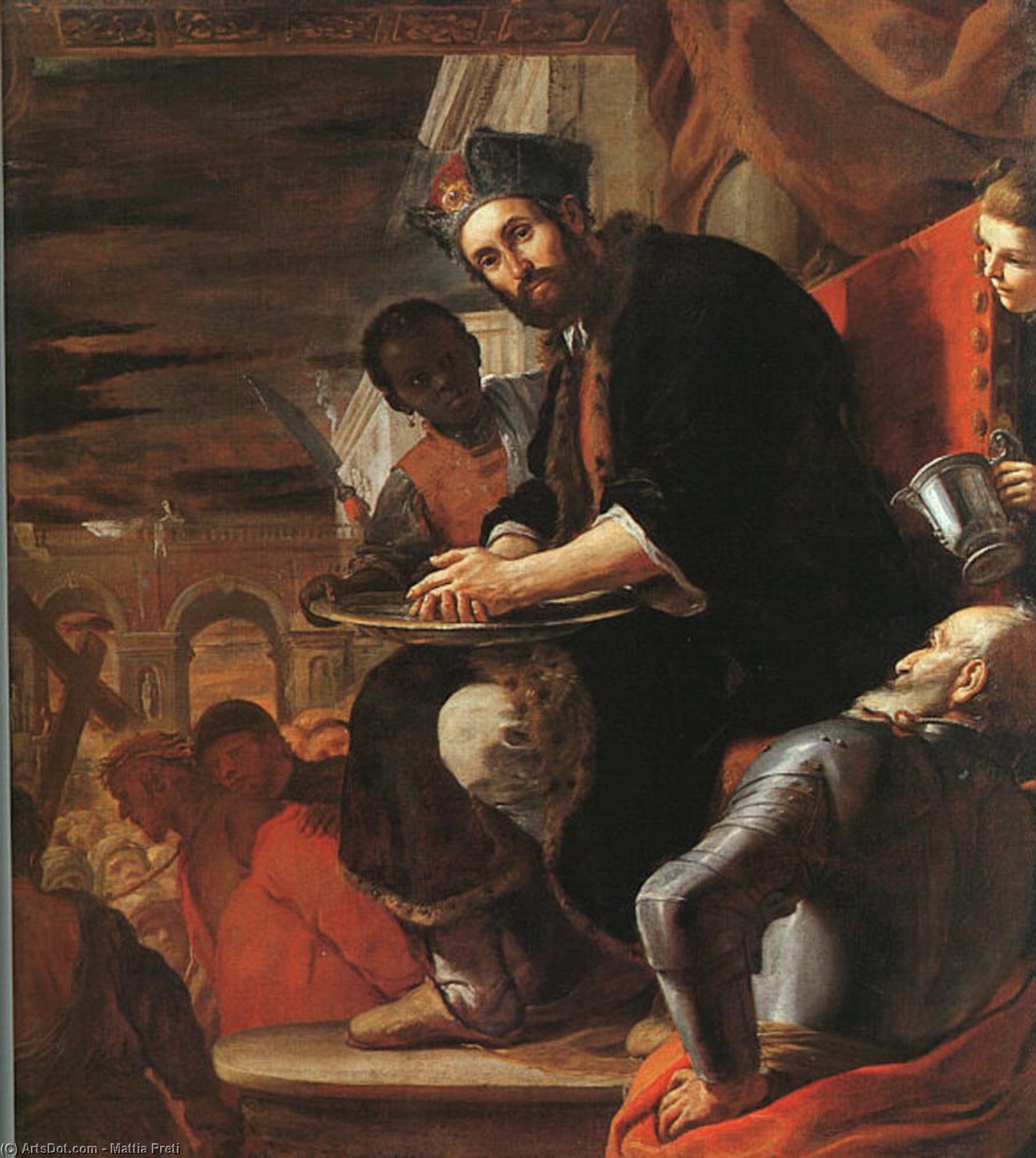
Pilate Washing His Hands: A Study in Dramatic Repression
Mattia Preti’s “Pilate Washing His Hands,” painted in 1663, is not merely a depiction of a biblical scene; it's a profound meditation on guilt, responsibility, and the corrosive nature of power. This arresting work, now housed within ArtsDot’s meticulously crafted hand-painted reproductions, offers a glimpse into the turbulent world of Baroque Malta, where Preti served as a Knight of the Order of St. John. The painting immediately commands attention with its masterful use of chiaroscuro – the dramatic interplay of light and shadow – a technique deeply rooted in Caravaggio's legacy, yet imbued by Preti with his own intensely personal expression.
At the heart of the composition stands Pontius Pilate, a figure rendered not as a triumphant Roman governor, but as a man consumed by anxiety and self-deception. Dressed in a somber black robe, he sits upon a simple chair, his hands clasped before him as he symbolically washes away the imagined stain of Christ’s blood. The gesture is both meticulous and futile, conveying a desperate attempt to absolve himself of an unbearable burden. Preti's attention to detail – the subtle wrinkles around Pilate’s eyes, the downward tilt of his head – reveals a deep understanding of human psychology, capturing not just the outward appearance but also the internal turmoil of this pivotal figure.
A Baroque Tableau: Composition and Symbolism
The painting's composition is carefully orchestrated to heighten its dramatic impact. Christ, depicted in the middle ground, is led towards his impending fate by a young African attendant – a detail that was remarkably progressive for its time. Preti’s decision to place this figure at the center of the scene, imbuing him with an air of solemn importance, subtly challenges conventional representations of biblical narratives and speaks to the artist's awareness of social dynamics within his environment. The inclusion of other figures – a book-carrying scholar, a soldier wielding a sword, and attendants observing from the periphery – creates a sense of immediacy and invites the viewer to become a witness to this momentous event.
The use of color is equally significant. The dominant tones are dark browns and blacks, reflecting the gravity of the scene and the moral ambiguity surrounding Pilate’s actions. However, strategically placed splashes of red – in the folds of Pilate's robe, the bloodstains on Christ’s hands – draw the eye and emphasize the central theme of sacrifice and guilt. The crimson sky serves as a backdrop, amplifying the painting’s emotional intensity and suggesting an impending doom.
Technique and Context: Preti’s Maltese Masterpiece
Mattia Preti's style in “Pilate Washing His Hands” is characterized by its dynamism, emotional depth, and masterful handling of paint. He employed a loose, expressive brushstroke, creating a sense of movement and immediacy that was characteristic of the Baroque period. The artist’s training under Caravaggio is evident in his dramatic use of light and shadow, but Preti developed his own distinct style, incorporating elements of Italian Renaissance painting and drawing inspiration from his time spent in Malta.
The painting was created during a period of significant political and social change in Malta. The island had recently been liberated from Ottoman rule and was undergoing a process of transformation as it transitioned into a center of trade and culture. Preti’s work reflects this dynamic environment, blending elements of religious piety with an awareness of the complexities of human relationships and power dynamics. His decision to depict Pilate – a figure often associated with imperial authority – in such a vulnerable and introspective manner suggests a critical engagement with the political realities of his time.
Collecting a Masterpiece: ArtsDot’s Reproduction
ArtsDot is proud to offer meticulously crafted hand-painted reproductions of “Pilate Washing His Hands,” capturing the essence of Preti's original masterpiece. Each reproduction is created by skilled artisans using traditional techniques and archival-quality materials, ensuring that it faithfully replicates the painting’s rich colors, dramatic lighting, and emotional depth. Whether you are an art collector, interior designer seeking a statement piece, or simply an admirer of Baroque art, ArtsDot's reproduction provides a beautiful and authentic way to experience this iconic work.
Explore our high-resolution images and detailed descriptions to bring the drama and symbolism of “Pilate Washing His Hands” into your home or studio. Discover the legacy of Mattia Preti through the timeless beauty of ArtsDot’s exceptional reproductions.