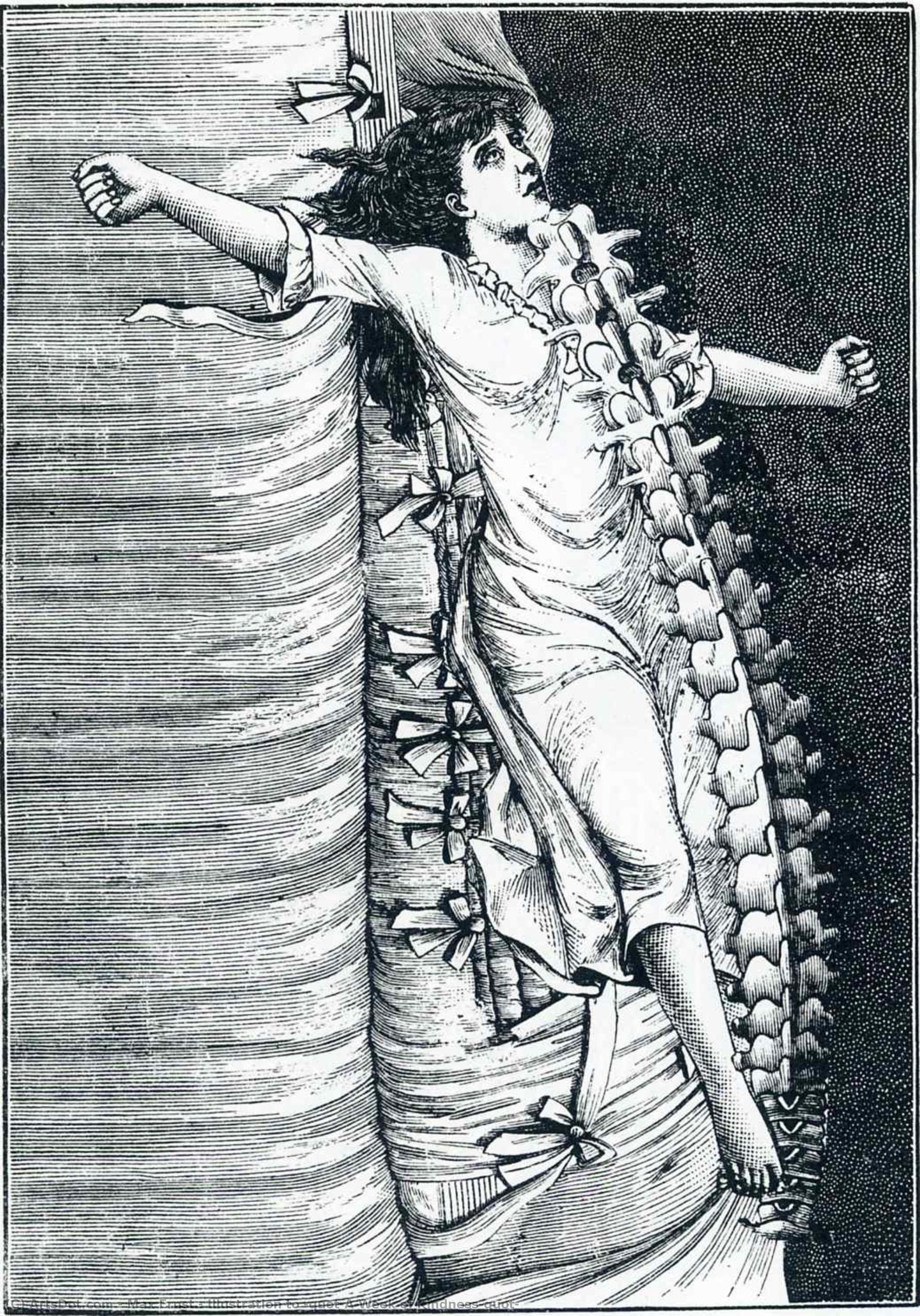
Illustration to “A Week of Kindness” – A Surrealist Echo of Constraint
Max Ernst’s 1934 engraving, ‘Illustration to “A Week of Kindness,”’ stands as a testament to the artist's unwavering commitment to exploring the subconscious and confronting societal pressures. Published alongside his monumental novel, this striking monochrome print embodies the core tenets of Surrealism—a movement born from Dada’s rejection of rational thought and fueled by Freudian psychoanalysis—and offers a compelling glimpse into Ernst’s artistic sensibilities.
- Subject Matter: The artwork depicts a solitary woman positioned within a colossal cylindrical column. This deliberate framing immediately establishes a sense of confinement, mirroring the broader anxieties surrounding individual autonomy and freedom during the interwar period.
- Style & Context: Ernst’s work firmly resides within Surrealist aesthetics, characterized by dreamlike imagery, illogical juxtapositions, and an exploration of irrational impulses. The piece reflects the influence of Dada's anti-establishment stance and aligns with a wider artistic preoccupation with psychological landscapes.
Technique: Ernst’s masterful execution leverages the precision of engraving—specifically burin technique—to achieve remarkable textural detail. Fine lines meticulously etched into zinc create an illusion of wood grain or stone, amplifying the column's imposing presence and conveying a palpable feeling of oppression. The artist skillfully employs hatching and cross-hatching to sculpt form and shadow, guiding the viewer’s eye through the composition.
- Composition: Vertical orientation emphasizes the column’s dominance, visually reinforcing its role as an obstacle to liberation. Geometric shapes—the cylinder itself—are juxtaposed with a stylized representation of the woman, highlighting the tension between internal struggle and external constraints.
- Lighting & Perspective: Linear perspective contributes to a sense of depth, drawing attention to the column’s voluminous form and casting dramatic shadows that heighten its visual impact. The upward illumination suggests an aspiration for transcendence amidst adversity.
Symbolism & Emotional Resonance: Beyond its formal qualities, ‘Illustration to “A Week of Kindness”’ resonates with profound symbolic meaning. The column can be interpreted as representing societal norms or oppressive forces impeding personal growth and self-expression. Ernst's deliberate use of monochrome reinforces the artwork’s melancholic mood—a reflection of existential anxieties prevalent in the era—and invites contemplation on themes of vulnerability, resilience, and the yearning for escape.
- Materials: The engraving utilizes zinc as its substrate, inked with pigment to produce a durable monochrome print. This technique underscores Ernst’s commitment to meticulous craftsmanship and ensures that the artwork retains its visual integrity across generations.
- Further Research: For deeper understanding of Ernst's artistic vision, consider exploring his novel ‘Five Volume Serial Novel,’ which similarly employs collage techniques and explores psychological themes—a stylistic parallel that illuminates the artist’s broader intellectual concerns.