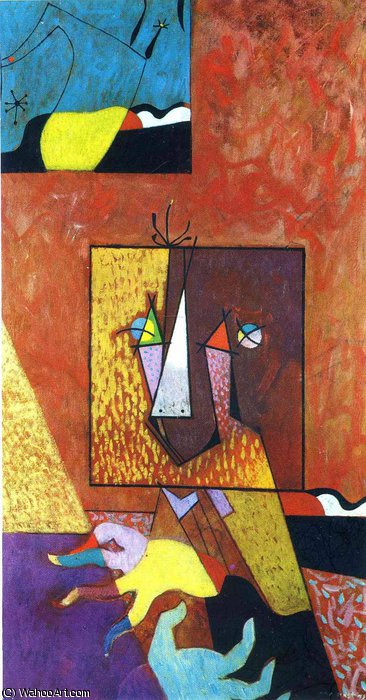
A surreal masterpiece by Max Ernst featuring a man with a dog's face, birds, and symbolic elements like a chair and clock—a captivating exploration of the subconscious mind.
Explore the surreal world of Max Ernst (1891-1976), a Dada & Surrealism pioneer! Discover his innovative frottage, collages & dreamlike paintings featuring birds, landscapes & psychological themes. #MaxErnst #Surrealism #Dada
A Surreal Metamorphosis
In Max Ernst’s 1935 masterpiece, Untitled (7248), the boundaries between the human and the animal dissolve into a hauntingly beautiful dreamscape. At first glance, the viewer is confronted by an arresting figure: a man whose very essence seems to be shifting, his face transformed into a canine visage through a vibrant, almost electric palette of red, yellow, and blue. This unsettling metamorphosis serves as a gateway into the depths of the subconscious, inviting us to question the stability of our own identities. Surrounded by avian companions that drift through the composition, the painting captures a moment of profound transition, where the rational world yields to the irrational beauty of a dream. The presence of unexpected elements—a distant chair, a solitary clock, and figures lurking in the background—adds layers of mystery, making each viewing a new discovery of surrealist wonder.
The Alchemy of Collage and Technique
Ernst’s approach to this work reflects his revolutionary role as a pioneer of the Surrealist movement. Rather than relying solely on traditional oil painting techniques, he utilized collage as a primary catalyst for creation. By meticulously assembling disparate materials—paper fragments, printed images, and textured scraps—he bypassed the logical mind to access primal, uninhibited impulses. This method creates a tactile, layered surface that does more than just depict a scene; it embodies the artist's psychological journey. For the discerning collector or interior designer, this technique offers a captivating depth. A high-quality reproduction of such a piece brings an exquisite texture and a sense of intellectual curiosity to any space, serving as a sophisticated focal point that rewards close, contemplative inspection.
Shadows of History and Symbolic Depth
To truly grasp the emotional weight of Untitled (7248), one must look toward the turbulent landscape of the Weimar Republic era in which it was conceived. Amidst the political instability and pervasive anxiety of 1930s Germany, Ernst’s surrealism acted as both a psychological refuge and a mirror to a fractured society. The central figure, with his dog-like countenance, embodies the vulnerability and the loss of human form felt during this period of profound upheaval. Meanwhile, the birds circling overhead introduce a complex duality: they represent both the soaring aspiration for freedom and the disorienting flight of a mind lost in chaos. This painting is far more than a visual curiosity; it is an emotional experience, offering a profound sense of mystery that continues to resonate with those who find beauty in the enigmatic, the transformative, and the unexpected.