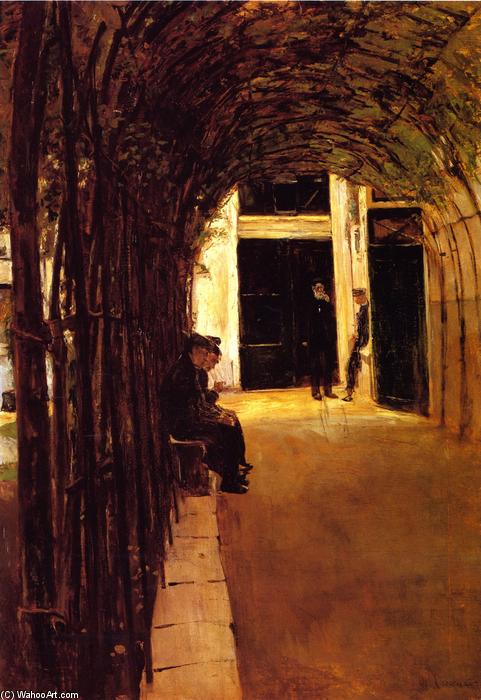
A Glimpse into Urban Solitude: Max Liebermann's "Old Men's Home in Amsterdam, Study"
Max Liebermann’s “Old Men’s Home in Amsterdam, Study,” painted in 1880, offers a poignant and intimate portrayal of everyday life. This oil on canvas painting, residing within the esteemed Staatsgalerie Stuttgart, exemplifies Liebermann's mastery of capturing fleeting moments with an Impressionistic sensibility. The artwork depicts a serene scene: an elderly man seated pensively on a bench before a building distinguished by graceful arches. The composition evokes a sense of quiet contemplation and urban solitude.
Impressionistic Technique and Artistic Style
Liebermann, a pivotal figure in the German Impressionist movement, skillfully employs oil paints to create depth and richness within the canvas. His brushwork is loose and expressive, characteristic of Impressionism, prioritizing the capture of atmospheric effects and fleeting moments over meticulous detail. The color palette leans towards muted browns, ochres, and yellows, establishing a warm yet subdued atmosphere. Light plays a crucial role in the composition; emanating from an unseen source above and to the left, it casts long shadows and highlights the textures of the foliage and brickwork, adding dimension and realism to the scene. The painting’s flattened perspective contributes to its unique visual appeal, drawing the viewer into the intimate setting.
Subject Matter and Historical Context
This "Study" provides a window into late 19th-century Amsterdam, specifically focusing on an institution for elderly men. Liebermann's choice of subject matter reflects his broader interest in depicting scenes of social life and humanity. The painting’s creation coincided with a period of rapid urbanization and societal change in Europe, where the realities of aging and institutional care were becoming increasingly visible. While seemingly mundane, Liebermann elevates this everyday scene to an artistic statement, prompting reflection on the lives and experiences of those often overlooked.
Symbolism and Emotional Impact
Beyond its visual appeal, "Old Men's Home in Amsterdam, Study" carries subtle symbolic weight. The archway framing the figures can be interpreted as a threshold or transition, hinting at the passage of time and the inevitability of aging. The solitary figure on the bench evokes feelings of quiet contemplation, perhaps even melancholy, inviting viewers to empathize with his experience. Liebermann’s ability to convey such profound emotion through seemingly simple imagery is a testament to his artistic skill.
Liebermann's Legacy and Related Works
Max Liebermann (1847-1935) was a prominent figure in the art world, known for his vibrant depictions of modern life. His work often explored themes of social justice and humanity, as seen in other notable pieces such as “Recess in the Amsterdam Orphanage - View of the Inner Courtyard, Study” (1876), housed at the Staatliche Museen zu Berlin. This painting offers a glimpse into the lives of children within an orphanage, further demonstrating Liebermann's commitment to portraying human experience with sensitivity and insight. His legacy continues to inspire artists and art enthusiasts alike, making his works highly sought-after reproductions for collectors and interior designers seeking timeless beauty and emotional depth.
- Use of oil on canvas medium to create depth and richness
- Attention to detail in capturing subtle expressions and postures
- Exploration of themes related to social justice and humanity