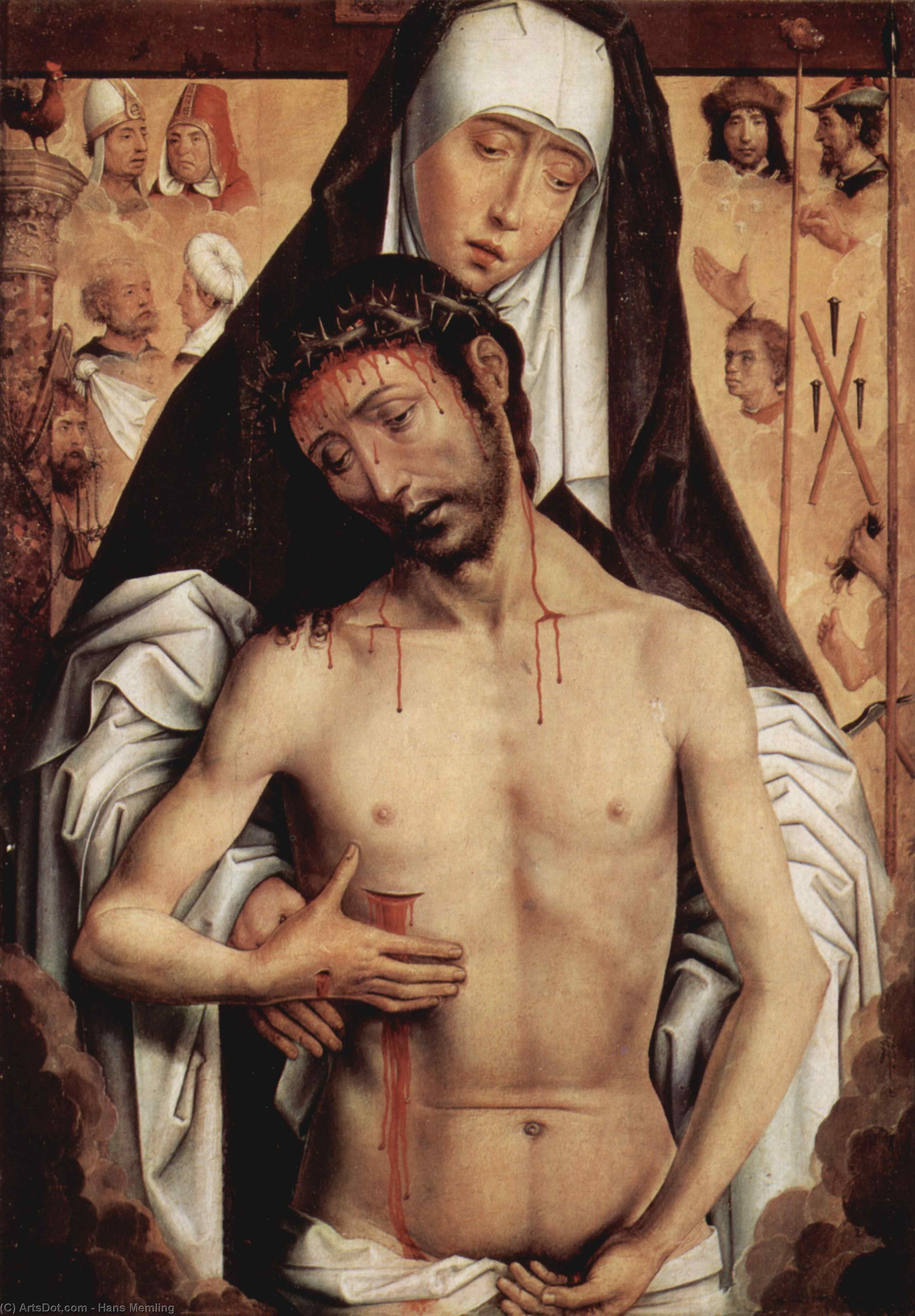
A Tender Encounter in the Flemish Masterpiece
In the quiet, hallowed atmosphere of Hans Memling’s The Man of Sorrows in the Arms of the Virgin, we are invited into a moment of profound intimacy that transcends the boundaries of time. Created around 1475, this exquisite work serves as a poignant testament to the Early Netherlandish tradition, where the divine and the human intersect through a lens of unparalleled tenderness. The painting captures a deeply moving scene: Christ, bearing the physical and spiritual weight of his passion, is cradled by the Virgin Mary. It is not merely a depiction of suffering, but a profound study of maternal grief and enduring love. As the viewer gazues upon the composition, the warmth of their connection radiates outward, offering a sense of solace that remains as potent today as it was in the fifteenth century.
The mastery of Memling is evident in the way he orchestrates the surrounding space to heighten this central emotional core. While the focus remains fixed on the embrace between Mother and Son, the background breathes with life, populated by figures that suggest a larger, communal experience of faith. The presence of a subtle vessel, perhaps a cup or bowl, near the center of the composition adds a layer of liturgical significance, hinting at the Eucharist and the sacrificial nature of the scene. Through his meticulous use of depth, Memling creates a world that feels both vast and incredibly close, drawing the observer into a sacred circle of mourning and devotion.
The Brilliance of Netherlandish Detail and Technique
To behold a work by Hans Memling is to witness the pinnacle of Flemish Primitive technique. Trained under the legendary Rogier van der Weyden, Memling inherited a devotion to sculptural modeling and an almost supernatural ability to render texture through the medium of oil paint. In this particular piece, every element—from the soft folds of the Virgin’s drapery to the subtle, luminous skin tones of the Man of Sorrows—is executed with a precision that demands close inspection. The artist utilizes light not just to illuminate the scene, but to sculpt the figures, giving them a tangible, three-dimensional presence that feels remarkably lifelike.
For the discerning collector or interior designer, this painting offers more than mere aesthetic beauty; it provides a focal point of immense character. The subtle interplay of light and shadow creates a rich, atmospheric quality that can anchor a room with a sense of historical gravity and quiet sophistication. Whether placed in a curated gallery setting or as a centerpiece in a classically styled study, the artwork’s ability to evoke emotion through technical perfection makes it an incomparable choice for those seeking to surround themselves with art that possesses both soul and substance.
Symbolism and the Legacy of Devotion
Beyond its visual splendor, The Man of Sorrows is a dense tapestry of spiritual symbolism. The very title evokes the theological weight of Christ's sacrifice, yet Memling softens this heavy doctrine with the humanizing element of Mary’s embrace. This duality—the agony of the crucifixion paired with the tenderness of a mother—is what gives the painting its enduring emotional impact. It invites a meditative state, encouraging the viewer to contemplate themes of sacrifice, empathy, and the resilience of love in the face of tragedy.
Owning a high-quality reproduction of such a masterpiece allows for the preservation of this historical legacy within a modern home. It is an opportunity to bring the quiet dignity of the Bruges masters into a contemporary space, fostering an environment of reflection and grace. As a piece of art, it does not merely decorate a wall; it transforms a room into a sanctuary of beauty and profound human connection.