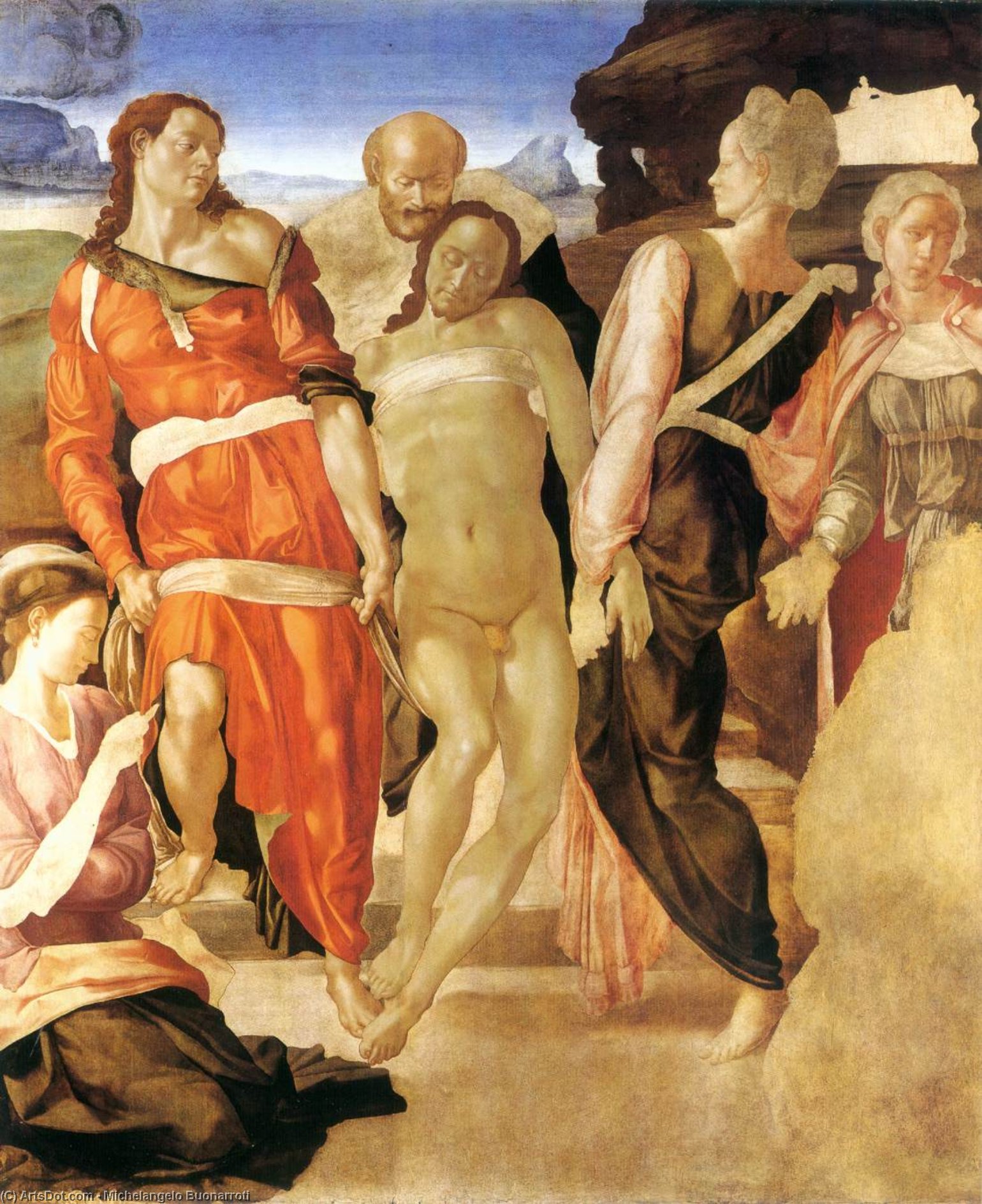
The Entombment by Michelangelo Buonarroti
Michelangelo Buonarroti’s *The Entombment*, completed around 1500-1501 in Florence, stands as one of the most poignant and influential depictions of Christ's burial within the High Renaissance artistic canon. More than just a visual representation of biblical scripture, it embodies Michelangelo’s profound understanding of human emotion and masterful command of sculptural form—qualities that continue to resonate powerfully with audiences today.
### History and Attribution
The painting’s provenance is somewhat enigmatic. Initial scholarship suggested it was executed by one of Michelangelo's pupils, perhaps Raffaello Sanzio da Urbino, but subsequent research bolstered the widely accepted belief that Michelangelo himself undertook this ambitious project. Commissioned for a funerary chapel dedicated to Giovanni da Viterbo in Rome’s Sant’Agostino church, the Entombment reflects the prevailing spiritual fervor of the era—a desire to honor Christ's sacrifice and contemplate mortality—yet it was left unfinished when Michelangelo returned to Florence to sculpt David. The decision to abandon the altarpiece underscores the artist’s prioritization of his monumental sculptural endeavors, cementing his legacy as a titan of artistic innovation.
### Depiction and Composition
The scene unfolds with breathtaking clarity and emotional depth. At its core lies Christ's lifeless body, positioned centrally on a stone slab—a deliberate reference to the Roman tomb where Jesus was laid after crucifixion. Michelangelo’s anatomical precision is evident in every muscle and bone, conveying an astonishing level of realism that surpasses contemporary artistic standards. Surrounding him are nine figures, each imbued with symbolic significance. Mary Magdalene kneels beside Christ's body, her sorrowful gaze capturing the universal grief associated with loss—a gesture mirrored by John the Apostle who supports Christ’s torso. The careful arrangement of these figures creates a sense of spatial depth and perspective, drawing the viewer into the heart of this solemn event. Notably, Michelangelo employed a pyramidal composition, anchoring the central figure and distributing visual weight across the canvas.
### Artistic Significance and Technique
Michelangelo's masterful technique—primarily tempera on panel—allowed for a rich, luminous color palette that enhances the drama of the Entombment. The artist skillfully utilized chiaroscuro—the interplay between light and shadow—to sculpt form from darkness, emphasizing Christ’s vulnerability and conveying an overwhelming sense of pathos. Furthermore, Michelangelo's meticulous attention to detail extends beyond anatomical accuracy; he painstakingly rendered textures—such as the linen shroud covering Christ’s body—creating a tactile experience that engages the viewer’s senses. The Entombment serves as a cornerstone of Renaissance art, influencing subsequent generations of artists and establishing Michelangelo as an unrivaled visionary whose work continues to inspire awe and contemplation.
### Context within Renaissance Art
The Entombment aligns seamlessly with other seminal works from the High Renaissance—including Andrea Mantegna's *Christ’s Descent into Limbo* and Diego Velázquez’s *Christ in the House of Mary and Martha (detail)*—all of which grapple with themes of faith, mortality, and divine grace. These paintings demonstrate a shared commitment to humanist ideals—celebrating human beauty and intellect while simultaneously acknowledging the limitations of earthly existence—a characteristic that distinguishes Renaissance art from its Gothic predecessors.
### Relevance in Modern Art Appreciation
Today, Michelangelo’s *The Entombment* retains its enduring power as a masterpiece of artistic achievement. Its profound emotional resonance transcends temporal boundaries, prompting viewers to confront fundamental questions about human experience and spiritual belief. For those seeking inspiration or exploring similar themes—such as Albert Pinkham Ryder's *Resurrection*, which reimagines the biblical narrative with visionary imagination—the Entombment offers a timeless testament to Michelangelo’s genius and the transformative potential of art.
### Conclusion
Michelangelo Buonarroti’s *The Entombment* remains an unparalleled exemplar of Renaissance artistry—a testament to his unwavering dedication to anatomical precision, sculptural virtuosity, and emotional depth. As part of the broader artistic tradition that championed humanist ideals and explored profound spiritual inquiries, it stands as a beacon of creative excellence—inspiring artists and captivating audiences alike for centuries to come. Explore reproductions of this iconic artwork at ArtsDot.com: -
Michelangelo Buonarroti: Entombment -
Andrea Mantegna: Christ’s Descent into Limbo -
Albert Pinkham Ryder: Resurrection -
Diego Velázquez: Christ in the House of Mary and Martha (detail) Visit
ArtsDot.com to discover more about these paintings and to explore our extensive collection of handmade oil painting reproductions.