The Genesis of Beauty: Michelangelo’s Ideal Face
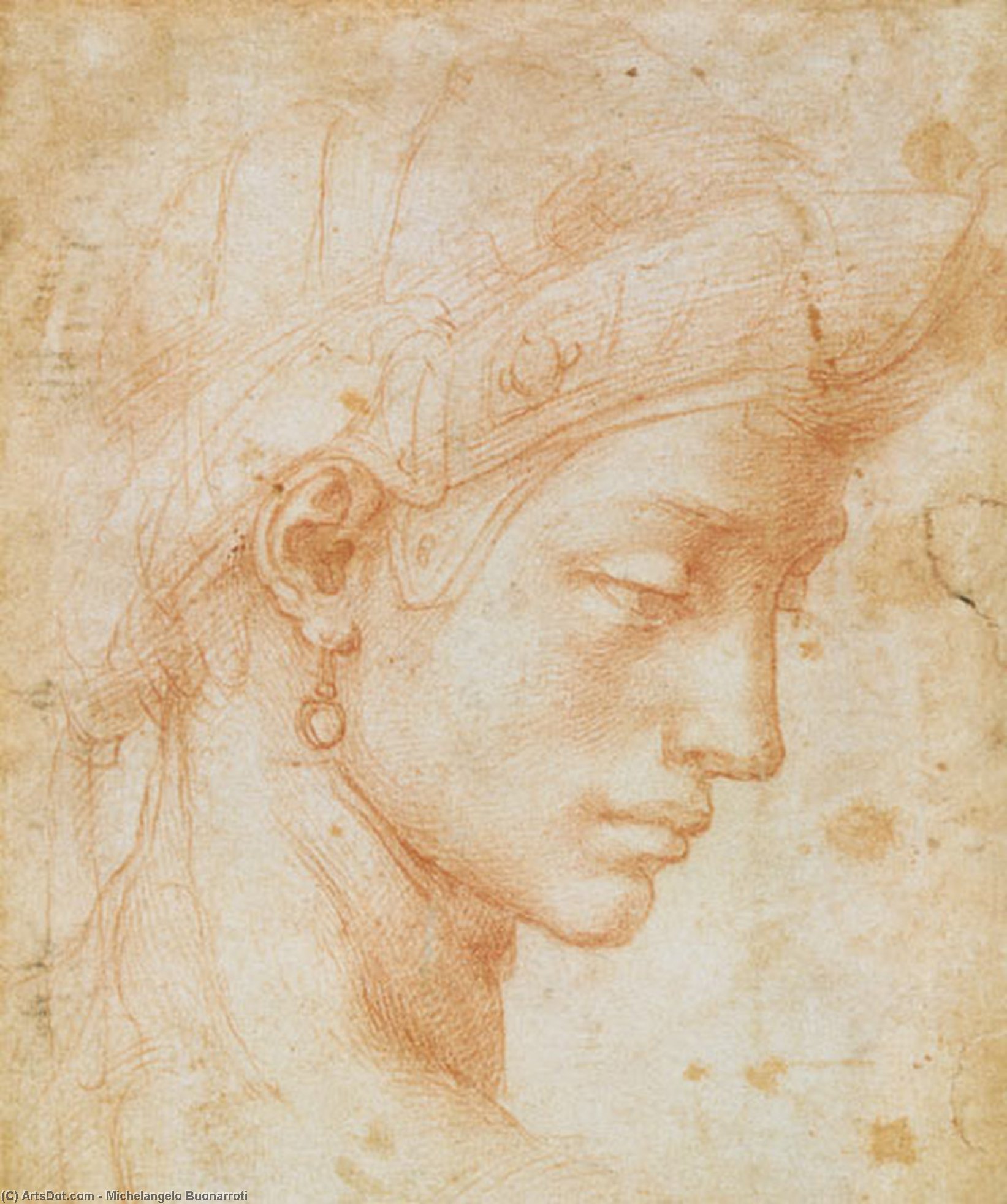
Michelangelo Buonarroti's “Ideal Face,” a chalk drawing executed in 1512, isn’t merely a portrait; it’s a distilled distillation of the Renaissance yearning for harmony, proportion, and the divine. Housed within the hallowed halls of the Galleria degli Uffizi in Florence, this deceptively simple work transcends its modest scale to offer a profound meditation on beauty itself. The image captures a young woman, her eyes gently closed as if lost in contemplation—a pose that immediately invites us into a space of serene introspection. It’s a moment frozen in time, an embodiment of the classical ideals Michelangelo relentlessly pursued throughout his extraordinary career. More than just a likeness, it's a carefully constructed representation of human perfection, reflecting the artist’s deep engagement with ancient Greek and Roman sculpture – those foundational sources of artistic inspiration for the era.
The choice of chalk as the medium is crucial to understanding the work’s character. Unlike oil paints or fresco, chalk offered unparalleled detail and a remarkable ability to capture subtle nuances in tone and texture. Michelangelo's mastery of this technique allows him to render the delicate curve of her cheekbone, the soft fall of her hair, and the almost imperceptible expression around her eyes with breathtaking precision. The resulting image possesses an ethereal quality, as if illuminated from within – a testament to the artist’s skill in manipulating light and shadow.
A Study in Anatomy and Harmony
“Ideal Face” is fundamentally rooted in anatomical observation, mirroring Michelangelo's lifelong fascination with the human form. The drawing meticulously dissects the face, revealing the underlying structure beneath a veil of idealized beauty. The proportions are flawlessly balanced, adhering to the principles of classical harmony – a deliberate echo of the sculptures that captivated him during his formative years. Notice how the placement of her features—the delicate bridge of her nose, the perfectly aligned lips, and the serene expression—creates a sense of visual equilibrium. This isn’t simply a representation of a woman; it's an exploration of the mathematical ratios that underpin beauty itself.
- The Crown: The subtle suggestion of a crown or headpiece adds to the image’s aura of nobility and divinity, hinting at her elevated status.
- Blurred Background: Michelangelo intentionally blurs the background, directing our attention entirely onto the subject's face – a technique that intensifies the sense of intimacy and focus.
- The Closed Eyes: The woman’s closed eyes invite us to share in her contemplative state, suggesting an inner world of peace and serenity.
Echoes of the Renaissance and Beyond
Created during a period of intense artistic innovation – Michelangelo was deeply involved in the monumental project of the Sistine Chapel ceiling – “Ideal Face” reflects the broader cultural currents of the High Renaissance. It embodies the era’s fascination with classical antiquity, its pursuit of humanism, and its belief in the potential for beauty to elevate the soul. The drawing stands as a testament to Michelangelo's ability to synthesize these diverse influences into a singular artistic vision.
However, “Ideal Face” isn’t simply a nostalgic homage to the past. It also anticipates future developments in art and aesthetics. Its emphasis on individual expression, its exploration of psychological depth, and its rejection of rigid conventions paved the way for subsequent generations of artists. The image continues to resonate today, reminding us of the enduring power of beauty to inspire and uplift.
Discovering “Ideal Face” – A Legacy Preserved
Today, “Ideal Face” remains a treasured masterpiece within the Galleria degli Uffizi, inviting countless visitors to contemplate its timeless beauty. For those seeking a deeper understanding of this extraordinary work, several resources offer valuable insights: The original drawing can be viewed online at WGA. Furthermore, the Galleria degli Uffizi itself provides detailed information about the painting and its historical context on their website: Galleria Website. And for those wishing to own a reproduction of this iconic image, numerous high-quality prints are available from reputable art dealers and online retailers.