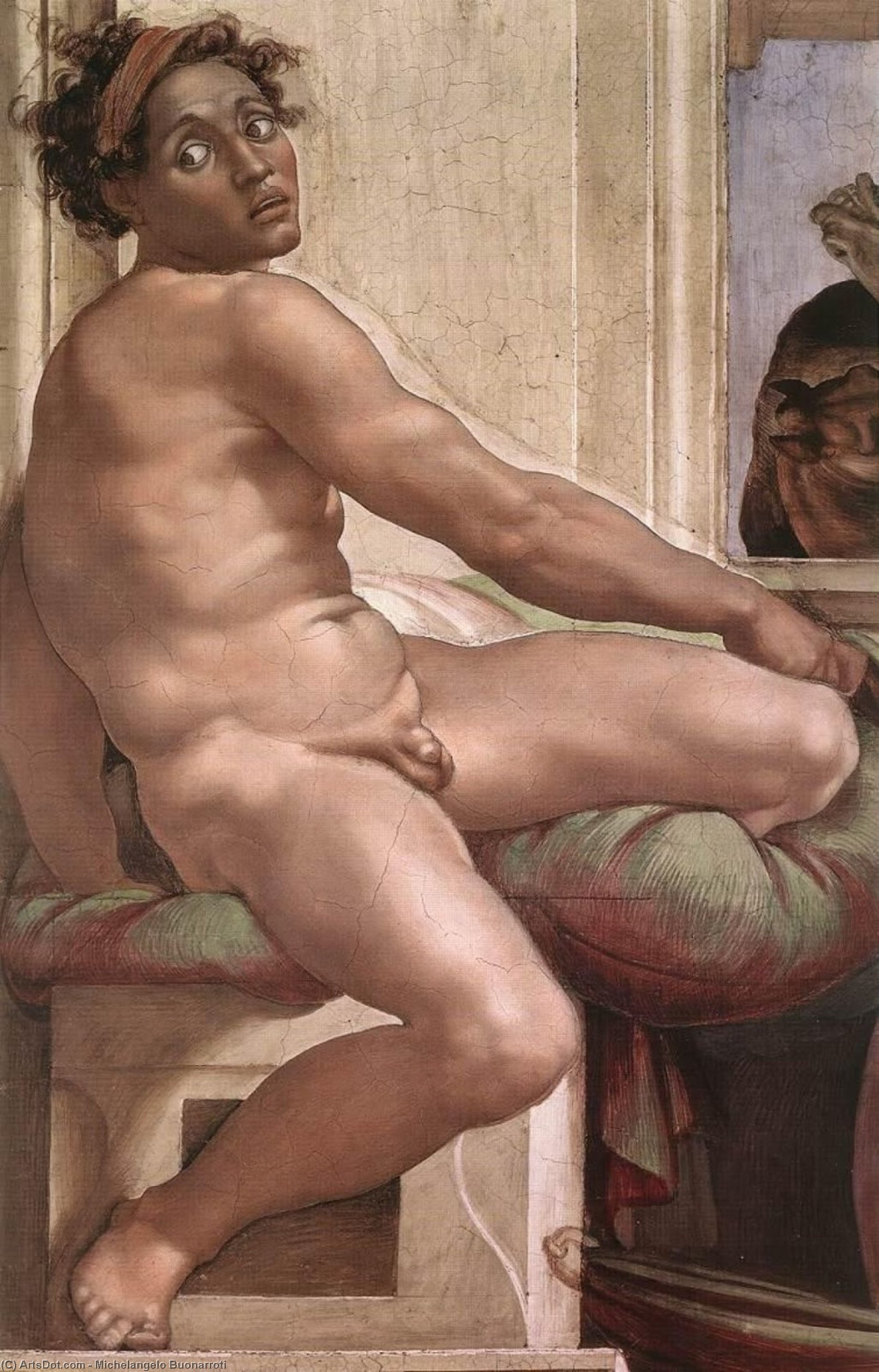
The Genesis of a Masterpiece: Ignudo (18)
Within the hallowed halls of the Sistine Chapel, nestled amongst the monumental narratives of Michelangelo’s ceiling frescoes, resides “Ignudo (18),” a deceptively simple yet profoundly resonant work. More than just a depiction of a nude male figure, this fresco embodies the core tenets of High Renaissance art – an exploration of human anatomy, a masterful command of perspective, and a subtle engagement with classical ideals. Painted in 1509 during a pivotal period of Michelangelo’s artistic development, “Ignudo (18)” offers a rare glimpse into his evolving understanding of form and the expressive potential of the human body.

The scene is remarkably restrained: a young man, seated on a simple chair, his legs crossed in a pose of quiet contemplation. He gazes towards an unseen point in the distance – perhaps a window, or even another figure entirely – creating a sense of depth and inviting the viewer to join him in this silent observation. While seemingly minimal, the composition is meticulously constructed. The subtle curve of his spine, the delicate musculature visible beneath his skin, and the careful rendering of his hands all speak to Michelangelo’s unparalleled skill in capturing the nuances of human anatomy. This wasn't merely a study of physical form; it was an investigation into the very essence of what it meant to be human.
Michelangelo’s High Renaissance Vision
Michelangelo Buonarroti, born in 1475, stands as one of the most influential artists in Western history. His career spanned decades and encompassed sculpture, painting, architecture, and poetry, each discipline reflecting his relentless pursuit of perfection and a deep engagement with classical antiquity. The Sistine Chapel ceiling, commissioned by Pope Julius II, represents the culmination of this ambition – a breathtaking panorama of biblical narratives executed with unprecedented scale and artistic innovation. “Ignudo (18)” is not an isolated work; it’s part of a larger scheme designed to enrich the chapel's visual vocabulary and reinforce its theological message.
Prior to Michelangelo’s monumental undertaking, the walls of the Sistine Chapel had been adorned by earlier artists – Sandro Botticelli, Domenico Ghirlandaio, and Pietro Perugino – each contributing their own distinct styles. Michelangelo's fresco, however, dramatically shifted the aesthetic direction, establishing a new standard for artistic excellence that would be emulated for centuries to come. The deliberate inclusion of figures like “Ignudo (18)” within this complex composition highlights Michelangelo’s understanding of how individual elements can contribute to a larger narrative and create a dynamic visual experience.
Symbolism and the Human Form
The figure of the nude male has long held significance in Western art, rooted in classical traditions that celebrated beauty, strength, and human potential. In “Ignudo (18),” Michelangelo masterfully utilizes this tradition while simultaneously imbuing the figure with a sense of quiet introspection. The pose itself – seated, relaxed, yet alert – suggests a state of contemplation, inviting viewers to consider their own place within the world. The subtle tension in his muscles hints at an underlying vitality, a readiness for action that contrasts sharply with his apparent stillness.
Furthermore, the presence of two other figures in the background adds layers of complexity to the composition. These secondary figures, partially obscured and rendered in a more subdued manner, create a sense of depth and perspective, drawing attention to the central figure while simultaneously suggesting a broader context. The interplay between these elements underscores Michelangelo’s sophisticated understanding of visual storytelling – how individual forms can be arranged to convey meaning and evoke emotion.
A Legacy Enduring Through Reproduction
“Ignudo (18)” has captivated audiences for centuries, inspiring countless artists and scholars. Its enduring appeal lies not only in Michelangelo’s technical brilliance but also in its profound exploration of the human condition. Today, ArtsDot offers meticulously crafted hand-painted reproductions that faithfully capture the essence of this iconic masterpiece. Whether you are an art enthusiast, a collector seeking to enrich your collection, or simply someone drawn to the beauty and power of Renaissance art, a reproduction of “Ignudo (18)” provides a unique opportunity to experience Michelangelo’s genius firsthand.