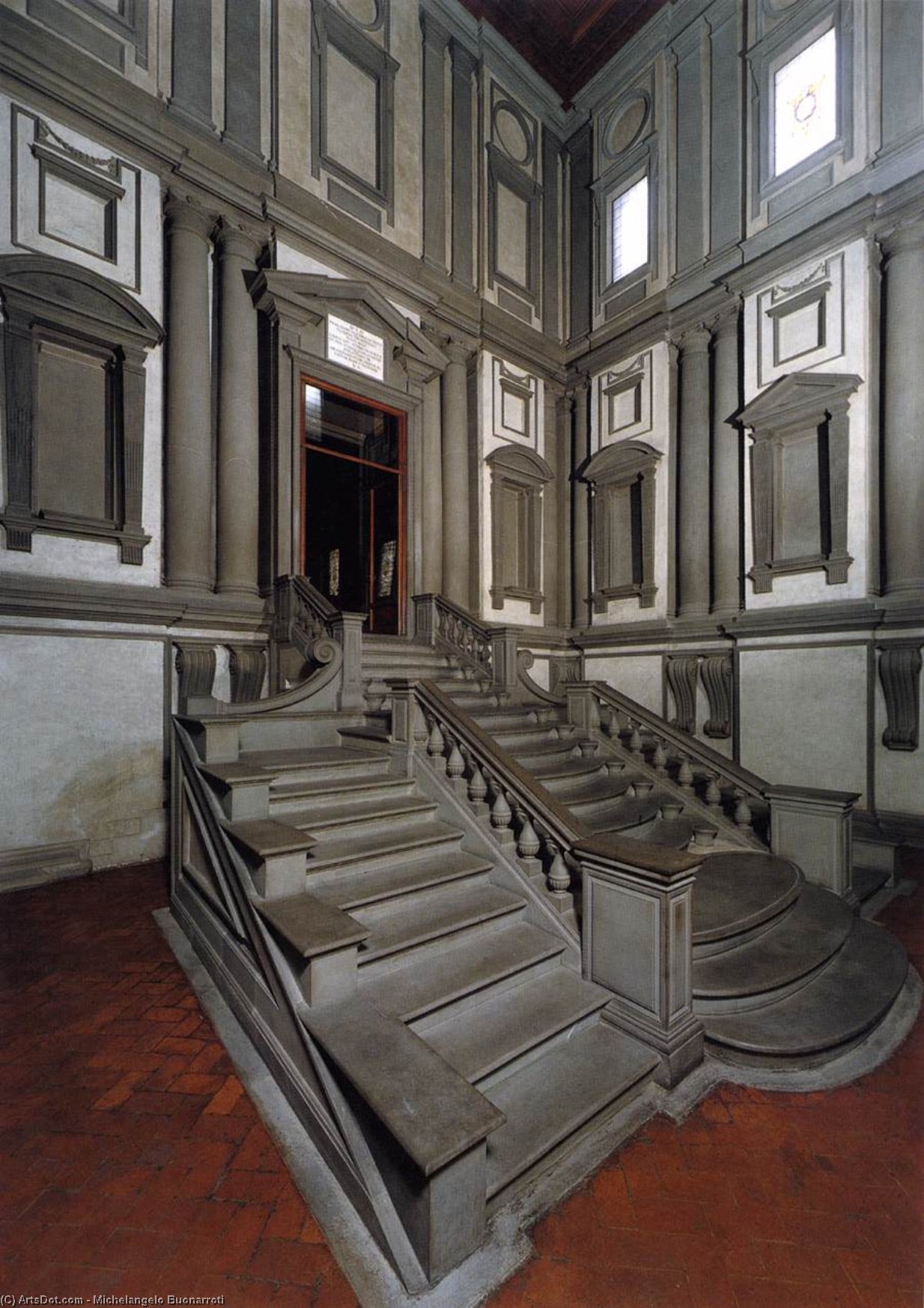
A Stairway to Genius: Michelangelo’s Laurentian Library
Michelangelo Buonarroti, arguably the pinnacle of Renaissance artistic achievement, bequeathed upon Florence—and indeed the world—a legacy that transcends mere sculpture and painting. His monumental works stand as tangible embodiments of humanist ideals, reflecting a profound understanding of human anatomy, proportion, and spiritual aspiration. Yet, amidst his colossal sculptures like David and Pietà, nestled within the serene walls of San Lorenzo Basilica, lies a lesser-known masterpiece: The Laurentian Library—a testament to Michelangelo’s architectural vision and an emblem of Florentine intellectual fervor. Completed in 1530, this building represents more than just stone and mortar; it embodies Michelangelo's unwavering commitment to elevating art as a vehicle for conveying profound philosophical concepts.
- The Architectural Context: Constructed under the patronage of Pope Clement VII Medici, the Laurentian Library was conceived as a symbol of humanist revival—a deliberate contrast to the austere grandeur of preceding papal palaces. Michelangelo’s design deliberately eschewed opulent decoration, prioritizing clarity and harmony with the surrounding basilica. He sought to create a space that fostered contemplation and intellectual discourse, mirroring the ideals championed by Renaissance thinkers.
- A Staircase as Symbol: The staircase leading into the library is itself laden with symbolic significance. Its twelve steps ascend towards the heavens, representing humanity’s journey toward divine enlightenment. Each step is meticulously crafted with distinct geometric patterns—a deliberate nod to classical architectural principles and a reflection of Michelangelo's mastery in translating mathematical precision into artistic form.
- Material Palette & Technique: Michelangelo employed Carrara marble – renowned for its purity and luminosity – throughout the building’s interior. His meticulous attention to detail is evident in every surface, where he skillfully applied polished plaster and subtle shading techniques to achieve an ethereal quality that enhances the space's grandeur.
Michelangelo’s Vision of Proportion & Harmony
Michelangelo’s approach to architecture wasn’t merely about constructing a building; it was about crafting an experience. He meticulously studied ancient Roman temples and basilicas, absorbing the principles of axial symmetry and rhythmic repetition—elements that would permeate his designs. The Laurentian Library exemplifies this dedication to proportion and harmony, demonstrating Michelangelo's belief that beauty resided in mathematical precision and balanced composition. This meticulous attention to detail is characteristic of his artistic style and underscores his conviction that architecture could inspire contemplation and elevate the human spirit.
- Geometric Precision: The staircase’s steps are precisely calculated, reflecting Michelangelo's fascination with geometric ratios—a cornerstone of Renaissance art theory. This deliberate use of mathematics reinforces the building’s spiritual dimension, suggesting a connection to divine order and harmony.
- Light & Shadow: Michelangelo skillfully manipulated natural light through strategically positioned windows, creating dramatic contrasts that illuminate the interior space and accentuate its sculptural qualities. The interplay of light and shadow contributes significantly to the library's atmosphere—a serene environment conducive to scholarly pursuits.
A Legacy of Inspiration
The Laurentian Library stands as a beacon of Renaissance artistic excellence, inspiring generations of architects and artists alike. Its understated elegance and profound symbolic depth continue to captivate viewers today, reminding us that true beauty lies not in ostentation but in intellectual rigor and spiritual contemplation. Reproductions of Michelangelo’s Laurentian Library offer an opportunity to experience the grandeur of Florentine art history firsthand—bringing a timeless masterpiece into your home or workspace.