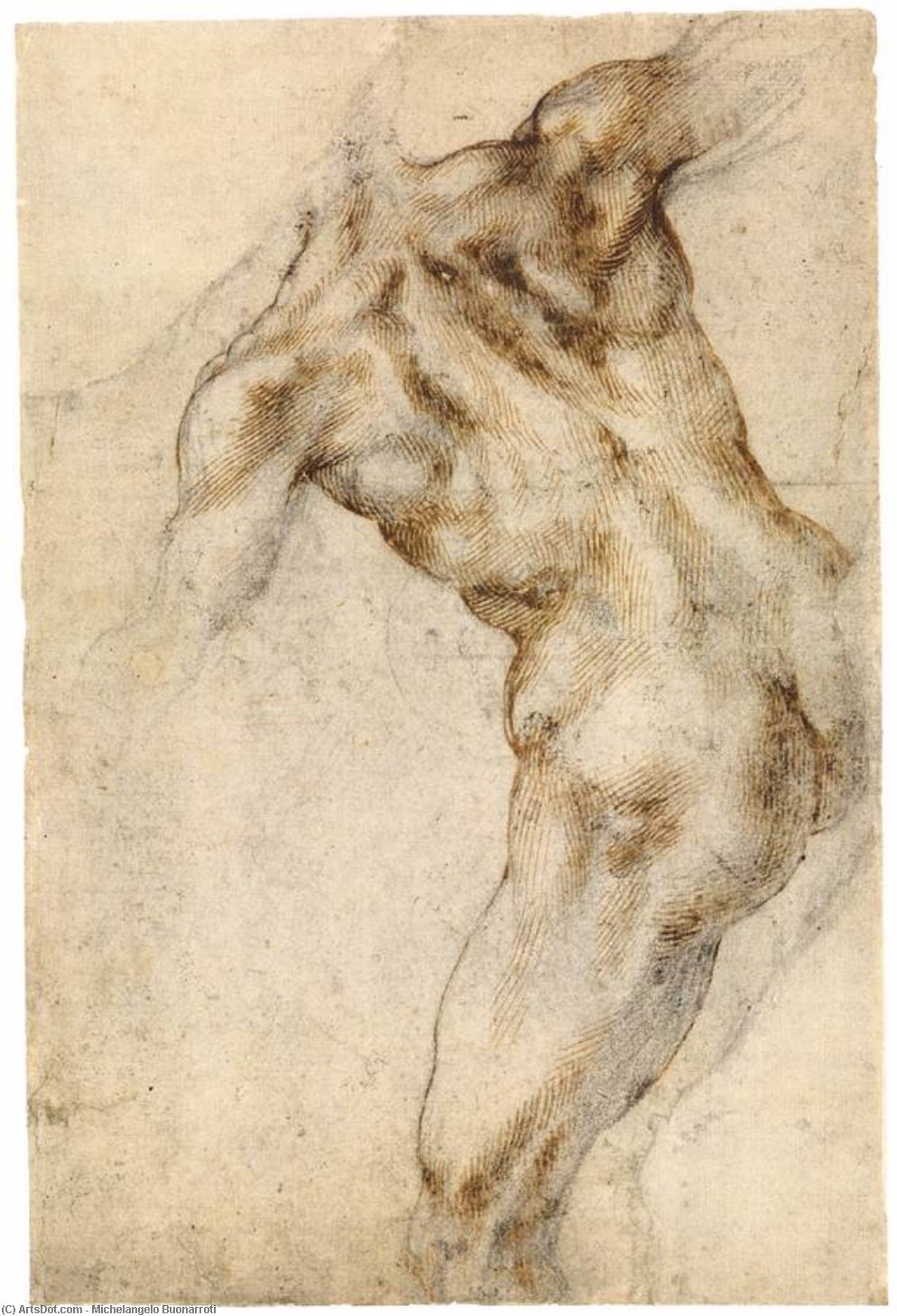
Michelangelo Buonarroti’s Anatomical Exploration: Male Nude, Seen from the Rear (recto)
Michelangelo Buonarroti stands as an undisputed titan of the Renaissance, a figure whose legacy continues to inspire awe and admiration across centuries. His unparalleled ability to transform stone into breathtaking sculpture and pigment into luminous painting cemented his place among history’s greatest artistic innovators. Among his vast oeuvre is ‘Male Nude, Seen from the Rear (recto)’—a chalk drawing executed in 1503—that exemplifies not only Michelangelo's technical prowess but also his profound engagement with the human form and its representation within the artistic canon.
More than just a depiction of nudity, this artwork represents a cornerstone of Renaissance anatomical study. Michelangelo’s relentless pursuit of accuracy stemmed from an unwavering fascination with the human body—a fascination fueled by meticulous dissection and observation. Unlike many artists of his time who relied on idealized forms drawn from classical mythology, Michelangelo sought to capture the reality of musculature and bone structure with unprecedented detail. The drawing serves as a testament to his dedication to scientific inquiry interwoven with artistic vision.
A Study in Precision: Technique and Style
Executed in chalk—a medium favored by Renaissance artists for its ability to achieve subtle tonal gradations—‘Male Nude, Seen from the Rear (recto)’ showcases Michelangelo’s masterful control over texture and shading. The artist employed a technique known as ‘sfumato,’ blurring lines and contours to create an illusion of depth and volume. This approach mirrors his sculptural practice where he painstakingly sculpted forms with chisels and hammers, striving for smoothness and realism.
The drawing’s composition is deceptively simple: a male nude positioned from the rear, facing away from the viewer. However, within this seemingly straightforward pose lies an astonishing level of anatomical complexity. Michelangelo meticulously rendered muscles—particularly those of the torso and back—with painstaking accuracy, capturing the subtle nuances of musculature that would later inspire artists like Rubens and Rembrandt.
Historical Context and Artistic Influence
‘Male Nude, Seen from the Rear (recto)’ resides at the Ashmolean Museum in Oxford, United Kingdom, a beacon of British art history. Established in 1678, it stands as Britain’s inaugural public museum—a testament to the burgeoning Enlightenment spirit and its commitment to disseminating knowledge through artistic appreciation.
Michelangelo's influence extends far beyond the confines of his own time. His anatomical studies profoundly impacted subsequent generations of artists who sought to elevate realism in their depictions of the human figure. Artists like Leonardo da Vinci and Raphael acknowledged Michelangelo’s groundbreaking approach, adapting his techniques to enrich their own artistic endeavors.
A Legacy Enduring Through Reproduction
At ArtsDot.com, we recognize the enduring fascination with Michelangelo's masterpieces. We offer meticulously crafted oil painting reproductions of ‘Male Nude, Seen from the Rear (recto)’—allowing art enthusiasts to experience the grandeur and beauty of this iconic artwork in their own homes. These reproductions capture the essence of Michelangelo’s vision, preserving the drawing’s textural richness and tonal subtleties for a new audience.
More than just an image on canvas, it's a connection to one of art history’s most influential figures—a reminder that true artistic achievement lies in both technical mastery and intellectual curiosity. Own a piece of Renaissance brilliance; explore our ‘Male Nude, Seen from the Rear (recto)’ reproductions today.