Michelangelo’s Nude Woman on Her Knees: A Study in Form, Emotion, and Renaissance Idealism
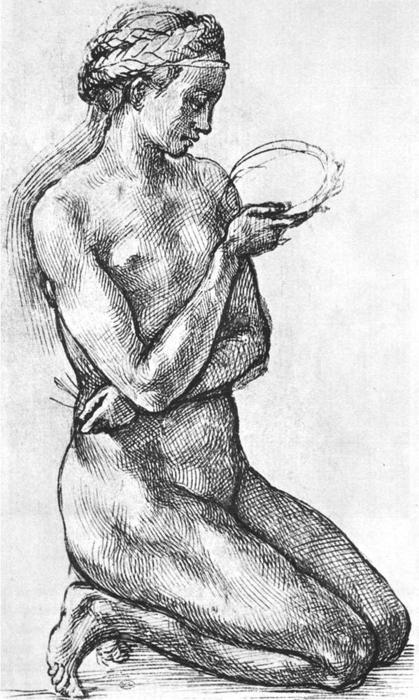
Michelangelo Buonarroti's “Nude Woman on Her Knees” is not merely a depiction of the human form; it’s a profound meditation on beauty, introspection, and the very essence of Renaissance artistry. This drawing, rendered with his signature mastery of line and shadow, offers a rare glimpse into the artist’s creative process – a moment captured before the monumental sculptures and frescoes that would cement his legacy. The work, executed in charcoal or graphite on paper, embodies the High Renaissance's fascination with classical ideals while simultaneously imbuing the subject with an intensely personal and emotional resonance.
The composition immediately draws the eye to the central figure, a woman kneeling gracefully, her posture suggesting both vulnerability and quiet strength. Her extended leg anchors her to the ground, while her bent knee hints at a contained energy, a subtle tension that speaks volumes about her inner state. The circular object she holds – likely a mirror or perhaps a fan – is strategically placed before her face, directing her gaze inward. This gesture invites us to contemplate the woman’s reflection, prompting questions about self-awareness and the complexities of human perception. The off-center placement of the figure creates a dynamic balance, preventing the image from feeling static and inviting the viewer to engage with the scene on a deeper level.
Technique and Artistic Detail
Michelangelo’s skill as a draftsman is breathtakingly evident in every delicate line. He employs a masterful use of hatching and cross-hatching, building up tonal values with astonishing precision to create a remarkable sense of volume and depth. The varying density of the lines – from the fine, almost imperceptible strokes that define the contours of her skin to the thicker, more expressive marks that suggest the musculature beneath – demonstrate his profound understanding of anatomy and his ability to translate three-dimensional form onto a two-dimensional surface. The drawing’s monochrome palette—a symphony of grays—further enhances this effect, allowing the subtle shifts in tone to sculpt the figure with remarkable realism. The meticulous attention to detail, particularly in rendering the folds of her clothing and the delicate curve of her hands, speaks to Michelangelo's relentless pursuit of perfection.
Symbolism and Renaissance Ideals
The “Nude Woman on Her Knees” is deeply rooted in the artistic conventions of the Renaissance. The depiction of a nude female figure was not uncommon during this period, often serving as a vehicle for exploring themes of beauty, virtue, and human potential. However, Michelangelo’s portrayal transcends mere representation; it embodies the idealized forms championed by classical antiquity. The woman's pose—kneeling in contemplation—suggests a connection to both earthly existence and spiritual reflection. The object she holds could symbolize vanity or self-admiration, but also invites us to consider themes of introspection and the search for inner truth – common motifs within Renaissance philosophy.
A Window into the Artist’s Soul
This drawing offers a rare and intimate glimpse into Michelangelo's creative process. It is not a finished masterpiece, but rather a preparatory study—a sketch that reveals the artist wrestling with form, composition, and emotion. The raw energy of the lines, the subtle shifts in tone, and the woman’s enigmatic expression all contribute to a powerful sense of immediacy. “Nude Woman on Her Knees” is more than just an image; it's a testament to Michelangelo’s genius—a poignant reminder of his ability to capture the beauty, complexity, and profound emotional depth of the human experience. A reproduction of this work allows us to appreciate not only its artistic merit but also the artist’s deeply personal vision.