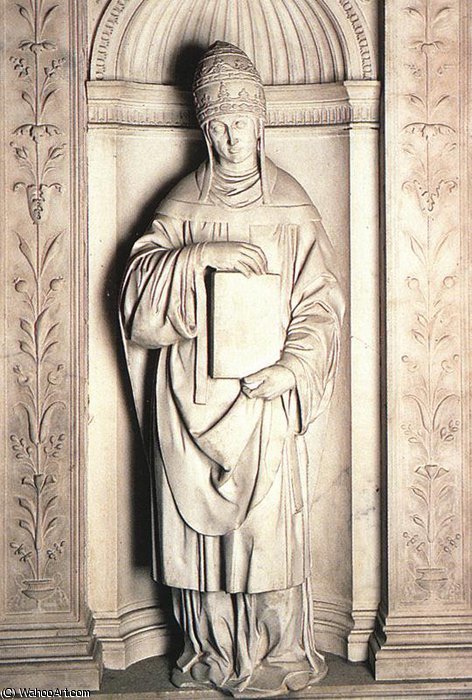
Michelangelo's Piùs Siena: A Testament to Human Potential
The photograph captures a striking black and white depiction of a statue – “Pius Siena,” attributed to the genius of Michelangelo Buonarroti. This isn’t merely a representation of stone; it’s an embodiment of Renaissance ideals, a tangible link to a period defined by profound intellectual and artistic exploration. The subject, a man holding a book, immediately evokes notions of scholarship, faith, and the pursuit of knowledge – themes central to Michelangelo's own life and work. The statue’s classical form, rendered in what appears to be marble or stone, speaks to Michelangelo’s deep engagement with ancient Greek and Roman sculpture, a cornerstone of his artistic education. The ornate wall behind the figure further elevates the scene, suggesting a sacred space – perhaps a chapel or a private devotional area – reinforcing the statue's purpose as an object of reverence and contemplation.
Technique and Artistic Influence
- Michelangelo’s mastery is immediately apparent in the meticulous detail of the sculpture. The artist’s deep understanding of human anatomy, honed through years of studying cadavers and observing the natural world, is evident in the statue's musculature and posture. Note the subtly rendered folds of drapery, a hallmark of Michelangelo’s approach to depicting fabric – it wasn’t simply painted on; it was sculpted with an almost tactile realism.
- The use of black and white photography enhances the timeless quality of the image, stripping away any potential distractions from color and focusing attention squarely on form and texture. This technique mirrors Michelangelo's own approach to sculpture – a relentless pursuit of pure form, unburdened by superficial embellishments.
- Michelangelo’s influence extends far beyond this single image. His exploration of human emotion, his dramatic use of light and shadow (chiaroscuro), and his innovative techniques in both sculpture and painting profoundly shaped the course of Western art. This statue serves as a potent reminder of his unparalleled skill and vision.
Symbolism and Historical Context
The book held by the figure is more than just an accessory; it’s a powerful symbol. It represents wisdom, divine revelation, and the transmission of knowledge – core tenets of both Christian theology and Renaissance humanism. Michelangelo, deeply influenced by humanist thought, sought to elevate humanity through art, portraying figures with dignity, strength, and intellectual depth. The statue's placement against an ornate wall suggests a connection to established religious traditions, yet its classical form hints at a broader philosophical engagement with the ancient world. This juxtaposition reflects the complex intellectual landscape of the High Renaissance – a period marked by both faith and reason.
Emotional Impact and Reproduction
"Pius Siena" transcends mere representation; it evokes a sense of contemplation and reverence. The statue’s serene expression, combined with its classical beauty, invites viewers to reflect on fundamental questions about human existence and the nature of truth. ArtsDot offers meticulously crafted hand-painted reproductions that capture not only the visual details but also the emotional essence of this iconic work. Each reproduction is created by skilled artisans using traditional techniques, ensuring a faithful representation of Michelangelo’s masterpiece for your home or office – a lasting tribute to one of history's greatest artistic geniuses.