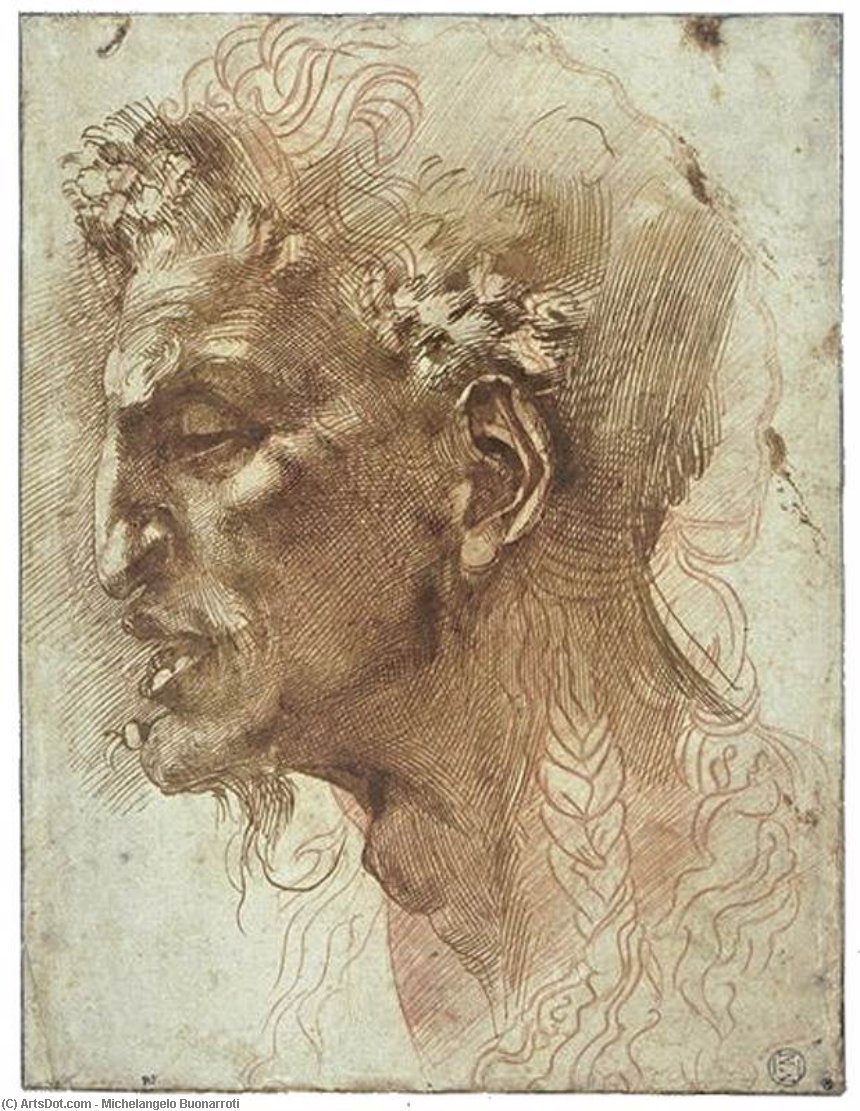
The Haunting Majesty of *Satyr’s Head*: A Renaissance Echo
Michelangelo Buonarroti's *Satyr’s Head*, a deceptively simple pen and ink drawing executed around 1501, is far more than a preliminary study for a larger work. It’s a profound meditation on the duality of human nature—a potent distillation of primal instinct and intellectual contemplation captured within the confines of a small sheet. This intimate portrait, now residing in the hallowed halls of the Louvre Museum in Paris, offers an unparalleled glimpse into the artist's process and his masterful command of anatomical detail and expressive gesture. The work’s enduring power lies not just in its technical brilliance but also in the unsettling ambiguity it evokes – a suggestion of wildness contained within a carefully sculpted form.
The subject itself, a satyr—a creature from Greek mythology embodying both fertility and savagery—immediately establishes a tension. Michelangelo doesn’t shy away from the animalistic features: the prominent horns, the mischievous grin, the thick beard. Yet, he imbues this figure with an unnerving intelligence. The gaze is direct, almost challenging, suggesting a consciousness that transcends mere bestial instinct. It's a deliberate subversion of classical ideals, rejecting the polished perfection of idealized beauty in favor of a more raw and unsettling realism.
A Study in Technique: Pen, Ink, and the Language of Line
What immediately strikes the viewer is Michelangelo’s extraordinary control over line. The drawing is executed with remarkable precision, each stroke meticulously placed to define form and texture. The use of pen and ink creates a captivating interplay of light and shadow, lending depth and volume to the satyr's head. Notice how the artist employs hatching—overlapping lines that create tonal variations—to suggest the contours of the face, the folds of the beard, and the texture of the skin. This technique is particularly effective in conveying the figure’s physicality, highlighting the musculature beneath the surface.
The monochrome palette – a masterful blend of blacks and grays – further enhances the drawing's dramatic impact. It strips away any superfluous color, forcing the viewer to focus entirely on form and gesture. The stark contrast between light and shadow creates a sense of immediacy, as if we are witnessing this creature in a fleeting moment of contemplation. The subtle variations within the grayscale range demonstrate Michelangelo’s deep understanding of how line weight can be used to create visual interest and depth.
Contextualizing the Masterpiece: Renaissance Ideals and Artistic Exploration
Created during the High Renaissance, *Satyr’s Head* reflects a period of intense artistic innovation. Michelangelo was deeply influenced by classical antiquity, particularly the sculptures of ancient Greece and Rome. However, he wasn't simply replicating these forms; he was reinterpreting them through his own unique vision. The satyr figure represents a departure from the idealized human form that dominated much of Renaissance art. Instead, Michelangelo embraces a more complex and ambiguous portrayal of humanity—one that acknowledges both our noble aspirations and our primal instincts.
Interestingly, this drawing is considered one of several preparatory studies for a larger composition, possibly intended as part of a series depicting mythological figures. The *Satyr’s Head* likely served as a crucial stepping stone in Michelangelo's creative process, allowing him to experiment with different poses and expressions before committing his final vision to canvas or marble. The Louvre Museum holds other related drawings by the artist, including “Various Studies (verso)” and “Studies of Nudes (verso),” offering further insight into his artistic explorations.
Beyond the Surface: Symbolism and Emotional Resonance
While rooted in classical mythology, *Satyr’s Head* transcends its literal subject matter to explore deeper themes. The satyr can be interpreted as a symbol of untamed desire, representing the darker aspects of human nature. However, Michelangelo doesn't portray this figure as purely malevolent; there is a hint of melancholy and perhaps even wisdom in his gaze. The drawing invites us to contemplate the complexities of the human psyche—the struggle between reason and instinct, beauty and savagery.
Ultimately, *Satyr’s Head* remains a powerfully evocative work of art. It's a testament to Michelangelo's genius—his ability to capture not only the physical likeness of his subject but also its inner essence. Reproductions of this drawing offer a remarkable opportunity to appreciate the artist’s meticulous technique and profound understanding of human emotion, making it a captivating addition to any collection or interior space.
For those seeking further exploration into Michelangelo's artistic legacy, we encourage you to visit Michelangelo Buonarroti: Satyr’s Head and The Louvre Museum, Paris, France on ArtsDot.com.