Michelangelo Buonarroti: A Renaissance Titan
Michelangelo di Lodovico Buonarroti Simoni, born March 6, 1475, in Caprese Michelangelo, Tuscany, stands as one of the most monumental figures in Western art history. His unparalleled talent for sculpture and painting cemented his legacy as a cornerstone of the High Renaissance—a period characterized by renewed interest in classical ideals and artistic innovation. From his humble beginnings as a stonemason’s son, Michelangelo ascended to become arguably the greatest artist of his time, leaving an indelible mark on architectural grandeur and humanist thought.
Early Life and Training (1475-1496)
Initially, his father resisted an artistic career but conceded to his son’s exceptional aptitude for drawing. At age 13, Michelangelo apprenticed with Domenico Ghirlandaio in Florence, mastering fresco techniques—a crucial skill that would define much of his early output. Crucially, he soon gravitated towards sculpture, studying the sculptures of antiquity in the Medici gardens – a formative experience that instilled within him an unwavering admiration for classical forms and proportions. This fascination would permeate his subsequent works, shaping his artistic vision for decades to come.
Early Period: Establishing Mastery (1490-1505)
Around 1496, Michelangelo received his first major commission: the sculpture of the Pietà—a breathtaking depiction of Mary cradling Jesus’s body after crucifixion. Completed in 1499, the Pietà remains a testament to Michelangelo's mastery over marble carving and his ability to convey profound emotion through sculptural form. Its serene beauty and anatomical precision continue to inspire awe and admiration. Shortly thereafter, he undertook the colossal statue of David—a symbol of Florentine republican ideals—representing courage, strength, and moral virtue. The statue’s monumental scale and idealized musculature embody Michelangelo's ambition to capture the human figure at its most sublime.
The Porta Pia Study: Architectural Genius in Miniature
The Painting
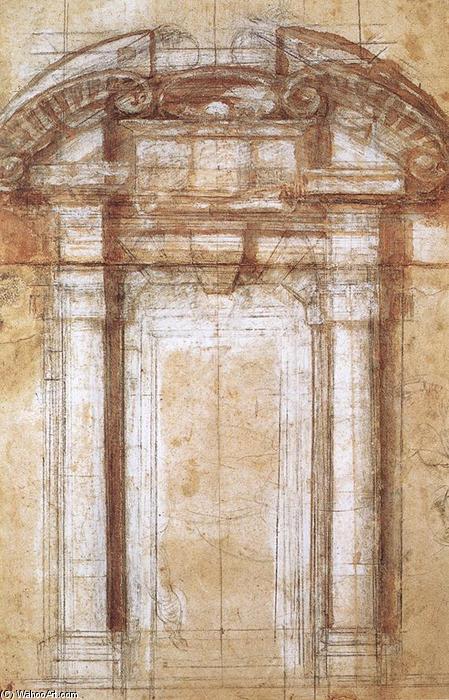
Measuring 44 x 28 cm and housed at the Casa Buonarroti Museum in Florence, Italy—established by Michelangelo’s great nephew, Michelangelo Buonarroti the Younger—the chalk drawing
Study for the Porta Pia offers a captivating glimpse into Michelangelo’s architectural thinking. The artwork depicts a doorway with a large arched entrance, adorned with a decorative carved stone frame—a design reflecting Michelangelo's meticulous attention to detail and his profound understanding of structural principles.
Architectural Significance
The Porta Pia was one of the gates in the Aurelian Walls of Rome, commissioned by Pope Pius IV in 1561 as part of a broader urban renewal project. Michelangelo’s design embodies his vision for innovative architectural solutions—integrating beauty with functionality—and serves as an exemplar of Mannerist aesthetics. The study showcases his ability to distill complex architectural concepts into a simplified drawing, demonstrating his mastery over spatial representation.
Artistic Technique
Michelangelo's masterful use of chalk allows for nuanced tonal variations—from deep shadows to luminous highlights—creating a palpable sense of depth and dimensionality. This technique underscores his skill in capturing the essence of architectural structures through drawing, mirroring the monumental scale of his sculptures and paintings. It’s a deceptively simple medium that yields extraordinary results.
Other Works by Michelangelo Buonarroti
Michelangelo's prolific output extends beyond sculpture and painting into architectural design—most notably St. Peter's Basilica, where he oversaw the construction of its dome and transformed its overall plan. Alongside David and the Pietà, his artistic legacy includes:
Conclusion
Study for the Porta Pia stands as a remarkable testament to Michelangelo Buonarroti’s artistic genius and architectural vision—a miniature masterpiece that encapsulates his unwavering dedication to both form and function. For more information on Michelangelo Buonarroti and his enduring influence, visit
List of works by Michelangelo on Wikipedia. Explore the expansive collection of Michelangelo’s creations and delve deeper into the history of Renaissance art.