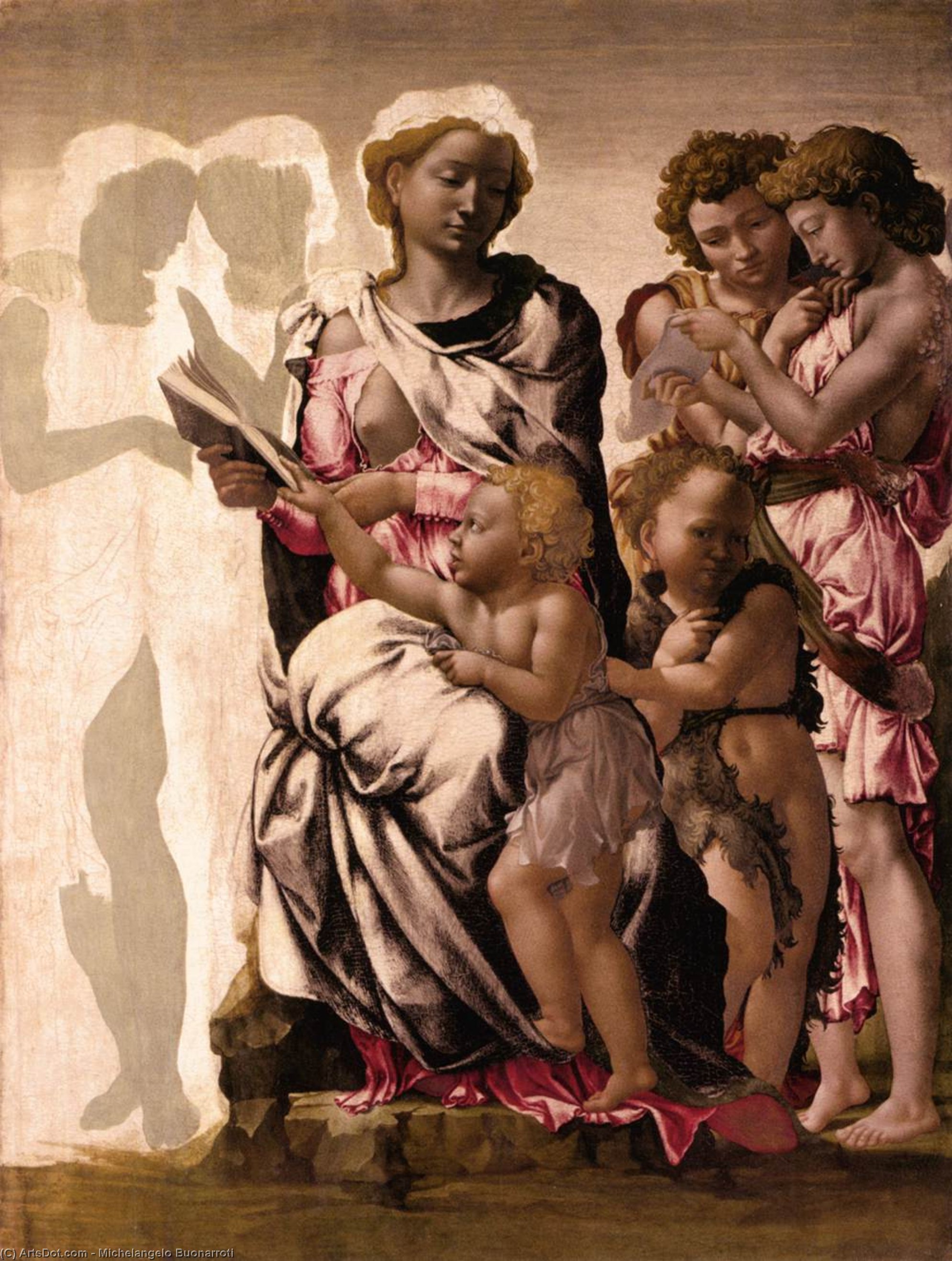
Michelangelo's "Virgin and Child" (1497) is a Renaissance masterpiece! Witness the divine beauty of Mary, Jesus, & St. John in this iconic tempera painting – a testament to human form & faith.
Michelangelo (1475-1564): Explore the Renaissance master's iconic sculptures like David & Pietà, breathtaking Sistine Chapel frescoes, and lasting impact on art history!
Explore European art from the 13th-19th centuries at London's National Gallery! Discover masterpieces by Van Gogh, Rembrandt & more – free entry!
Michelangelo Buonarroti’s Virgin and Child with St John and Angels: A Symphony of Faith and Form
The painting “Virgin and Child with St John and Angels,” executed by Michelangelo Buonarroti in 1497, stands as a cornerstone of Renaissance art—a breathtaking testament to humanist ideals intertwined with profound spiritual contemplation. Held proudly at the National Gallery in London, this tempera masterpiece transcends mere representation; it embodies Michelangelo’s genius in capturing not only visual beauty but also the very essence of Christian iconography and artistic innovation.
Historical Context and Creation
Painted during Michelangelo's formative years—a period marked by burgeoning patronage from Lorenzo de Medici—the artwork reflects the intellectual fervor of Florence at the time. The Renaissance was experiencing a revival of classical learning, influencing artists to strive for idealized forms and harmonious compositions reminiscent of ancient Greek sculptures. Michelangelo’s meticulous study of Roman art profoundly impacted his approach to portraying human figures with anatomical accuracy and grace – principles evident throughout his oeuvre. Measuring 105 x 77 cm, the painting was commissioned as part of a larger cycle intended for the Palazzo Vecchio in Florence, showcasing Michelangelo's ambition to elevate artistic expression within civic life.
Key Elements and Symbolism
At its core lies the Virgin Mary, depicted with serene dignity, cradling Jesus Christ—a motif central to Christian iconography symbolizing purity, motherhood, and divine grace. The positioning of Mary and Jesus is deliberately deliberate, emphasizing their intimate connection and highlighting the sacred narrative at play. Surrounding them are angels, rendered in luminous hues, conveying reverence and spiritual guardianship. Notably, a book positioned near the top-left corner serves as a subtle yet powerful symbol—representing knowledge, piety, and the Gospels’ proclamation of divine wisdom. The careful arrangement of figures contributes to an overall sense of balance and harmony, reflecting Michelangelo's mastery of visual composition.
Michelangelo’s Artistic Journey and Technique
Before achieving his monumental fame with sculptures like David and Pietà, Michelangelo honed his skills under Domenico Ghirlandaio, mastering fresco painting techniques—a craft demanding patience, precision, and an understanding of pigment mixing and layering. His early work, “The Torment of Saint Anthony,” demonstrates his burgeoning talent for conveying emotion through expressive brushstrokes and nuanced shading – qualities that would characterize his subsequent masterpieces. Michelangelo’s dedication to anatomical realism is palpable throughout "Virgin and Child with St John and Angels," achieved through painstaking observation and meticulous sketching—a hallmark of his artistic philosophy. The tempera medium, favored by Renaissance artists for its durability and luminosity, ensured the painting's enduring beauty across centuries.
Emotional Impact and Legacy
“Virgin and Child with St John and Angels” continues to resonate deeply with viewers today, eliciting feelings of compassion, serenity, and spiritual awe. Michelangelo’s ability to imbue his figures with palpable emotion—captured in subtle facial expressions—elevates the artwork beyond mere visual spectacle. It stands as a timeless symbol of maternal love, divine grace, and artistic perfection—a masterpiece that secures Michelangelo Buonarroti's place among history’s greatest sculptors and painters. Its influence extends far beyond its original context, inspiring generations of artists to strive for similar levels of beauty and expressive power.