Discover Michiel Sweerts (1618-1664), a Flemish Baroque painter of genre scenes, portraits & allegories. A Bamboccianti member who traveled extensively, his work blends realism with social commentary.
Explore European art history at the Thyssen-Bornemisza Museum! Discover masterpieces spanning eight centuries, from Botticelli to Van Gogh, in a stunning Madrid setting.
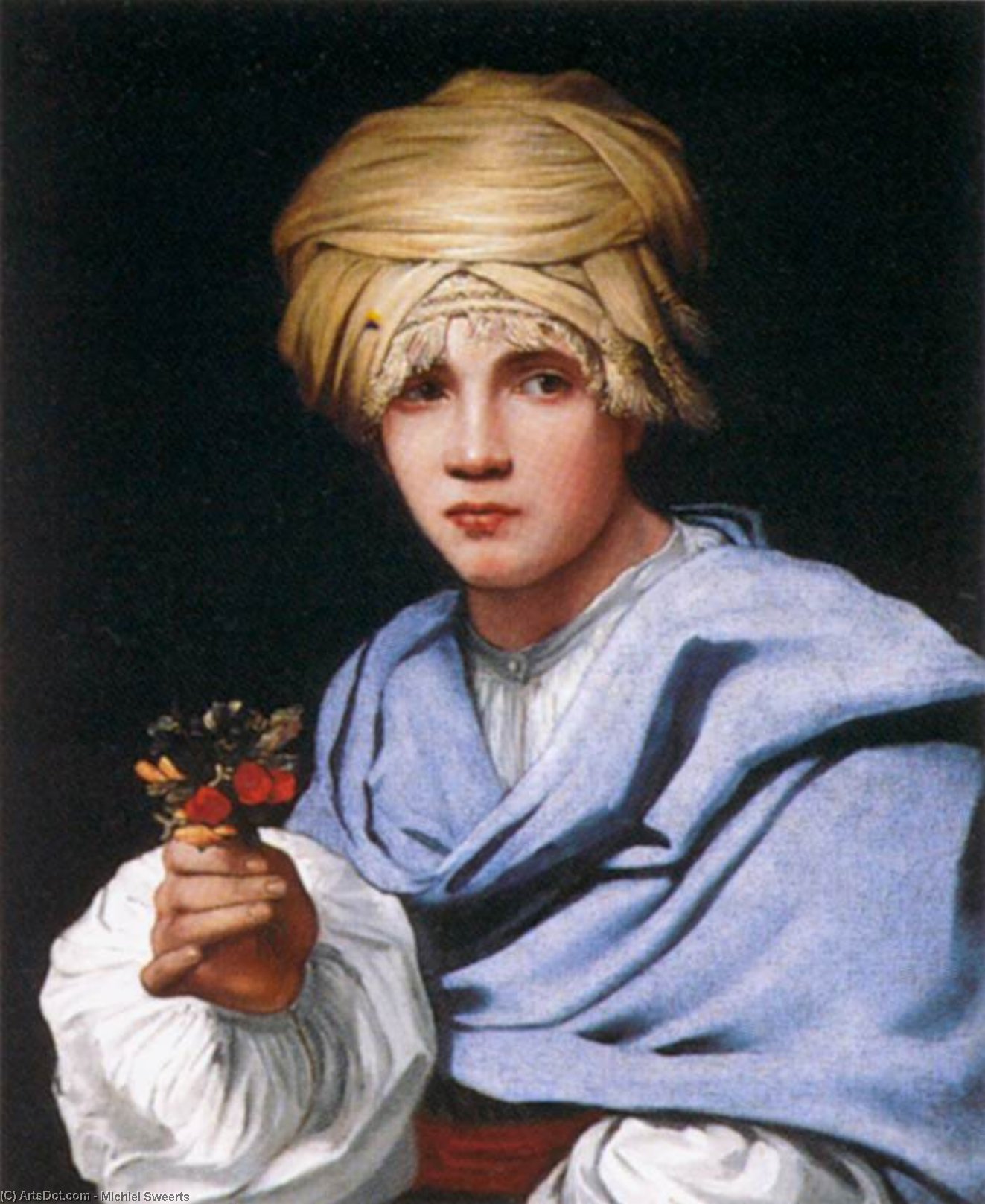
Boy in a Turban Holding a Nosegay - A Window Into Baroque Splendor
The painting “Boy in a Turban Holding a Nosegay,” attributed to Michiel Sweerts, stands as a testament to the artistic fervor of the Baroque period—specifically circa 1658-61—and offers a glimpse into the cultural sensibilities of its time. Created during Sweerts’ prolific engagement with the Bamboccianti movement in Rome, this canvas transcends mere depiction; it embodies an ambitious exploration of humanist ideals and visual storytelling characteristic of the era.
Sweerts' mastery lies not only in his meticulous observation of detail but also in his ability to infuse his compositions with profound symbolic resonance. The subject—a young boy elegantly adorned in a turban—is presented against a dark, velvety backdrop that dramatically accentuates the luminous quality of the figure and its surrounding elements. This masterful use of chiaroscuro—the interplay between light and shadow—was a cornerstone of Baroque painting technique, championed by artists like Caravaggio and Bernini, aiming to evoke emotion and heighten dramatic impact. Sweerts skillfully employs this method to convey both physical presence and psychological depth.
The boy’s posture exudes composure and quiet contemplation, holding aloft a bouquet of flowers – a deliberate gesture laden with symbolism. Flowers frequently served as emblems of virtue and beauty within Baroque art, representing innocence, purity, and divine grace. Their inclusion underscores Sweerts' intention to elevate the subject beyond a simple portrait into an allegory of youthful idealism—a theme prevalent throughout European artistic circles during this period. The artist’s meticulous rendering of fabric folds and textures demonstrates his dedication to realism, grounding the fantastical symbolism in tangible observation.
- Artist: Michiel Sweerts (1618-1664)
- Date: Circa 1658-61
- Medium: Oil on Canvas
- Location: Wallace Collection, London
### Further Exploration - Context and Style
Sweerts’ artistic journey spanned across Europe—Rome, Brussels, Amsterdam—reflecting the cosmopolitan spirit of the Baroque age. His affiliation with the Bamboccianti movement solidified his reputation as a painter who captured the essence of everyday life in Italy, mirroring the broader humanist preoccupation with portraying human experience authentically. Unlike many artists of his time focused on grand narratives or religious iconography, Sweerts’ canvases often prioritized nuanced psychological portraits and intimate scenes—a stylistic preference that distinguishes him from contemporaries like Rembrandt and Rubens.
The Bamboccianti's distinctive style involved depicting young men engaged in scholarly pursuits – reading books, studying instruments, and engaging in philosophical discussions – within richly ornamented interiors. These paintings served as a commentary on the education of noble youth and aimed to convey moral lessons alongside aesthetic beauty. Sweerts’ approach aligns seamlessly with this tradition, demonstrating his understanding of artistic conventions while simultaneously injecting them with personal vision.
Notable Technique: Sweerts' use of chiaroscuro—the dramatic contrast between light and dark—is particularly striking. He achieves remarkable depth and volume through careful modeling and shading, creating an illusionistic effect that draws the viewer into the scene. The artist’s meticulous attention to detail extends beyond mere representation; he strives to capture not only what is visible but also what lies beneath the surface – conveying emotion and psychological complexity.
### Symbolism Beyond Appearance
Beyond its formal qualities, “Boy in a Turban Holding a Nosegay” speaks volumes about the intellectual currents of the Baroque era. The turban itself—a symbol of royalty and spiritual authority—suggests an aspiration for noble status and moral refinement. Simultaneously, the bouquet of flowers embodies ideals of beauty and innocence, reinforcing Sweerts’ desire to portray his subject as embodying virtue and intellect.
The painting's placement within the Wallace Collection underscores its enduring appeal to collectors and art historians alike. Its masterful execution exemplifies the artistic achievements of the Baroque period—a time marked by fervent religious fervor, humanist inquiry, and an unparalleled commitment to visual splendor. Studying Sweerts’ work offers invaluable insight into the cultural landscape of seventeenth-century Europe and illuminates the profound ways in which artists sought to communicate complex ideas through evocative imagery.