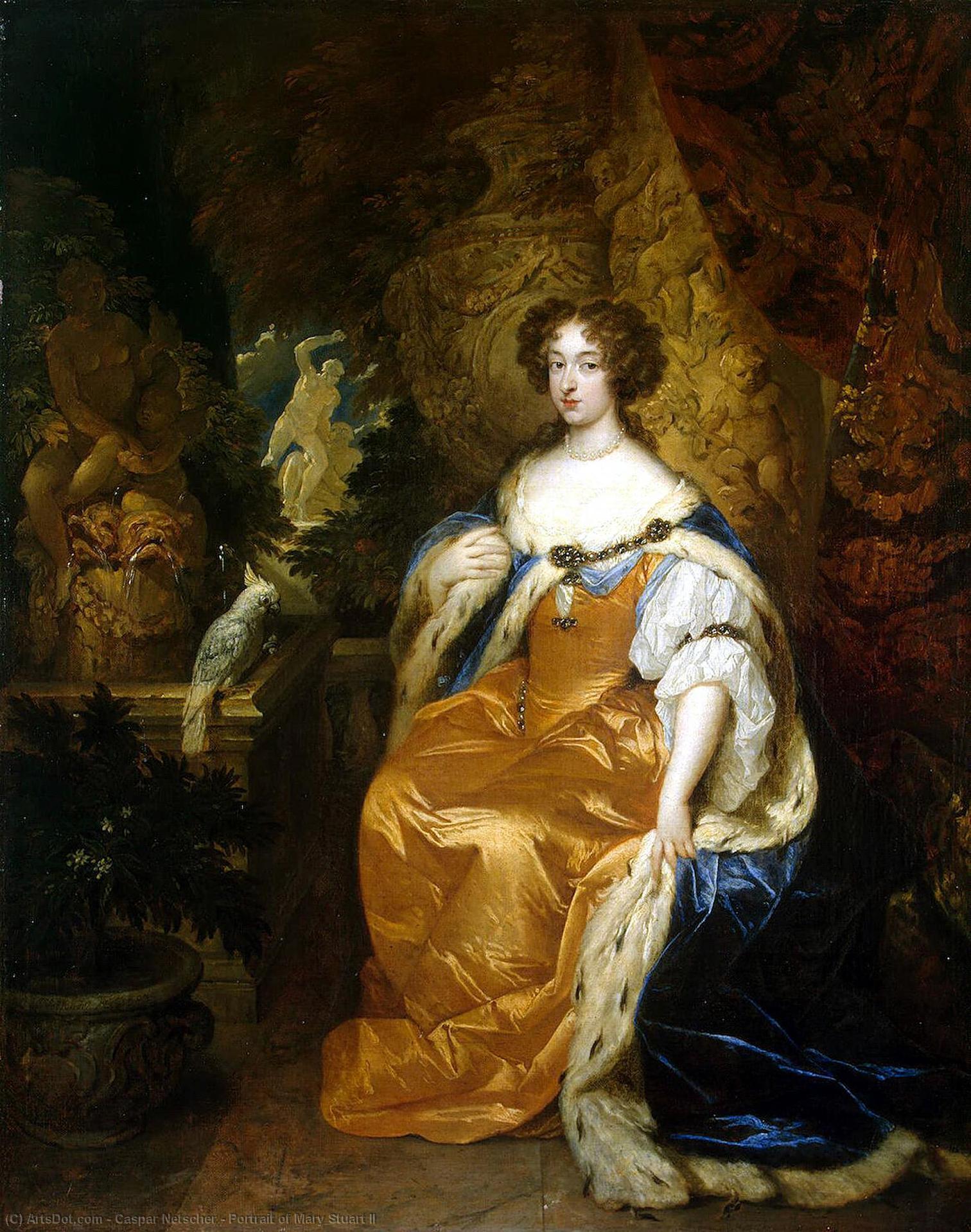
A Vision of Royal Dignity: The Luminous Presence of Mary Stuart II
In the grand tapestry of the Dutch Golden Age, few portraits capture the intersection of political tension and personal grace as profoundly as Caspar Netscher’s 1683 masterpiece, Portrait of Mary Stuart II. This exquisite oil on canvas is far more than a mere likeness; it is a carefully orchestrated drama of light and shadow that invites the viewer into the opulent, high-stakes world of the seventeenth-century court. As one gazes upon the subject, there is an immediate sense of being transported to an era where every fold of silk and every glint of light served as a silent messenger of status and power. Netscher, a master of the Baroque style, utilizes chiaroscuro to sculpt the Queen’s form, creating a three-dimensional presence that feels almost palpable within the frame.
The portrait serves as a poignant window into a tumultuous historical moment. Painted in the shadow of the Glorious Revolution, the work captures Mary Stuart II—a figure of immense controversy and resilience. As a Catholic monarch navigating the religious and political fractures between Protestant England and papal Rome, her serene expression acts as a deliberate shield. Netscher avoids the chaos of her era, choosing instead to render a face of quiet dignity and inward reflection. This choice allows the viewer to connect with the human element behind the crown, finding a sense of calm amidst the historical upheaval that defined her reign.
The Artistry of Texture and Symbolism
For the discerning collector or interior designer, the true allure of this work lies in its breathtaking technical execution. Netscher was renowned for his ability to render the tactile world with unparalleled precision. In this composition, the artist’s brushwork achieves a luminous quality, particularly in the way light dances across the subject's skin and the heavy, luxurious fabrics of her attire. The inclusion of oriental rugs in the background—a hallmark of Netscher’s international style—not only adds a layer of exotic grandeur but also reflects the era's fascination with Eastern aesthetics, grounding the portrait in the sophisticated tastes of the Dutch elite.
Beyond the surface beauty, the painting is rich with allegorical depth. The presence of mythological figures, specifically Apollo and Diana, flanking the Queen, elevates the portrait from a secular record to a divine narrative. Apollo, representing reason and light, paired with Diana, symbolizing the moon and the hunt, suggests a cosmic balance that mirrors the intended stability of the monarchy. This layering of classical mythology with contemporary portraiture creates a sophisticated visual metaphor for power, suggesting that Mary Stuart’s authority is sanctioned by the very heavens themselves.
An Enduring Legacy for the Modern Interior
Integrating a reproduction of such caliber into a contemporary space offers more than just decoration; it provides an anchor of historical weight and aesthetic elegance. The painting’s balanced composition, characterized by flowing lines and a harmonious interplay of organic and geometric forms, makes it a versatile centerpiece for a variety of sophisticated interiors. Whether placed in a formal study or a grand living hall, the work evokes a sense of contemplative melancholy and timeless prestige.
To possess a high-quality reproduction of this Netscher masterpiece is to hold a piece of the Baroque soul. It is an invitation to appreciate the meticulous craftsmanship of the past—the fine layering of colors, the dramatic use of light, and the profound emotional resonance that continues to captivate art lovers centuries after the final brushstroke was laid. For those seeking to infuse their surroundings with a sense of narrative depth and royal splendor, the Portrait of Mary Stuart II remains an incomparable choice.