A Visionary Glimpse: Unveiling Nicholas Roerich’s “A Guy with the Horn”
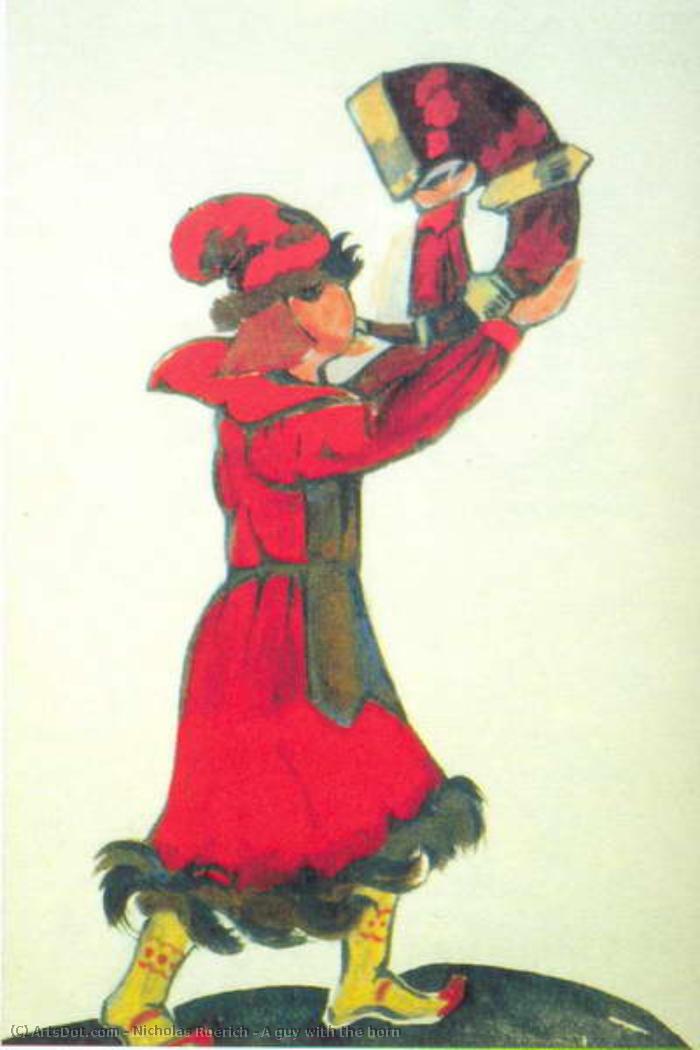
Nicholas Roerich's 1921 gouache painting, “A Guy with the Horn,” is more than a simple depiction of a figure; it’s a vibrant echo of a cultural past and a testament to Roerich’s unique artistic vision. The artwork immediately draws the eye with its bold use of color, dominated by a striking red that envelops the central figure's clothing. This isn’t merely decorative—the intensity of the hue speaks to energy, passion, and perhaps even ritualistic significance. The simplified forms and deliberate outlines lend the piece a folk art quality, reminiscent of traditional Russian lubok prints or Central Asian textiles, yet it transcends simple imitation through Roerich's masterful composition and symbolic layering.
Echoes of Tradition and Spiritual Quest
The subject matter itself is steeped in intrigue. The figure, clad in ornate attire—a long red coat trimmed with fur, striking yellow boots—holds aloft a horn-like object. This isn’t a hunting horn, but something more ceremonial, suggesting a role within a traditional rite or celebration. Roerich was deeply fascinated by the cultures of Central Asia and Russia, often incorporating elements of their folklore and spiritual beliefs into his work. The painting feels like a captured moment from a story, a glimpse into a world where ancient traditions still hold sway. Considering Roerich’s own burgeoning interest in Theosophy and Eastern religions during this period—a fascination shared with his wife, Helena—it's tempting to interpret the horn as a symbol of spiritual awakening or connection to higher realms. The figure isn’t merely *presenting* the horn; he is offering it, perhaps as an invocation or a gesture of reverence.
Technique and Artistic Lineage
Roerich's technique in “A Guy with the Horn” is characterized by its deliberate flatness. There’s minimal attempt at realistic shading or perspective, which further enhances the artwork’s illustrative quality. The gouache medium allows for rich, opaque color application, contributing to the painting’s vibrancy. The lines are bold and somewhat uneven, adding a sense of immediacy and handcrafted authenticity. This stylistic choice aligns Roerich with early modernist movements that rejected academic realism in favor of expressive simplification. While influenced by Russian Symbolism—a movement emphasizing emotional depth and spiritual themes—Roerich forged his own path, blending it with an appreciation for folk art traditions and the decorative arts. His earlier work as a stage designer for Sergei Diaghilev’s Ballets Russes undoubtedly informed his compositional skills and his ability to create visually arresting imagery.
A Legacy of Cultural Preservation
Nicholas Roerich was not only an artist but also a passionate advocate for cultural preservation. He witnessed firsthand the devastation of war and revolution, fueling his commitment to protecting artistic heritage. This dedication is subtly present in “A Guy with the Horn,” which can be seen as a celebration of a specific cultural identity—a visual record of traditions that Roerich feared might be lost. Today, the Nicholas Roerich Museum in New York City stands as a testament to his legacy, housing an extensive collection of his work and continuing his mission of promoting peace and understanding through art. Owning a reproduction of “A Guy with the Horn” isn’t simply acquiring a beautiful image; it's connecting with a rich artistic heritage and supporting the values that Roerich championed throughout his life.