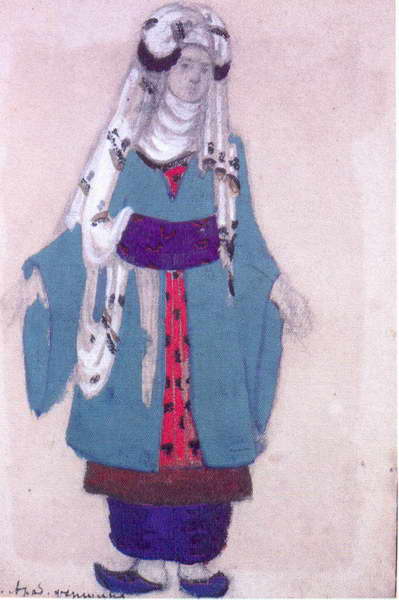
This stunning Art Nouveau painting by Nicholas Roerich depicts an Arabian woman in exquisite detail, showcasing vibrant colors and intricate patterns reflecting the artist’s fascination with Eastern mysticism and cultural heritage. Explore this captivating artwork at ArtsDot.
Explore Nicholas Roerich's (1874-1947) captivating art: Symbolism, Himalayan landscapes & mystical paintings. Designs for Ballets Russes & advocate for cultural preservation.
A Portrait of Tradition: Exploring Nicholas Roerich’s “Arabian Woman”
Nicholas Roerich's "Arabian Woman," painted in 1912, stands as a testament to the Art Nouveau movement’s fascination with exoticism and decorative elegance. More than just a depiction of a woman in traditional garb—a vibrant blue dress accented by bold red and black motifs—the painting embodies a deeper exploration of cultural heritage and spiritual symbolism. Roerich's meticulous attention to detail captures not only the visual beauty of the subject but also conveys a profound sense of serenity and contemplation.
Style and Technique: Art Nouveau’s Fluid Embrace
The artwork exemplifies the stylistic hallmarks of Art Nouveau, characterized by flowing lines, organic forms inspired by nature, and an emphasis on ornamentation. Roerich skillfully employs watercolor and gouache pigments—a combination that lends luminosity to the colors while maintaining a velvety texture—to achieve this effect. Delicate brushstrokes delineate the contours of the woman’s figure and drapery, creating a harmonious balance between realism and stylized abstraction. The artist's masterful use of color contributes significantly to the painting's emotive power, reflecting the movement’s desire to evoke feelings of beauty and wonder.
Historical Context: Echoes of Eastern Mysticism
Painted during Roerich’s formative years, “Arabian Woman” reflects his burgeoning interest in Eastern philosophies and spiritual traditions—particularly Hinduism and Buddhism. These influences permeate the artwork's symbolism, subtly hinting at concepts of harmony, balance, and transcendence. The woman’s gaze directs upwards, suggesting a connection to celestial realms and reinforcing the overarching theme of spiritual aspiration. Roerich was deeply concerned with promoting intercultural understanding and combating prejudice, and this painting serves as an embodiment of his humanist convictions.
Symbolism: Color and Pattern as Vessels of Meaning
The dominant color palette—primarily blues and reds—holds symbolic significance within Islamic culture. Blue represents purity and tranquility, mirroring the serene expression on the woman’s face, while red symbolizes vitality and passion – a counterpoint to the stillness of the scene. Furthermore, the intricate patterns adorning the dress are not merely decorative; they represent interconnectedness and cosmic order—concepts central to Roerich's worldview. These motifs resonate with ancient artistic traditions, grounding the painting in a rich tapestry of cultural heritage.
Emotional Impact: Capturing Inner Peace
Ultimately, “Arabian Woman” transcends its formal qualities to convey an enduring emotional resonance. The painting’s quiet dignity and contemplative gaze invite viewers into a realm of inner peace—a sentiment that aligns perfectly with Roerich's lifelong pursuit of spiritual enlightenment. It is a piece that speaks to the timeless beauty of human experience, reminding us of the importance of reverence for tradition and the transformative power of artistic contemplation.