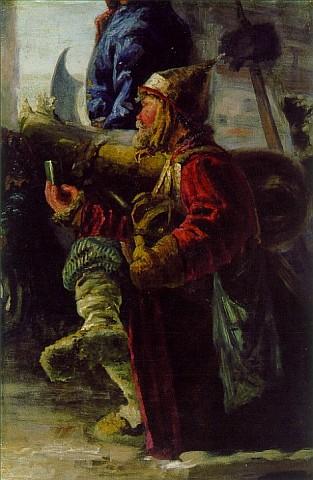
Nicholas Roerich’s ‘Artilleryman,’ painted in 1894, captures a striking portrait of two men beside a cannon, showcasing the artist's distinctive style and period. Discover this captivating artwork and bring its timeless beauty into your space.
Nicholas Roerich's "Artilleryman": A Portrait of Power and Spiritual Seeking
Nicholas Roemerich’s “Artilleryman,” painted in 1894, is more than just a depiction of two men beside a cannon; it’s a carefully constructed tableau brimming with symbolism and reflecting the artist's evolving worldview. The painting immediately draws the eye to the central figure – a man clad in a striking red uniform, holding the massive cannon with an air of authority. This deliberate use of color, particularly the vibrant red, is significant. Red has long been associated with power, passion, and even sacrifice within Western artistic traditions, hinting at the artilleryman’s role as a defender and potentially alluding to deeper spiritual concepts prevalent in Roerich's later work.
- Subject Matter: The scene depicts a moment of readiness, suggesting military preparedness but also evoking a sense of potential conflict.
- Composition: The diagonal lines created by the cannon and the figures’ stances contribute to a dynamic composition, emphasizing movement and action.
- Technique: Roerich employed his characteristic meticulous brushwork, building up layers of color to create a rich, textured surface. This technique is particularly evident in the rendering of the cannon's metal surfaces and the fabric of the artilleryman’s uniform.
Historical Context and Artistic Influences
"Artilleryman" was created during a period of significant social and political change in Russia, marked by growing industrialization and increasing military tensions. Roerich, educated at St. Petersburg University and the Imperial Academy of Arts, absorbed these currents into his artistic practice. His early work often reflected a fascination with historical subjects and classical mythology – influences readily apparent in the painting’s formal structure and the implied grandeur of the scene. However, beneath this surface lies a nascent exploration of themes that would become increasingly central to Roerich's oeuvre: the relationship between humanity and the cosmos, and the search for spiritual meaning within earthly endeavors.
The inclusion of the horse in the background adds another layer of complexity. Horses have historically represented power, nobility, and connection to nature – elements frequently explored by artists throughout history. The two birds soaring above the figures could be interpreted as symbols of freedom, aspiration, or perhaps a divine presence observing human activity.
Symbolism and Roerich’s Expanding Vision
As Roerich's career progressed, his art became increasingly infused with esoteric symbolism and philosophical ideas. While “Artilleryman” doesn’t yet fully reveal the depth of these later explorations, it represents a crucial step in his artistic development. The painting can be seen as an early manifestation of his interest in exploring themes of human destiny, spiritual forces, and the interconnectedness of all things – concepts that would dominate his work for decades to come. The cannon itself, a symbol of destructive power, is juxtaposed with the figures’ presence, prompting contemplation on the responsibility that comes with such strength.
Emotional Impact and Reproduction Possibilities
"Artilleryman" possesses a compelling emotional resonance, capturing a moment of poised readiness and hinting at underlying tensions. Its powerful imagery and meticulous execution make it a significant work in Roerich’s artistic journey. ArtsDot.com offers meticulously crafted hand-painted reproductions that faithfully recreate the original's beauty and detail. These reproductions are ideal for collectors seeking to own a piece of art history, or for interior designers looking to add a touch of intellectual depth and evocative power to any space.