Nicholas Roerich's "Brangena": A Portrait of Mystery and Spiritual Seeking
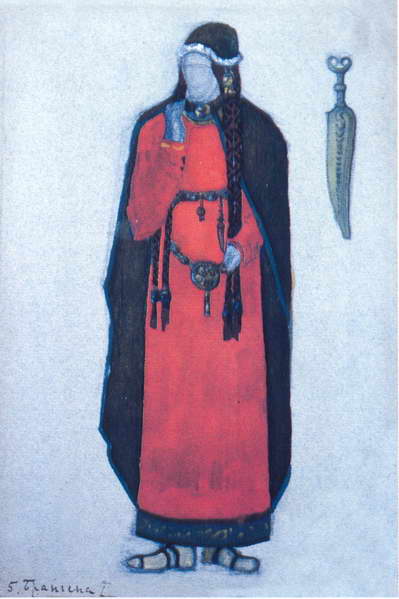
Nicholas Roemerich’s “Brangena,” painted in 1912, is more than just a portrait; it’s an immersive experience, a visual echo of the artist’s lifelong fascination with symbolism, spirituality, and the profound connection between art and human consciousness. This striking image, depicting a woman adorned in crimson and holding a knife, immediately draws the viewer into a realm of enigmatic beauty and quiet contemplation. The painting's vintage aesthetic, firmly rooted in the Art Nouveau movement, lends it an air of timelessness, suggesting that its themes – power, vulnerability, and perhaps even sacrifice – resonate across generations.
Subject and Composition: A Woman at the Crossroads
The central figure is a woman presented with a striking combination of strength and fragility. Her red attire, a color historically associated with passion, royalty, and danger, immediately commands attention. The presence of a knife in her hands – a potent symbol throughout art history – introduces an element of ambiguity. Is she wielding power? Is she defending herself? Or is the knife a tool for transformation, representing a deliberate act of creation or destruction? The addition of a clock on the right side of the canvas adds another layer of complexity. Clocks are universally recognized as symbols of time, mortality, and the relentless march forward. Its placement suggests a confrontation with these concepts, perhaps reflecting the woman’s own contemplation of her role within them.
Artistic Technique and Style: Echoes of Art Nouveau
Roerich's masterful technique is evident in the meticulous rendering of textures – the flowing fabric of the dress, the polished surface of the knife, and the intricate details of the clock. His brushwork is characterized by a smooth, almost ethereal quality, typical of the Art Nouveau style that was gaining prominence at the time. This movement emphasized organic forms, decorative patterns, and a sense of harmony between nature and human design. Roerich’s use of color is particularly noteworthy; the deep reds and muted tones create a dramatic contrast, intensifying the emotional impact of the scene. The overall composition adheres to Art Nouveau principles, prioritizing flowing lines and an elegant, almost dreamlike quality.
Historical Context and Symbolism: Roerich’s Spiritual Journey
"Brangena" was created during a pivotal period in Roerich's life – a time when he was deeply engaged with esoteric philosophies and the search for universal symbols. His work frequently incorporated elements of ancient mythology, religious iconography, and his own personal spiritual beliefs. The title "Brangena," derived from an ancient Siberian legend, suggests a connection to shamanistic traditions and the exploration of altered states of consciousness. This painting can be interpreted as a visual representation of this journey – a quest for knowledge, a confrontation with mortality, and ultimately, a striving towards enlightenment. Roerich believed that art possessed the power to unlock hidden dimensions of reality, and “Brangena” exemplifies this conviction.
Emotional Impact and Collector’s Appeal
“Brangena” possesses an undeniable emotional resonance. Its enigmatic subject matter invites viewers to engage in a personal dialogue with the painting, prompting questions about identity, purpose, and the nature of existence. This work's enduring appeal lies not only in its aesthetic beauty but also in its profound symbolism and Roerich’s deeply held spiritual beliefs. A hand-painted reproduction offers an exceptional opportunity to bring this captivating artwork into your home or office, adding a touch of mystery, sophistication, and intellectual depth to any space. It is a piece that will undoubtedly spark conversation and inspire contemplation for years to come.