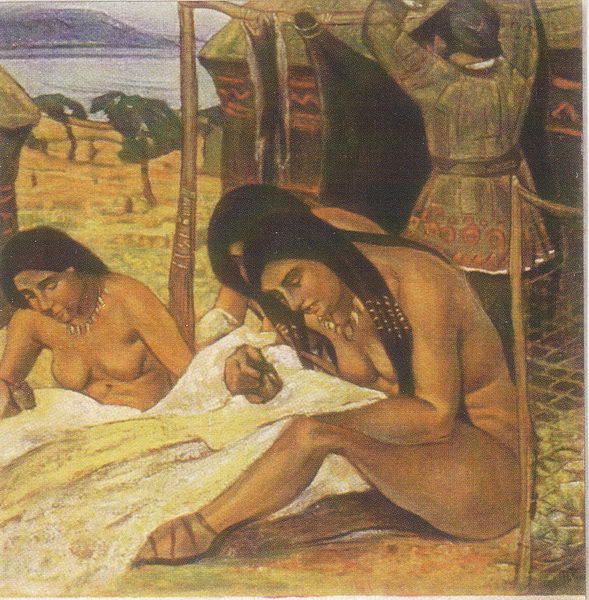
“Making clothing (Stone Age)” by Nicholas Roerich (1908) exemplifies Symbolism art movement. The painting portrays a Stone Age scene featuring two figures diligently crafting garments, set against a backdrop of primitive shelters and natural landscapes. Roerich’s masterful use of color and texture captures the essence of prehistoric life.
Nicholas Roerich: Conceive Clothing (Stone Age) – A Vision of Primordial Harmony
Nicholas Roerich’s “Making clothing (Stone Age)” stands as a testament to the artist's profound engagement with symbolism and his unwavering fascination for exploring the spiritual dimensions of human experience. Painted in 1908, this striking canvas embodies the ethos of Russian Symbolism – a movement that sought to transcend literal representation and delve into realms beyond sensory perception.
The artwork depicts a scene from prehistoric times: women diligently crafting garments from fabric. The composition is dominated by earthy tones—muted browns and ochres—that evoke the textures and colors of the Stone Age landscape. Roerich meticulously rendered details, capturing the focused expressions of the figures and the tactile quality of their labor. This careful observation isn’t merely descriptive; it's imbued with symbolic intent.
- Style: Symbolism – Roerich prioritized conveying emotional resonance over precise realism. The painting eschews conventional perspective, favoring a flattened plane that emphasizes unity and interconnectedness.
- Technique: Tempera on canvas—Roerich utilized tempera paint, known for its luminosity and durability, to achieve rich hues and subtle gradations of tone. This technique lends an ethereal quality to the scene, mirroring Roerich’s spiritual explorations.
- Historical Context: Painted during the burgeoning Symbolist movement in Russia, “Making clothing (Stone Age)” reflects a broader artistic preoccupation with mythology, folklore, and esoteric traditions. It aligns with Roerich's interest in exploring archetypal imagery and conveying universal truths.
Beyond its formal qualities, the painting resonates with deeper symbolic meanings. The act of crafting clothes represents not only practical necessity but also a fundamental human endeavor—the creation of order from chaos, the assertion of agency within the natural world. Roerich’s depiction of women engaged in this activity speaks to themes of fertility, nurturing, and the cyclical rhythms of life.
The inclusion of trees in the background reinforces these ideas, symbolizing resilience, growth, and connection to the earth—elements central to Roerich's spiritual worldview. The subtle interplay of light and shadow contributes to an atmosphere of tranquility and contemplation, inviting viewers to contemplate the timeless beauty of primal harmony.
“Making clothing (Stone Age)” is more than just a depiction of prehistoric labor; it’s a visual meditation on the origins of civilization and the enduring power of human creativity. Roerich's masterful technique and symbolic vision continue to inspire admiration for its artistic merit and its profound spiritual depth.