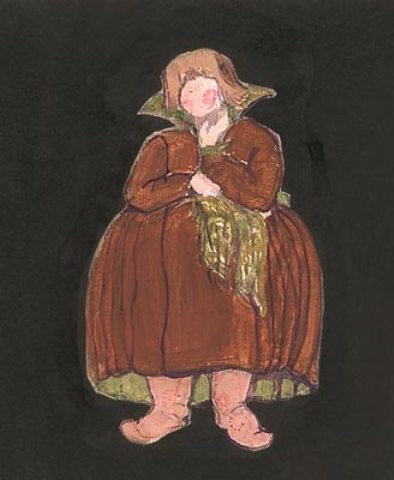
A Portrait of Enchantment: Costume Design for "The Tale of Tsar Saltan" by Nicholas Roerich
This captivating black and white study, “Costume design for Rimsky-Korsakov’s opera ‘The Tale of Tsar Saltan’,” offers a poignant glimpse into the creative process of one of the 20th century's most enigmatic artists, Nicholas Roerich. More than just a preparatory sketch, it embodies the spirit of his work – a profound fusion of artistic vision with philosophical and spiritual inquiry. The image depicts a woman, rendered in meticulous detail, likely intended as a character within Rimsky-Korsakov’s grand operatic spectacle. Her posture, gazing downwards with an air of quiet contemplation, immediately draws the viewer into her world, inviting speculation about her role and emotional state.
Roerich's Artistic Vision: A Synthesis of Disciplines
Born in 1874 in Saint Petersburg, Nicholas Roerich’s life was a remarkable testament to the power of interdisciplinary pursuits. Initially trained as both an artist and a lawyer – graduating from St. Petersburg University with degrees in both fields – he seamlessly blended intellectual rigor with artistic sensitivity. This unique approach is strikingly evident in this costume design; it's not merely a depiction of clothing, but a carefully considered composition imbued with symbolic weight. Roerich’s work was deeply influenced by his explorations of ancient cultures and philosophies, particularly those of the East, which he believed held keys to unlocking humanity’s spiritual potential. His travels throughout Asia, notably in Central Asia and Tibet, profoundly shaped his artistic vocabulary, introducing him to vibrant color palettes and complex mythological narratives that would later permeate his paintings.
Technique and Style: A Masterful Study
The artwork’s stark black and white palette immediately establishes a formal, almost theatrical quality. Roerich's technique is characterized by precise linework and subtle tonal variations, achieved through meticulous layering of charcoal and possibly other drawing media. The rendering of the woman’s face – her long hair flowing gracefully, her expression thoughtful – demonstrates a remarkable command of form and gesture. The artist’s attention to detail extends beyond mere representation; it suggests an intention to capture not just the physical appearance but also the character and inner life of his subject. This is evident in the way he has rendered the folds of the dress and the texture of the scarf, creating a sense of tactile realism that elevates the image beyond a simple sketch.
Symbolism and Narrative Context
Within the context of Rimsky-Korsakov’s “The Tale of Tsar Saltan,” this costume design likely represents a princess or a sorceress, figures frequently associated with magic, transformation, and hidden depths. The downward gaze could symbolize introspection, vulnerability, or perhaps a connection to the unseen forces that govern the opera's narrative. Roerich was deeply interested in exploring themes of good versus evil, fate versus free will, and the relationship between humanity and the cosmos – all central concerns within the operatic work. This image serves as a tangible manifestation of these ideas, inviting viewers to contemplate the complex moral dilemmas at the heart of the story.
A Timeless Piece for Your Collection
This hand-painted reproduction captures the essence of Nicholas Roerich’s artistic genius. Perfect for adorning a study, gallery wall, or simply as a captivating piece of art to inspire contemplation, this artwork offers a unique opportunity to own a fragment of a pivotal moment in 20th-century art history. Its timeless appeal and evocative imagery will undoubtedly become a cherished addition to any discerning collection.