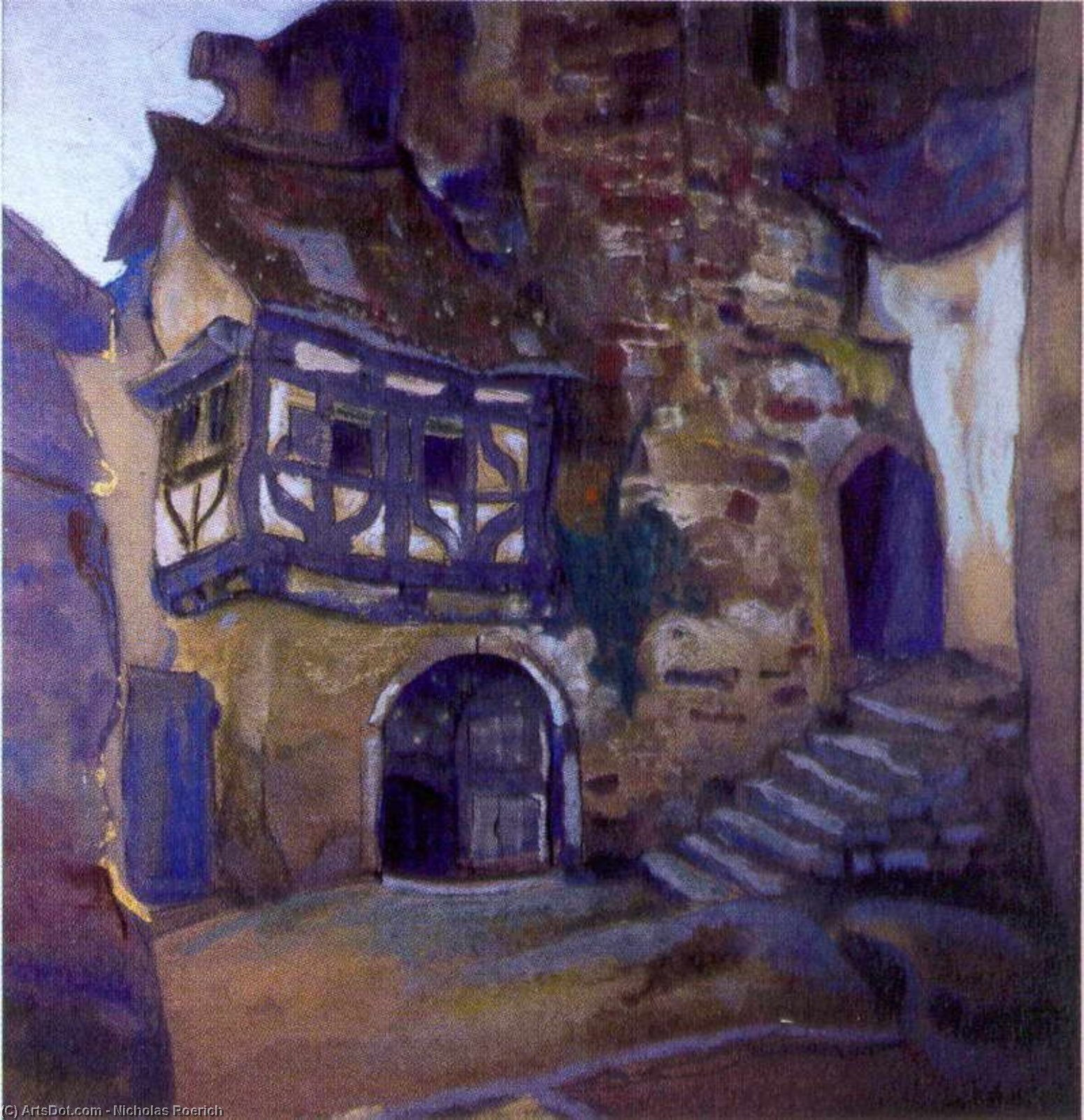
Nicholas Roerich’s ‘Gegstad Manor’ (1912) – a stylized, evocative oil painting of an old European street scene. Explore its expressionistic style, muted colors & textural brushwork.
Explore Nicholas Roerich's (1874-1947) captivating art: Symbolism, Himalayan landscapes & mystical paintings. Designs for Ballets Russes & advocate for cultural preservation.
A Journey Through Spirit and Color: Exploring Nicholas Roerich’s “Gegstad Manor”
Nicholas Roerich's "Gegstad Manor," painted in 1912, isn’t merely a depiction of an old European street scene; it’s a carefully constructed portal into a world where architecture whispers tales of history and spirituality intertwines with the tangible. This evocative oil painting, now housed within the Nicholas Roerich Museum in New York City, stands as a testament to the artist's unique vision – a blend of expressionistic brushwork, meticulous architectural detail, and a profound engagement with Eastern mysticism. The scene unfolds within a narrow street lined by two imposing buildings, their weathered stone walls and timber-framed upper stories hinting at centuries past. Yet, Roerich doesn’t simply recreate a historical facade; he imbues it with an atmosphere of quiet mystery and poignant nostalgia.
The Expressionist Palette: Capturing Atmosphere over Reality
Roerich's style leans heavily into the tenets of expressionism, prioritizing the conveyance of mood and emotion over strict adherence to photographic realism. The color palette is deliberately muted – a symphony of blues, browns, and grays dominates, creating a sense of age and timelessness. Thick impasto brushstrokes are liberally applied, particularly on the building walls, lending a tactile quality to the canvas and inviting the viewer to almost feel the rough texture of the stone beneath their fingertips. Notice how light is diffused, casting long shadows that deepen the sense of depth and enclosure. This deliberate manipulation of color and texture isn’t about accuracy; it's about capturing the *feeling* of the scene – a subtle melancholy mingled with a profound appreciation for the enduring beauty of the past.
Architectural Echoes and Symbolism’s Dance
The architectural details within “Gegstad Manor” are remarkably precise, suggesting a deep understanding of medieval European design. Arched doorways, protruding timber-framed elements, and intricate stonework all contribute to a sense of historical authenticity. However, Roerich subtly distorts perspective, creating an almost dreamlike quality. The buildings seem to lean inward, drawing the viewer into the scene, while the narrow street creates a feeling of confinement. Beyond mere architectural representation, these details carry symbolic weight. The manor itself can be interpreted as a symbol of resilience and continuity – a steadfast presence amidst the passage of time. The use of repeating geometric shapes—rectangles for windows and doors, triangles for roof gables—provides a grounding element within the painterly abstraction.
Roerich’s Spiritual Lens: A Bridge Between East and West
Nicholas Roerich's artistic journey was profoundly shaped by his exploration of Eastern philosophies, particularly Theosophy and Vedanta. This spiritual quest permeated his work, manifesting in a fascination with symbolism, mysticism, and the interconnectedness of all things. “Gegstad Manor” is no exception; it’s believed that the artist sought to capture not just the physical appearance of the building but also its underlying essence – a sense of history, memory, and perhaps even a hint of something beyond the visible world. The muted colors and atmospheric perspective can be seen as reflections of this spiritual sensibility, creating an image that invites contemplation and introspection. The painting’s connection to Roerich's later work exploring Himalayan landscapes and his advocacy for cultural preservation further enriches its meaning.
A Timeless Masterpiece: Reproduction and Beyond
Today, “Gegstad Manor” remains a captivating example of Nicholas Roerich’s artistic genius. High-quality reproductions offer an accessible way to experience the painting's beauty and depth, bringing this evocative scene into any space. Whether displayed as a statement piece in a contemporary setting or alongside historical artifacts, "Gegstad Manor" continues to resonate with viewers who appreciate its blend of architectural detail, expressive brushwork, and profound spiritual undertones. It’s a reminder that art can transcend mere representation, offering a glimpse into the artist's soul and inviting us to contemplate the mysteries of time, memory, and the human spirit.