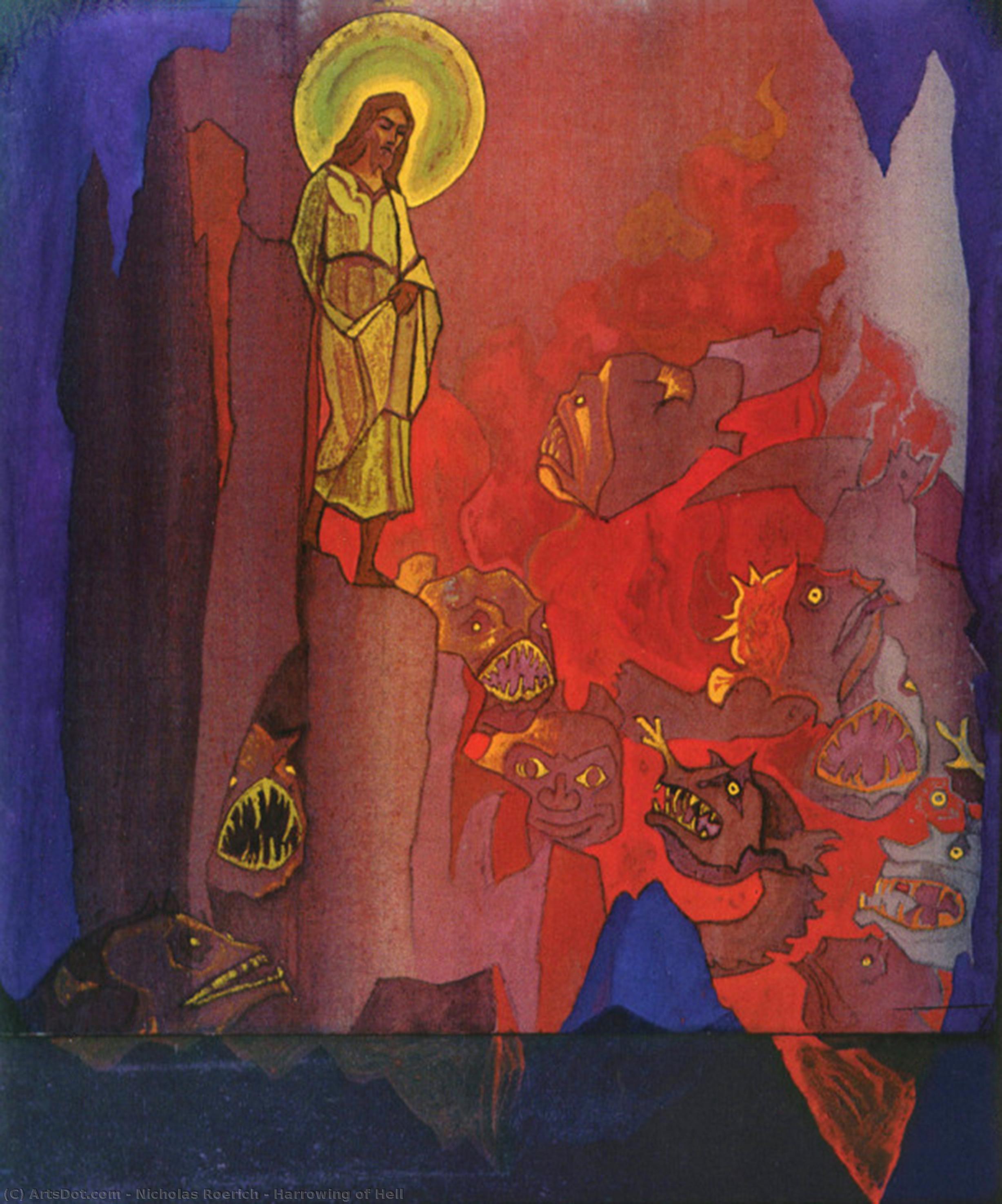
Nicholas Roerich's "Harrowing of Hell": A Descent into Symbolism
Nicholas Roemerich’s “Harrowing of Hell,” painted in 1933, is not merely a depiction of fantastical creatures; it’s a profound meditation on the struggle between good and evil, hope and despair. This monumental work, born from the artist's deep spiritual convictions and archaeological explorations, immediately captivates with its dramatic composition and unsettling beauty. The painting portrays a lone figure – a man poised atop a rocky outcrop – surveying a chaotic panorama of demonic entities. Thirteen distinct figures, ranging from serpentine dragons to monstrous humanoids, swirl below him, embodying the forces of darkness that threaten to consume all light.
- Subject Matter: The central theme is the “Harrowing of Hell,” a concept drawn from Christian theology representing Christ’s descent into hell to liberate the souls trapped within.
- Composition: Roerich masterfully employs a pyramidal composition, with the figure at its apex, symbolizing humanity's potential for salvation and dominion over darkness.
- Color Palette: The artist utilizes a rich, earthy palette dominated by deep reds, browns, and blacks, punctuated by flashes of gold and silver – colors traditionally associated with divinity and spiritual power.
A Masterclass in Symbolism and Technique
Roerich’s technique is characterized by its meticulous detail and expressive brushwork. He employed a layering method, building up the image through numerous thin glazes of oil paint, creating a luminous effect that imbues the scene with an almost otherworldly quality. The textures are remarkably varied – from the rough stone beneath the figure to the swirling, vaporous forms of the demons – adding to the painting’s dramatic impact. His training at both the Imperial Academy of Arts and his self-directed study of archaeology informed a meticulous approach to rendering form and detail, evident in the anatomical accuracy of the monstrous figures alongside their fantastical design.
- Oil on Canvas: The work is executed in oil paint on canvas, a traditional medium that allowed Roerich to achieve the desired level of richness and depth.
- Glazing Technique: The extensive use of glazing created a sense of atmospheric perspective and heightened the luminosity of the colors.
- Detailed Rendering: Each creature is rendered with painstaking detail, reflecting Roerich’s commitment to realism within his symbolic framework.
Historical Context and Roerich's Vision
"Harrowing of Hell" was created during a period of intense spiritual searching for Nicholas Roerich. His work reflects the broader cultural anxieties of the 1930s, marked by rising totalitarianism and a renewed interest in esoteric philosophies and religious symbolism. Roerich’s belief system, rooted in a synthesis of Eastern mysticism and Western spirituality, profoundly influenced his art. He saw himself as a “painter-philosopher,” striving to express universal truths through his artistic creations. His travels throughout Central Asia, particularly his expeditions to Tibet and Mongolia, fueled his fascination with ancient myths and legends, which he incorporated into his paintings.
- Roerich’s Philosophy: The painting embodies Roerich's belief in the interconnectedness of all things and the importance of spiritual striving.
- Influence of Esoteric Traditions: Elements of Gurdjieffian philosophy, prevalent at the time, can be discerned in the depiction of the figure as a solitary seeker confronting overwhelming forces.
- Art Deco Influence: The dramatic composition and use of strong contrasts align with the aesthetic trends of the Art Deco movement, popular during this era.
Emotional Impact and Artistic Legacy
"Harrowing of Hell" continues to resonate with viewers today due to its powerful emotional impact. It evokes a sense of awe, fear, and ultimately, hope. The painting’s enduring appeal lies in its ability to tap into fundamental human anxieties about mortality, evil, and the search for meaning. Roerich's work is now recognized as a significant contribution to 20th-century art, showcasing his unique blend of symbolism, technique, and spiritual vision. A hand-painted reproduction offers an unparalleled opportunity to experience the full force of this captivating masterpiece in your own space.