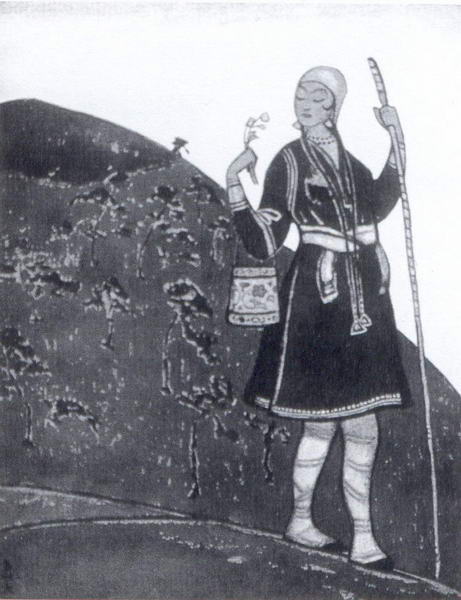
Nicholas Roerich’s ‘Kupava’ presents a serene Symbolist depiction of a Slavic goddess before a stylized landscape, evoking spirituality and timelessness. Explore this captivating artwork by the renowned Russian artist and consider owning a piece of art history.
Nicholas Roerich's 'Kupava': A Portrait of Mythic Serenity
Nicholas Roerich’s ‘Kupava,’ painted circa 1920, is more than just a depiction of a woman; it’s an immersion into a world steeped in Slavic mythology and the artist’s deeply held spiritual beliefs. This monochromatic work, presented as a photograph of the original painting, immediately draws the viewer into its quiet intensity. The grainy texture hints at the materiality of the artwork itself – likely tempera or oil on canvas – while the deliberate flatness speaks to a conscious rejection of photographic realism in favor of symbolic representation. The central figure, identified as Kupava, a Slavic goddess associated with healing and springtime, embodies an almost timeless quality, her presence radiating serenity and connection to the natural world.
- Subject Matter & Symbolism: The very title, ‘Kupava,’ anchors the piece within a rich tapestry of Eastern European folklore. Kupava represents fertility, abundance, and the rejuvenating power of spring – themes central to Roerich’s broader artistic explorations. Her traditional attire further reinforces this connection to ancient beliefs and practices, suggesting a continuity between the pagan past and the artist's own spiritual quest.
- Style & Technique: Roerich’s style is firmly rooted in Symbolism, prioritizing evocative imagery over precise detail. The technique employed – a careful layering of outlines and shading – creates a sense of volume and depth despite the overall flatness. Noticeable are the deliberate geometric shapes within the landscape, reminiscent of folk art traditions, adding to the work's stylized quality. The absence of strong highlights or shadows contributes to the painting’s ethereal atmosphere.
A Window into Roerich’s Worldview
Understanding ‘Kupava’ requires acknowledging Nicholas Roerich’s broader intellectual and spiritual journey. Born in 1874, he was a man of immense curiosity, deeply involved in archaeology, philosophy, and the pursuit of universal harmony. His work wasn't simply about creating beautiful images; it was an attempt to translate his personal experiences and profound beliefs into visual form. The painting’s muted color palette – predominantly grayscale with subtle tonal variations – reflects this spiritual focus, suggesting a world beyond the purely material. Roerich believed in the interconnectedness of all things, a concept powerfully conveyed through the image of Kupava, standing as a bridge between humanity and the ancient forces of nature.
- Historical Context: ‘Kupava’ was created during a period of significant artistic and intellectual ferment. The Symbolist movement, with its emphasis on subjective experience and spiritual symbolism, was gaining momentum across Europe. Roerich's work aligns with this trend while simultaneously forging his own unique path, blending Western influences with Eastern traditions.
- Materials & Production: The likely use of tempera or oil paints on canvas or panel speaks to Roerich’s meticulous approach. The technique suggests a deliberate process of layering and building up the image, creating a rich surface texture despite the photographic representation.
Emotional Resonance and Artistic Legacy
'Kupava' possesses a remarkable ability to evoke a sense of quiet contemplation and spiritual connection. Its serene composition and symbolic imagery invite viewers to reflect on themes of nature, mythology, and the human condition. The painting’s enduring appeal lies in its timeless quality – it feels as though it could have been created centuries ago, yet remains profoundly relevant today. This reproduction offers a unique opportunity to experience the power and beauty of Roerich's vision, bringing this evocative artwork into your home or studio.
- Interior Design Applications: The painting’s muted tones and symbolic imagery make it an ideal addition to a variety of interior design styles, particularly those with a focus on nature, spirituality, or Eastern influences. Its understated elegance will complement both modern and traditional spaces.