The Weight of the Sky: Nicholas Roerich’s ‘Morning Rider’
Nicholas Roerich's “Morning Rider,” painted in 1918, isn’t merely a landscape; it’s an immersion. The painting immediately evokes a profound sense of solitude and contemplation, drawing the viewer into a world where the boundaries between earth and sky blur, and time seems to slow to a meditative pace. It's a work steeped in the spirit of Impressionism, yet distinctly shaped by Roerich’s later explorations of symbolism and spiritual themes – a fascinating confluence that elevates it beyond a simple depiction of nature.
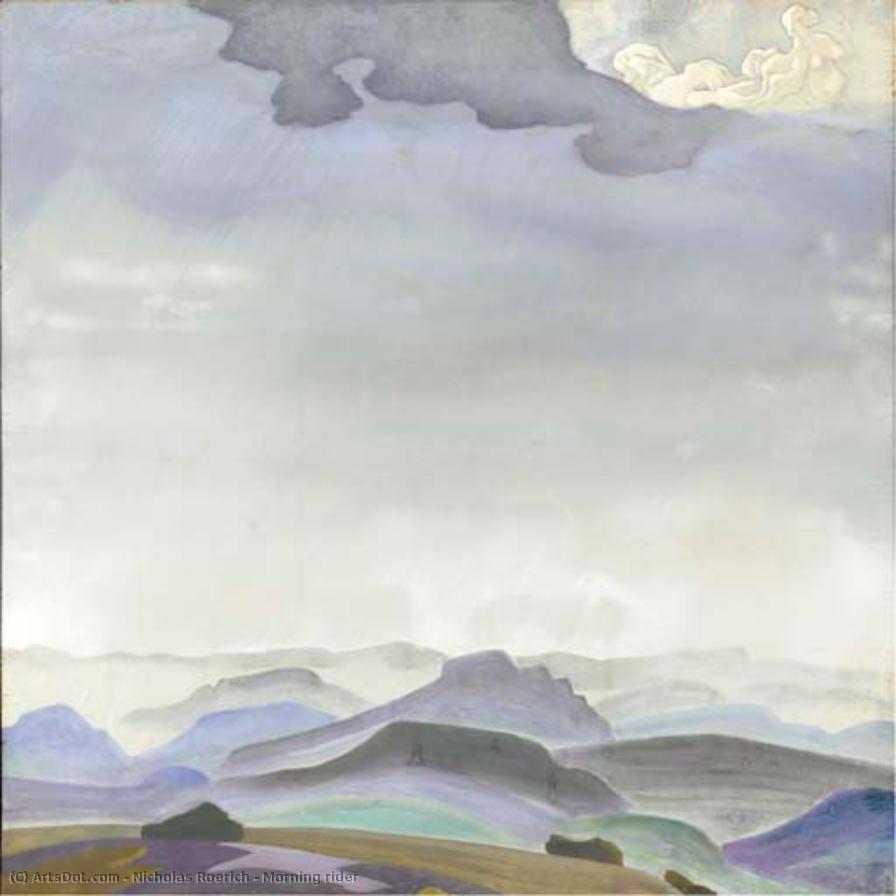
The scene unfolds beneath a dramatic, bruised sky dominated by swirling clouds rendered with loose, almost frantic brushstrokes. These aren't the tidy, idealized clouds of academic painting; they’re dynamic, turbulent masses, hinting at an approaching storm or perhaps reflecting the turmoil within the human soul. Below, rolling hills and distant mountains emerge from the haze, their forms softened and indistinct, contributing to the overall feeling of atmospheric depth. The muted palette – primarily shades of gray, blue, and purple – reinforces this sense of melancholy and introspection. Roerich masterfully employs wet-on-wet painting techniques, allowing the colors to bleed into one another seamlessly, creating a hazy, dreamlike quality that’s characteristic of Impressionism but imbued with a uniquely personal intensity.
A Symbolist Vision: Echoes of Eastern Mysticism
While firmly rooted in the Impressionistic style, “Morning Rider” reveals deeper symbolic layers. Roerich, particularly later in his career, was deeply influenced by Eastern philosophies and spiritual practices, including Theosophy and Vedanta. This influence is evident in the painting’s evocative use of color and form. The dominant gray tones can be interpreted as representing the veil between worlds – a suggestion that this landscape isn't just a physical place but also a threshold to something beyond our immediate perception.
- The Rider: The central figure, though obscured by the mist and distance, is often interpreted as a representation of the soul’s journey—a solitary traveler navigating an uncertain path.
- Mountains & Clouds: The towering mountains symbolize strength, permanence, and spiritual aspiration, while the swirling clouds represent change, uncertainty, and the ever-shifting nature of reality.
- Color Palette: The somber hues contribute to a mood of introspection and contemplation, inviting viewers to reflect on their own inner landscapes.
Roerich’s work frequently incorporated elements of mythology and folklore, drawing inspiration from ancient cultures and spiritual traditions. “Morning Rider” is no exception; it feels like a visual meditation on themes of mortality, transcendence, and the interconnectedness of all things.
Craftsmanship & Historical Context
Painted in 1918, during the tumultuous years following the Russian Revolution, “Morning Rider” reflects both the anxieties and the artistic ferment of the time. Roerich’s career spanned decades and continents, encompassing a remarkable range of activities – from archaeological expeditions to stage design for Sergei Diaghilev's Ballets Russes. This breadth of experience profoundly shaped his artistic vision, informing his meticulous attention to detail, his deep understanding of color theory, and his ability to synthesize diverse influences.
The painting itself is executed in oil on canvas, demonstrating Roerich’s mastery of technique. The loose brushwork creates a sense of movement and atmosphere, while the subtle gradations of color evoke a remarkable sense of depth and realism. It's a testament to his ability to capture not just the appearance of a landscape but also its emotional resonance.
A Timeless Resonance: Reproduction & Beyond
“Morning Rider” continues to captivate viewers with its haunting beauty and profound symbolism. It’s a work that invites repeated viewing, revealing new layers of meaning with each encounter. High-quality reproductions offer an accessible way to bring this evocative masterpiece into your home or office, allowing you to experience its atmospheric power and spiritual depth firsthand. Consider it not just as a decorative piece but as a portal to contemplation—a reminder of the enduring mysteries of nature and the human spirit.