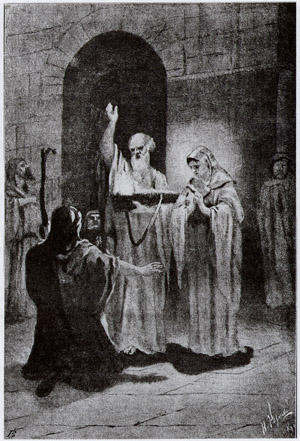
Presentation of Jesus at the Temple by Nicholas Roerich: A Study in Reverent Lineage
Nicholas Roerich’s “Presentation of Jesus at the Temple,” created in 1894, is more than a simple depiction of a biblical scene; it's a profound meditation on faith, devotion, and the enduring power of tradition. Executed with meticulous detail in black and white graphite, this drawing immediately draws the viewer into its solemn atmosphere – an atmosphere born from Roerich’s deep understanding of both artistic technique and spiritual contemplation. The work’s restrained palette, entirely reliant on shades of gray, amplifies the impact of each carefully rendered line, creating a textured surface that invites close inspection and fosters a sense of tangible presence.
Technical Mastery: Line as Prayer
Roerich's skill is immediately apparent in his masterful use of linework. The drawing’s foundation rests upon a complex layering of hatching and cross-hatching, techniques that were hallmarks of academic drawing during the late 19th century. These methods aren't merely employed for representation; they actively contribute to the artwork’s emotional resonance. Thick lines delineate the primary forms – the figures’ robes, the architectural elements of the temple – while finer lines meticulously capture details like facial features and the folds of fabric. This deliberate control over line weight and density generates a remarkable sense of depth and volume, transforming a two-dimensional surface into an illusion of three-dimensionality. The choice of graphite, likely due to its ability to produce smooth, controllable marks, perfectly suits Roerich’s vision.
Symbolism and Narrative: A Sacred Moment
The scene itself – the Presentation of Jesus at the Temple – is rich in symbolic weight. As depicted here, it represents a pivotal moment in Christian theology, marking Jesus' first public act of defiance against his earthly family and establishing his role as Messiah. The composition, with its central figures arranged in a semi-circular fashion, directs the viewer’s gaze towards the infant Jesus, emphasizing his divine nature. The arched doorway behind serves not just as architectural backdrop but also as a visual metaphor for entry into the sacred realm. The presence of other individuals flanking the main group reinforces the narrative's communal and spiritual significance – it is a scene of shared faith and reverence.
Historical Context and Artistic Influence
Created in 1894, “Presentation of Jesus at the Temple” reflects the artistic currents of its time, particularly the influence of academic drawing. Roerich’s training at St. Petersburg University and the Imperial Academy of Arts instilled in him a rigorous approach to observation and representation, mirroring the style prevalent within those institutions. Considering Roerich's later works, such as “Pantokrator” (1909), which showcases his exploration of spiritual themes through dynamic compositions and symbolic imagery, this earlier piece can be seen as an early manifestation of his artistic concerns – a foundational step in developing his distinctive visual language. The drawing’s focus on detail and realism anticipates the later development of Symbolism within art.
- Artist: Nicholas Roerich
- Year: 1894
- Medium: Graphite on Paper
- Style: Academic Drawing, reminiscent of Art Nouveau aesthetics.