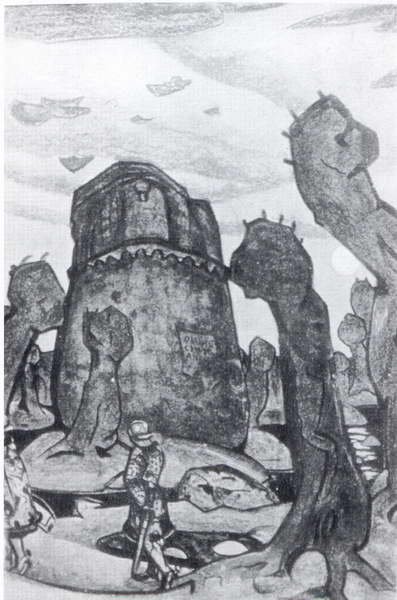
Nicholas Roerich’s ‘Queen Anna’s Tower,’ a Symbolist masterpiece from 1913, evokes a dreamlike Scandinavian landscape with its expressive linework and monochromatic palette. Explore this captivating Expressionist artwork and discover the enduring spirit of Roerich's vision.
Nicholas Roerich’s ‘Queen Anna’s Tower’: A Chronicle of Myth and Memory
“Queen Anna’s Tower,” created in 1913 by the visionary artist Nicholas Roemerich, is more than a depiction of a solitary stone structure; it's an immersive exploration of folklore, spirituality, and the enduring power of memory. Executed with meticulous attention to line and tone, this monochromatic work embodies the hallmarks of Symbolism and early Expressionism, inviting viewers into a realm where history and dream intertwine. The artwork’s stark beauty lies in its ability to evoke a profound sense of quiet contemplation, prompting questions about resilience, connection to the past, and the very nature of perception.
Composition and Technique: A Dance of Line
Roerich's masterful technique is immediately apparent in the artwork’s construction. The composition centers around a powerfully rendered cylindrical tower – a dominant form that commands immediate attention. Surrounding it are stylized trees and rock formations, arranged to create an enclosed space that feels both mysterious and protective. The artist employs hatching and cross-hatching with remarkable precision, building up areas of shadow and texture through layers of dark ink on paper. This technique isn’t merely representational; it's a deliberate choice to convey the rough, weathered surface of the stone, imbuing the tower with an almost tactile quality. The flattened perspective, deliberately eschewing traditional linear realism, adds to the artwork’s dreamlike atmosphere and reinforces its symbolic intent.
Symbolism and Historical Context
Created in 1913, “Queen Anna’s Tower” reflects Roerich's deep engagement with Scandinavian folklore and his broader interest in ancient civilizations. The tower itself is open to interpretation – it could represent a fortress of the mind, a beacon of hope amidst darkness, or perhaps a tangible link to forgotten histories. Roerich was deeply interested in exploring themes of spirituality and the relationship between humanity and nature, often drawing inspiration from Eastern philosophies and shamanic traditions. His work during this period reflects a growing fascination with the mystical aspects of European folklore, particularly tales of powerful women and ancient monuments.
Emotional Resonance and Artistic Style
The artwork’s monochromatic palette – shades of gray and black against a stark white background – amplifies its emotional impact. The lack of color intensifies the sense of mystery and isolation, drawing the viewer into the scene's contemplative mood. Roerich’s expressive linework, characterized by thick, deliberate strokes, contributes to the artwork’s raw aesthetic and imbues it with a palpable energy. It is this combination of meticulous technique and emotional depth that elevates “Queen Anna’s Tower” beyond a simple landscape depiction; it becomes a powerful meditation on the human condition – a testament to our enduring fascination with myth, memory, and the search for meaning.
Materials and Production
- Support: Paper
- Technique: Lithograph (likely)
- Inks: Black ink, possibly mixed with other pigments for tonal variation.