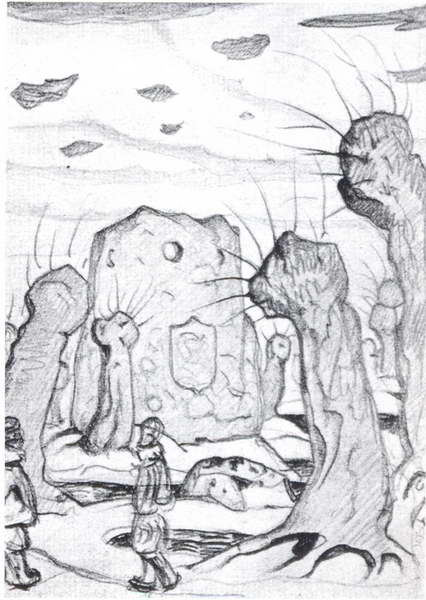
Nicholas Roerich’s ‘Queen Anna’s Tower’ presents a hauntingly beautiful monochromatic sketch of an ancient fortress, embodying early 20th-century Russian Symbolism and evoking mystery. Discover this evocative artwork and bring its timeless spirit into your collection.
Nicholas Roerich’s ‘Queen Anna’s Tower’: A Chronicle of Mystery and Timeless Contemplation
Nicholas Roemerich's 1913 sketch, “Queen Anna’s Tower,” is more than a simple landscape drawing; it’s a portal to a realm of profound mystery and contemplative solitude. Executed in stark monochrome, the artwork immediately arrests the viewer with its raw energy and evocative power. The central figure – a towering fortress-like structure – dominates the composition, rendered with a deliberate roughness that speaks volumes about Roerich's artistic intent. This isn’t merely a depiction of a place; it’s an exploration of human experience, filtered through the lens of early 20th-century Symbolism and imbued with a deep spiritual resonance.
A Sketch from the Heart of Russian Symbolism
Created during a pivotal moment in Roerich's career, “Queen Anna’s Tower” exemplifies his growing fascination with depicting not just what he saw, but what he *felt*. Rooted firmly within the traditions of Russian Symbolism – a movement that sought to express spiritual truths through artistic imagery – the work eschews realistic representation for a more subjective and emotionally charged interpretation. The loose, expressive lines, achieved through meticulous hatching and cross-hatching, create a palpable sense of texture and immediacy. It’s as if Roerich has captured a fleeting impression, a moment of profound stillness within a landscape brimming with unspoken narratives. The influence of artists like Gustave Moreau is evident in the stylized forms and the deliberate avoidance of photographic accuracy.
Technique and Materials: A Study in Line
- Medium: Pencil on Paper – The artist’s masterful control over pencil demonstrates a deep understanding of tonal variation.
- Line Quality: The artwork is characterized by a deliberate roughness, achieved through varied line weights and expressive hatching. This technique isn't simply about shading; it actively contributes to the overall mood and sense of age.
- Shading Techniques: Hatching and cross-hatching are employed with precision, creating subtle gradations in tone that define form and depth. The artist’s attention to detail is remarkable, particularly considering the sketch's overall impressionistic style.
Symbolism and Emotional Resonance
The imposing tower itself immediately evokes a sense of power, resilience, and perhaps even isolation. The solitary figure in the foreground – seemingly lost in contemplation – amplifies this feeling, inviting the viewer to share in the scene’s inherent mystery. The monochromatic palette further enhances the artwork's emotional impact, stripping away any distractions and focusing attention on the fundamental elements of form and texture. Roerich was deeply interested in archetypes and mythic narratives, and “Queen Anna’s Tower” could be interpreted as a representation of an ancient fortress guarding secrets or symbolizing the enduring struggle between humanity and the unknown. The lack of a clear light source adds to the artwork's dreamlike quality, suggesting a timeless realm beyond the constraints of earthly perception.
A Legacy of Vision
“Queen Anna’s Tower” stands as a testament to Nicholas Roerich’s extraordinary artistic vision and his profound engagement with spiritual themes. This evocative sketch, created in 1913, continues to captivate viewers with its haunting beauty and enduring sense of mystery. ArtsDot offers meticulously crafted hand-painted reproductions that faithfully capture the essence of this remarkable artwork, allowing you to experience Roerich’s vision firsthand.