Nicholas Roerich’s ‘Room of Queen Anna’: A Tapestry of Spirit and Style
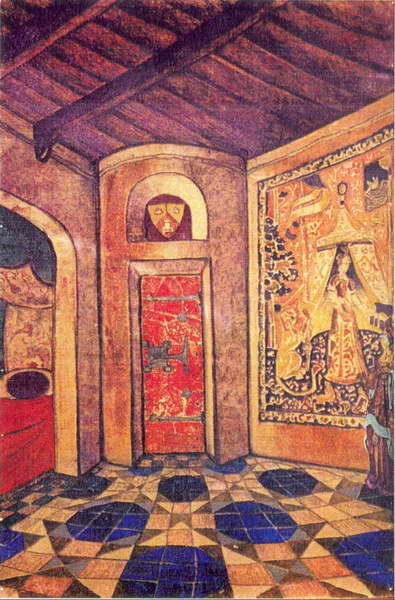
“Room of Queen Anna,” painted in 1913 by the visionary artist Nicholas Roerich, is more than a depiction of an interior space; it's a profound meditation on history, spirituality, and the enduring power of artistic symbolism. This captivating work, rendered in the distinctive Art Nouveau style that characterized the early 20th century, invites viewers into a world where the tangible and the ethereal intertwine seamlessly. The painting’s immediate impact stems from its rich color palette – the dominant blues of the tiled floor echoing the vastness of the sky, contrasted dramatically by the assertive red of the doorway, a traditional symbol of transition and perhaps even danger. Scattered figures within the room contribute to a sense of layered narrative, hinting at stories untold and lives intersecting.
Art Nouveau’s Embrace: Form and Ornament
Roerich was a key figure in the Art Nouveau movement, a style that prioritized organic forms, flowing lines, and intricate ornamentation. ‘Room of Queen Anna’ exemplifies this beautifully. Notice the meticulous detail lavished upon every element – the swirling patterns within the mural depicting a woman, the delicate curves of the chair, and the stylized rendering of the figures themselves. This technique reflects Roerich's deep engagement with decorative arts, aiming to create not just a painting but a total artistic environment. The use of vibrant colors and textures further enhances this immersive quality, drawing the viewer into the scene’s emotional core.
Symbolism Woven Within
Beyond its aesthetic beauty, ‘Room of Queen Anna’ is laden with symbolic meaning, reflecting Roerich's broader philosophical interests. The mural figure, often interpreted as a representation of ancient wisdom or a divine feminine archetype, dominates the composition. The red doorway, frequently associated with portals to other realms and the unknown, adds an element of mystery and intrigue. The presence of multiple figures suggests a gathering, perhaps a meeting of minds or spirits – a common theme in Roerich’s work, reflecting his belief in interconnectedness across time and space. Considering the historical context—1913, a period of significant social and political upheaval—the painting can be seen as an exploration of continuity and change.
A Legacy of Vision: Roerich's Artistic Journey
Nicholas Roerich’s artistic journey was marked by a relentless pursuit of beauty and truth. Born in 1874, he combined his formal training in law with a passionate dedication to painting, ultimately forging a unique artistic voice that blended realism with spiritual symbolism. His work reflects a deep engagement with archaeology, philosophy, and the exploration of human consciousness. ‘Room of Queen Anna’ stands as a testament to Roerich's extraordinary vision – a timeless masterpiece that continues to resonate with viewers today. ArtsDot offers meticulously crafted hand-painted reproductions of this iconic artwork, allowing you to bring its beauty and profound symbolism into your own space.