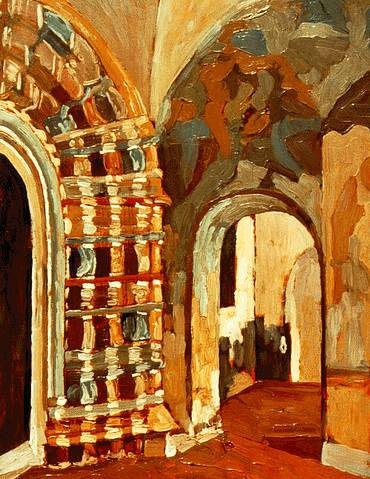
Explore Nicholas Roerich’s ‘Rostov Veliky Interior,’ a stunning Art Nouveau oil painting showcasing architectural detail & warm light. Discover this masterpiece!
Explore Nicholas Roerich's (1874-1947) captivating art: Symbolism, Himalayan landscapes & mystical paintings. Designs for Ballets Russes & advocate for cultural preservation.
Rostov Veliky. Interior of Church – A Symphony in Light and Line
Nicholas Roerich’s “Rostov Veliky Interior,” painted in 1903, stands as a testament to the burgeoning Art Nouveau movement's fascination with organic forms and spiritual contemplation. More than just a depiction of architectural space, it embodies Roereich’s broader artistic philosophy—a harmonious blend of observation and imaginative interpretation rooted in Eastern mysticism. The artwork captures the grandeur of Rostov Veliky Cathedral, showcasing its soaring arches and intricate detailing bathed in warm, directional light. This careful composition immediately draws the viewer into a contemplative experience.
Composition and Technique: Embracing Organic Curves
The painting’s dominant visual element is undoubtedly the series of arched passageways that dominate the scene. These converging lines create an illusion of depth, guiding the eye upwards towards an unseen source of illumination—a subtle gesture reflecting Roereich's interest in visualizing cosmic energies. The artist skillfully employs impasto technique, applying thick layers of oil paint to the walls and columns, resulting in a tactile surface rich with texture. Visible brushstrokes contribute to this effect, emphasizing the materiality of the building itself and conveying a sense of dynamism. Geometric elements like pillars provide structural support but are subtly softened by the curvilinear arches, creating a harmonious balance between form and line.
Historical Context: Art Nouveau’s Quest for Beauty and Harmony
“Rostov Veliky Interior” emerged during a period marked by significant artistic experimentation—the Art Nouveau era (roughly 1890-1910). Artists across Europe sought inspiration in nature, incorporating flowing lines, floral motifs, and iridescent colors into their works. Roereich’s approach aligns perfectly with this aesthetic impulse, prioritizing beauty and harmony as expressions of spiritual truth. The cathedral itself represents a symbol of faith and tradition—a venerable edifice that has endured centuries of history. Roerich's depiction captures not only the physical appearance but also the intangible atmosphere of reverence associated with sacred spaces.
Color Palette and Emotional Impact: Warmth and Tranquility
The painting’s color palette is dominated by earthy tones – ochre, terracotta, and brown—accentuated by darker shades of grey and blue in the shadows. This warm hue scheme evokes feelings of comfort, stability, and serenity. The artist's masterful use of light creates dramatic contrasts, highlighting the textures of the stone surfaces and emphasizing the grandeur of the cathedral interior. Roereich’s intention was to convey a sense of spiritual illumination—the belief that beauty can inspire contemplation and connect us to something larger than ourselves. Viewing “Rostov Veliky Interior” is akin to stepping into a realm of tranquility, where architectural form merges seamlessly with divine light.
Symbolism: Journey Towards Transcendence
The converging arches symbolize the path towards enlightenment – a journey inward as well as outward. They represent aspiration and transformation, mirroring Roereich’s lifelong pursuit of spiritual understanding. The cathedral's walls stand as guardians of history and faith, reminding us of humanity's enduring connection to sacred traditions. Ultimately, “Rostov Veliky Interior” invites viewers to contemplate the sublime beauty of creation and to embrace the transformative power of art.