Nicholas Roerich's Evocative Landscape: "Second Bridge on Road to Threshing Floor in State Forest"
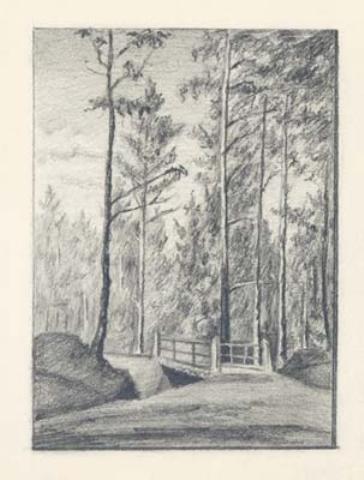
Nicholas Roerich’s “Second Bridge on Road to Threshing Floor in State Forest” is a profoundly contemplative work, a testament to the artist’s deep connection with nature and his exploration of themes far beyond mere landscape depiction. Executed in a grayscale palette that emphasizes texture and atmosphere, this piece transports the viewer to a realm of quietude and introspection, echoing the spirit of early 20th-century realist painting while hinting at Roerich's later, more mystical interests. The artwork’s strength lies not just in its technical execution – the meticulous use of hatching and cross-hatching to build form and tone – but also in its ability to evoke a powerful emotional response, inviting contemplation on themes of transition, connection, and the enduring power of the natural world.
A Study in Texture and Line: Technique and Materials
- Drawing Mastery: The artwork’s foundation rests upon a masterful command of line. Fine lines, meticulously rendered with graphite or charcoal (as evidenced by the surface texture), define every element – from the rough bark of the towering trees to the delicate layering of foliage. This technique isn't simply representational; it actively shapes the viewer’s perception, guiding the eye and creating a palpable sense of depth.
- Hatching and Cross-Hatching: The extensive use of hatching and cross-hatching is crucial to Roerich’s success. These techniques build up tonal variations with incredible subtlety, allowing him to capture the nuances of light and shadow within the forest scene. This creates a remarkable sense of volume and realism, despite the monochromatic palette.
- Surface Texture: The artist deliberately created a textured surface through layering and manipulation of the charcoal or graphite, mirroring the ruggedness of the landscape and adding another layer of visual interest.
Symbolic Resonance: Interpretation and Context
Roerich’s work is steeped in symbolism, reflecting his broader philosophical concerns. The bridge itself – a recurring motif in his oeuvre – represents transition, passage, and the connection between disparate realms. It suggests a journey, both literal and metaphorical, inviting the viewer to contemplate their own path through life. The forest, a frequent subject of Roerich’s art, embodies mystery, introspection, and the enduring power of nature. The high horizon line emphasizes the verticality of the trees, creating a sense of enclosure and perhaps hinting at a spiritual or psychological space within the landscape. Considering Roerich's later interest in esoteric philosophies and his belief in the interconnectedness of all things, this piece can be interpreted as an exploration of the relationship between humanity and the divine, reflected through the beauty and power of the natural world.
Roerich’s Legacy: A Bridge to a Broader Vision
Created during a period of significant artistic and intellectual ferment, “Second Bridge on Road to Threshing Floor in State Forest” exemplifies Roerich's unique vision. His work transcends simple landscape painting; it is imbued with spiritual depth and philosophical inquiry. As an artist deeply engaged with archaeology, philosophy, and the preservation of cultural heritage, Roerich sought to capture not just what he saw, but also what he *felt* – a profound connection to the earth and its mysteries. This reproduction offers a window into that world, allowing viewers to experience the quiet beauty and contemplative power of one of Russia’s most significant artistic figures.