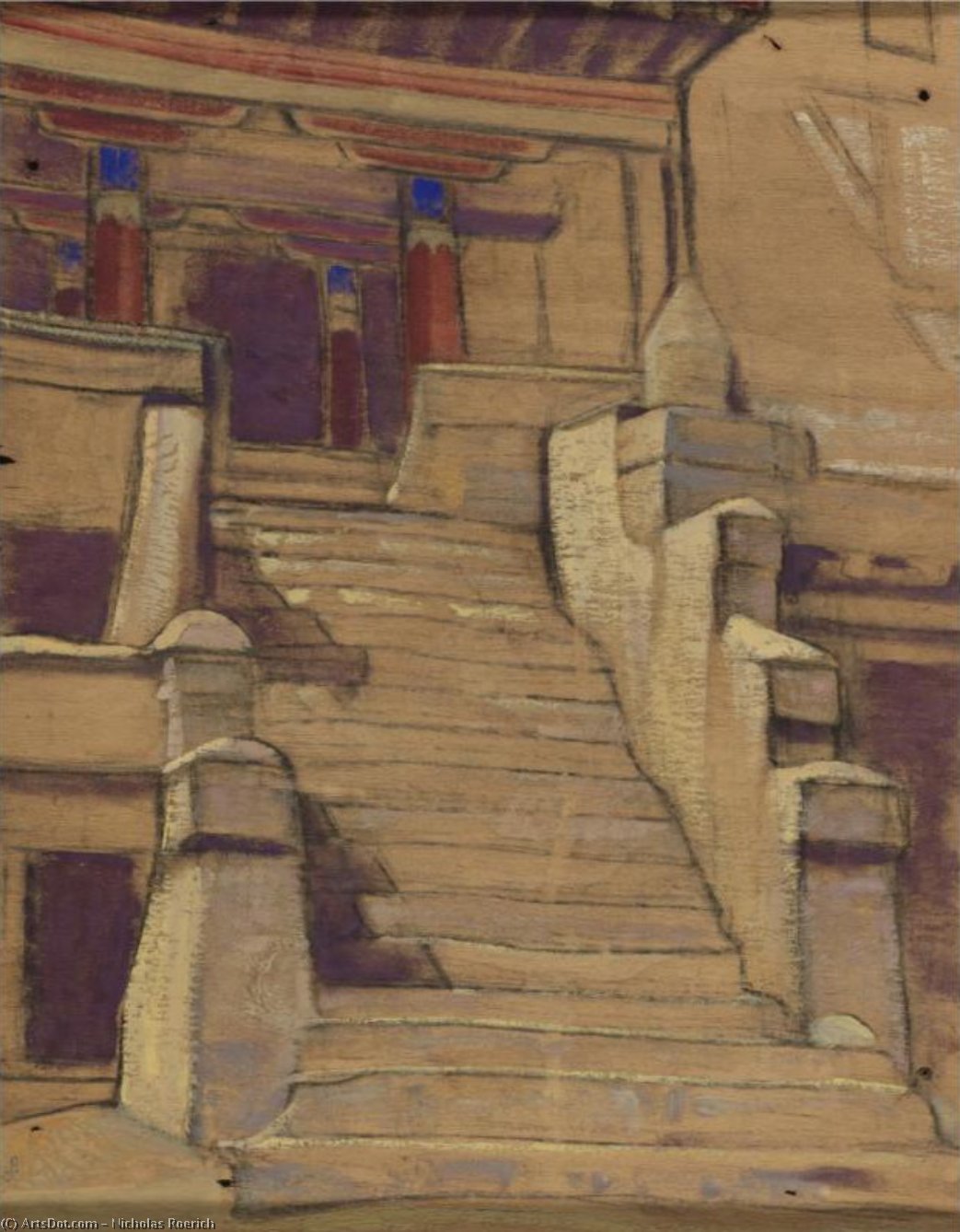
Nicholas Roerich’s ‘Spitok, Ladakh’ (1926) is a captivating Symbolism cityscape depicting a weathered stone staircase leading to a temple, evoking spiritual depth and scale within the remote Ladakhi landscape.
Spitok, Ladakh: A Stairway to Spiritual Ascent
Nicholas Roerich’s “Spitok, Ladakh,” painted in 1926, is more than just a depiction of a Himalayan staircase; it's an immersive journey into the heart of Buddhist spirituality and the artist’s deeply held belief system. Created during a period of intense exploration and philosophical inquiry, this work exemplifies Roerich’s signature style – a potent blend of Symbolism and his own unique vision rooted in esoteric traditions. The painting captures a moment within the remote Ladakhi village of Spitok, where ancient temples and monasteries cling to the rugged landscape, offering a tangible connection to centuries of religious practice.
Symbolic Stairways and the Quest for Enlightenment
The central element of “Spitok, Ladakh” – the stone staircase leading towards an unseen temple or pagoda – is profoundly symbolic. In Buddhist cosmology, staircases represent the arduous path toward enlightenment, a gradual ascent through stages of understanding and spiritual purification. The worn appearance of the steps suggests both time’s passage and the countless souls who have traversed this same route seeking liberation from suffering. Roerich frequently employed such imagery to convey his belief in a universal interconnectedness – that humanity is linked across space and time by shared spiritual experiences. The figures present, one at the top left and another on the right, are not merely incidental details; they represent individuals engaged in this very quest, adding a layer of human drama to the monumental scene.
Roerich’s Technique: A Fusion of Realism and Symbolism
Roerich's technique in “Spitok, Ladakh” is characterized by meticulous detail combined with expressive brushwork. He employed a predominantly realistic approach to render the architecture and landscape, grounding the scene in tangible reality. However, he layered this realism with symbolic elements – vibrant colors, carefully positioned figures, and evocative lighting – to imbue the painting with deeper meaning. The use of warm earth tones—ochres, browns, and reds—evokes the arid beauty of Ladakh while simultaneously suggesting a connection to the earth’s primordial energy. His application of paint is thick in places, creating textural richness that draws the viewer's eye and enhances the sense of depth.
Historical Context and Roerich’s Vision
"Spitok, Ladakh" was created during a pivotal moment in Roerich’s life – his extensive travels throughout Central Asia and Tibet. These journeys were not simply expeditions; they were deeply spiritual quests fueled by his fascination with ancient cultures and esoteric traditions. He sought to uncover lost knowledge and promote the idea of a “Universal Christ,” believing that all religions ultimately pointed towards the same divine truth. This painting reflects this broader context, embodying Roerich’s commitment to bridging cultural divides and fostering global harmony through art.