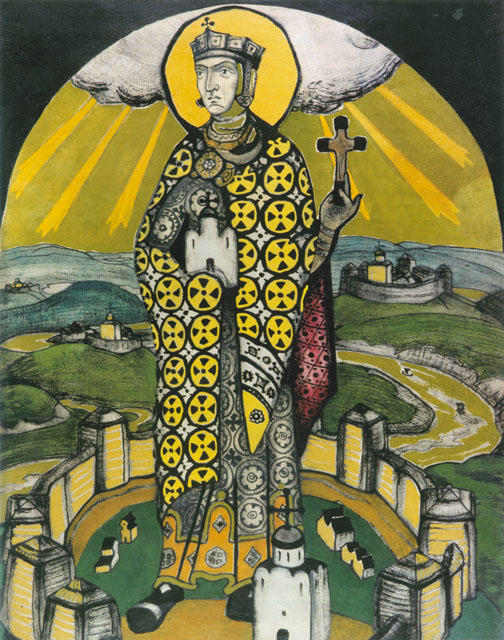
Nicholas Roerich’s ‘St. Olga of Kiev’ portrays the powerful saint with a crown and symbols of authority, set against a grand castle backdrop. This iconic 1915 painting captures Roerich's spiritual and artistic vision – explore this masterpiece and own a piece of art history.
Nicholas Roerich’s ‘St. Olga of Kiev’: A Portrait of Power and Spiritual Resolve
Nicholas Roemerich's “St. Olga of Kiev,” completed in 1915, is more than a mere depiction of a historical figure; it’s a profound meditation on power, faith, and the enduring spirit of Russia. Painted during a period of immense social and political upheaval – just before World War I – the work embodies Roerich's signature blend of meticulous realism with deeply symbolic elements, reflecting his lifelong fascination with ancient cultures and spiritual philosophies. The canvas pulsates with an almost palpable energy, drawing the viewer into a scene that feels both timeless and intensely immediate.
- Subject Matter: The central figure is St. Olga, the first Christian princess of Kiev, revered as a protector of her people and a symbol of unwavering devotion. Her regal bearing, accentuated by the crown and elaborate garments, immediately establishes her authority and spiritual significance.
- Composition: Roerich masterfully employs pyramidal composition, directing the viewer’s eye from Olga's powerful stance to the castle-like structure in the background – a deliberate reference to Kiev itself, representing the seat of Rus' power and faith. The inclusion of other figures surrounding her suggests a courtly scene, emphasizing her role as a leader and mediator.
Technique and Style: Roerich’s Layered Realism
Roerich was renowned for his incredibly detailed technique, achieved through multiple layers of thin glazes applied over time – a process known as ‘verdancy.’ This painstaking method allowed him to capture the subtle nuances of light and texture, imbuing the painting with an almost three-dimensional quality. The use of rich, saturated colors—deep blues, reds, and golds—contributes significantly to the work’s dramatic impact. Notice the meticulous rendering of fabrics, armor, and architectural details; a testament to Roerich's dedication to accuracy and his profound respect for historical subjects. The brushwork is controlled yet expressive, conveying both strength and vulnerability in Olga’s posture.
- Verdancy Technique: This layering technique creates depth and luminosity, characteristic of Roerich’s style.
- Color Palette: The rich hues evoke a sense of grandeur and spiritual significance.
Symbolism and Historical Context
“St. Olga of Kiev” is laden with symbolism reflecting Roerich's broader philosophical concerns. The cross she holds represents her conversion to Christianity, marking a pivotal moment in the history of Russia and solidifying its connection to European culture. The scepter symbolizes her authority as ruler, while the castle backdrop speaks to the enduring legacy of Kiev as a center of civilization. Painted in 1915, during a period of intense national identity formation for Russia, the work can be interpreted as an affirmation of Russian Orthodox faith and cultural heritage. It’s important to note Roerich's deep interest in archaeological discoveries – particularly those related to ancient Slavic cultures – which informed his artistic vision and fueled his belief in a shared spiritual ancestry.
- The Cross: Represents religious conversion and spiritual authority.
- The Scepter: Symbolizes leadership and power.
- Kiev Castle: Represents the historical and cultural heart of Russia.
Emotional Impact and Artistic Legacy
“St. Olga of Kiev” transcends a simple portrait; it’s an emotionally resonant work that speaks to themes of faith, leadership, and resilience. The painting's grandeur and the subject's determined gaze inspire a sense of awe and respect. Roerich’s ability to infuse historical figures with psychological depth is evident in Olga’s expression – a mixture of strength, wisdom, and perhaps even melancholy. This piece remains a cornerstone of Roerich’s oeuvre, exemplifying his unique artistic vision and cementing his place as one of the 20th century's most significant artists. A hand-painted reproduction offers an unparalleled opportunity to experience the full impact of this powerful and evocative artwork.