A Monochromatic Echo of Ancient Rituals: Exploring Nicholas Roerich’s ‘Standard-bearer’
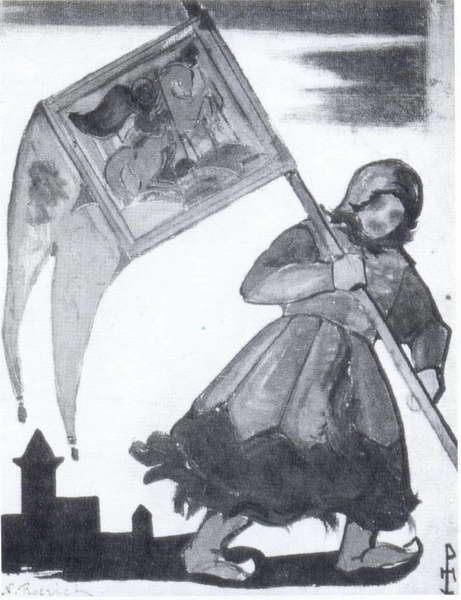
Nicholas Roemerich's 1921 painting, “Standard-bearer,” is more than just a depiction of a figure holding a banner; it’s a potent distillation of historical memory, spiritual yearning, and the enduring power of symbolic representation. Executed in a strikingly austere grayscale palette, the work immediately draws the viewer into a world stripped bare of extraneous detail, forcing a concentrated engagement with its core elements – form, line, and the implied narrative woven within.
- Primitive Roots: The artwork’s aesthetic aligns powerfully with Roerich's broader artistic philosophy, rooted in his fascination with ancient cultures and their spiritual traditions. This influence manifests in a style reminiscent of folk art or medieval illumination – bold lines define the central figure and banner, while simplified geometric shapes construct the background, evoking a sense of timelessness and ritualistic solemnity.
- A Flattened Perspective: The deliberate rejection of traditional perspective creates an almost iconographic quality, akin to religious icons. This flattened space emphasizes the symbolic weight of the subject rather than striving for realistic representation. It’s as if Roerich sought to capture not a moment in time, but a timeless archetype.
Technique and Materials: Charcoal's Dance on Paper
The execution of “Standard-bearer” reveals a meticulous hand at work. The artist employed charcoal or graphite on paper, utilizing hatching and cross-hatching with remarkable precision to build up tonal variations within the grayscale palette. This technique isn’t merely about shading; it’s about creating texture and suggesting volume – the rough application of lines lends a tactile quality to the image, as if one could almost feel the grit of the charcoal on the paper.
- Hatching and Cross-hatching: The deliberate layering of lines creates depth and dimension within the limited palette. This technique is characteristic of Roerich’s approach, prioritizing expressive mark-making over photographic realism.
- Likely Materials: Based on the grainy texture and tonal range, it's highly probable that charcoal or graphite was used, creating a surface rich in visual information despite its monochromatic nature.
Symbolism and Emotional Resonance
Beyond its formal qualities, “Standard-bearer” resonates with profound symbolic meaning. The figure holding the banner – a potent emblem of leadership, authority, and perhaps even divine mandate – commands our attention. The downward angle of the banner suggests both submission and defiance, creating a dynamic tension within the composition. The lack of color amplifies this emotional impact, lending an air of mystery and solemnity.
- Historical Context: Painted in 1921, during a period of significant social and political upheaval, the artwork can be interpreted as a reflection on tradition, duty, and the enduring values of civilization.
- Spiritual Undertones: Roerich’s work frequently explored themes of spirituality and interconnectedness, suggesting that “Standard-bearer” may represent a connection to ancient rites and beliefs.
A Timeless Masterpiece – Perfect for Collection or Interior Design
“Standard-bearer,” with its striking simplicity and powerful symbolism, is a testament to Nicholas Roerich’s artistic vision. ArtsDot offers meticulously crafted hand-painted reproductions of this captivating artwork, allowing you to bring its timeless beauty into your home or office. Whether you are an art collector seeking to expand your collection or an interior designer looking for a statement piece, this reproduction provides an authentic and evocative representation of a truly remarkable work.