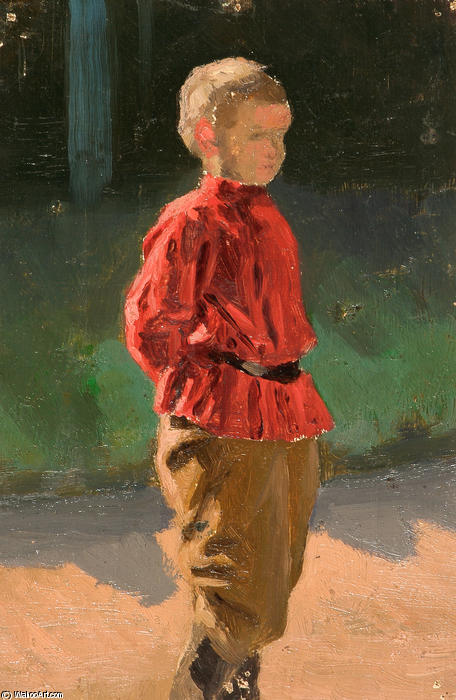
Nicholas Roerich’s ‘Study of a Boy’: A Portrait of Innocence and Spiritual Seeking
Nicholas Roemerich's “Study of a Boy” is more than just a portrait; it’s a poignant meditation on childhood, spirituality, and the enduring human connection to nature. Painted during a period of intense personal and artistic exploration for the Russian artist, this work embodies his signature style – a blend of meticulous realism with deeply layered symbolism rooted in Eastern mysticism and a fervent belief in the interconnectedness of all things. The painting’s quiet intensity draws the viewer into a moment of profound contemplation, inviting us to consider the boy's gaze and the secrets held within the surrounding landscape.
Subject and Composition
The subject is a young boy, presented with an almost unnerving directness. He stands squarely before the viewer, his brown hair neatly arranged, wearing a simple red shirt that immediately draws the eye. The composition is deliberately uncluttered, focusing entirely on this central figure. Roerich’s careful attention to detail – the texture of the boy's clothing, the individual strands of his hair, and the subtle variations in light and shadow – speaks to his rigorous artistic training and his desire to capture not just a likeness but an essence. The inclusion of two secondary figures, subtly placed in the background, adds another layer of complexity, suggesting a familial or communal setting that further enhances the narrative potential of the piece.
- The boy’s direct gaze is particularly striking, conveying a sense of seriousness and perhaps even melancholy.
- The tree behind him isn't merely a backdrop; it acts as a visual anchor, connecting the boy to the natural world – a recurring motif in Roerich’s work.
- The positioning of the secondary figures hints at themes of guardianship and protection, common within Roerich’s symbolic language.
Technique and Style: The Roerich Aesthetic
Roerich's technique is characterized by a remarkable ability to render texture with astonishing accuracy. His brushwork is precise yet fluid, creating a sense of depth and volume that brings the boy and his surroundings to life. He employed glazing techniques – applying thin layers of translucent paint over dried underlayers – to achieve luminous colors and subtle tonal variations. This meticulous approach, combined with his deep understanding of light and shadow, creates an almost photographic realism, yet infused with a spiritual quality. The painting’s palette is dominated by earthy tones—browns, greens, and ochres—reflecting the natural setting and contributing to its overall sense of tranquility.
Symbolism and Historical Context
"Study of a Boy" reflects Roerich's evolving philosophical and spiritual beliefs. Influenced by his travels in Central Asia and his studies of ancient cultures, he increasingly incorporated symbols from various traditions – particularly those associated with the East—into his work. The tree itself is laden with symbolic meaning, representing life, growth, and connection to the divine. Roerich was deeply interested in exploring themes of immortality and the soul’s journey through time and space, ideas that are subtly present within this portrait. Painted during a period when Roerich was actively involved in promoting peace and cultural understanding, the work can be interpreted as an appeal for compassion and respect between peoples.
Emotional Impact and Artistic Legacy
Ultimately, “Study of a Boy” resonates with viewers on a deeply emotional level. Its quiet intensity and evocative symbolism invite contemplation about childhood innocence, spiritual seeking, and the enduring power of human connection. Roerich’s work continues to captivate audiences today, demonstrating his mastery of technique and his profound understanding of the human condition. A hand-painted reproduction offers an unparalleled opportunity to experience the full beauty and emotional depth of this remarkable portrait, bringing a touch of Roerich's visionary spirit into your home or workspace.