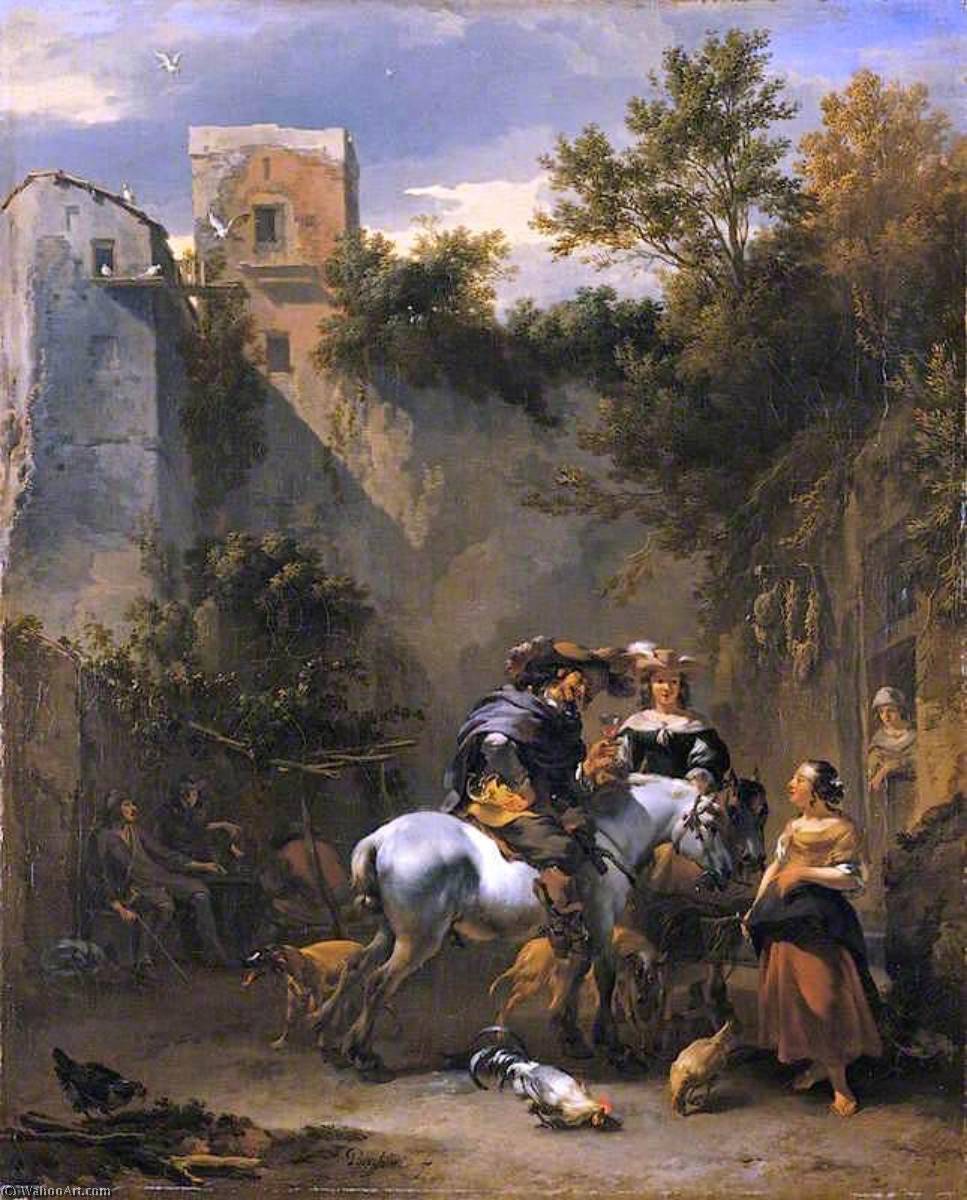
Explore 'Halt at an Inn' by Nicolaes Pietersz Berchem (1679). A Dutch Golden Age masterpiece depicting a bustling Mediterranean scene with rich detail & narrative storytelling. Discover this iconic artwork!
Nicolaes Pietersz Berchem (1620-1683) was a Dutch Golden Age master of idyllic Italianate landscapes, blending Northern realism with Southern romanticism. Explore his pastoral scenes & enduring legacy.
Discover exquisite French art & arms at the Wallace Collection! Explore Rococo masterpieces, Georgian grandeur, and a unique royal townhouse experience – free admission awaits!
A Window Into Venetian Pastoral: Examining Nicolaes Pietersz Berchem’s ‘Halt at an Inn’
Nicolaes Pietersz Berchem's “Halt at an Inn,” painted in 1679, stands as a quintessential emblem of the Dutch Golden Age – a testament to its fascination with idealized landscapes and masterful artistic execution. More than just a depiction of a rural scene, this artwork embodies a profound engagement with classical ideals and invites contemplation on themes of commerce, social interaction, and the harmonious coexistence of humanity and nature. Its enduring appeal lies in Berchem’s ability to capture not merely what was seen but what was felt, transporting viewers back to a vibrant period brimming with artistic innovation and intellectual curiosity.
Composition & Style: Echoes of Italian Arcadia
The painting's composition immediately establishes a sense of grandeur and order, characteristic of the Baroque tradition yet tempered by Berchem’s distinctly Northern sensibility. At its core is a central group comprised of figures engaged in a transaction – likely exchanging goods – alongside a horse-drawn cart laden with merchandise. This dynamic interplay captures the pulse of daily life within a Mediterranean village, skillfully rendered against a backdrop of lush foliage and distant buildings. Berchem deliberately employs flattened perspective, prioritizing clarity and visual impact over strict realism; this technique aligns perfectly with the prevailing stylistic trends of his time – specifically, the influence of Italian Arcadia, where artists sought to recreate idealized visions of pastoral beauty inspired by Virgil’s Georgics. The artist meticulously observes light and shadow, utilizing chiaroscuro—a technique perfected during the Baroque era—to sculpt forms and imbue the scene with atmospheric depth.
Technique & Detail: Precision Meets Romantic Emotion
Berchem's mastery is evident in his painstaking attention to detail. Each element of the composition – from the folds of clothing to the texture of the horse’s coat – is rendered with remarkable precision, demonstrating a commitment to observational accuracy that distinguishes him from many contemporaries. The brushwork itself is relatively smooth, contributing to an overall impression of serenity and refinement. However, beneath this surface calm lies a subtle undercurrent of emotion. Berchem skillfully employs color palettes—muted greens, browns, and ochres—to evoke the tranquility of the countryside while simultaneously conveying a sense of warmth and inviting contemplation. The artist’s meticulous rendering of natural elements – trees, shrubs, and flowers – underscores his belief in the transformative power of nature and its ability to inspire artistic expression.
Historical Context: A Reflection of Dutch Prosperity
“Halt at an Inn” was created during a period of unprecedented economic prosperity for the Netherlands—the culmination of centuries of maritime trade and colonial expansion. This newfound wealth fueled artistic patronage, encouraging artists like Berchem to explore ambitious themes and experiment with innovative techniques. The painting reflects the broader cultural preoccupation with classical ideals and humanist values prevalent throughout Europe at the time, mirroring the burgeoning interest in reviving Greco-Roman art and literature. Furthermore, it speaks to a deeper societal yearning for beauty and harmony—a desire to escape the anxieties of urban life and reconnect with the rhythms of the natural world.
Symbolism & Emotional Impact: Beyond Mere Representation
Beyond its formal qualities, “Halt at an Inn” resonates with symbolic significance. The transaction depicted represents not only economic exchange but also social interaction – a microcosm of human relationships within a larger community. The horse and cart symbolize movement and progress, yet they are framed by the stillness of the landscape, suggesting that true fulfillment lies in finding balance between activity and contemplation. Ultimately, Berchem’s masterpiece succeeds in transporting viewers to another realm—a place where beauty reigns supreme and tranquility prevails. It remains an enduring testament to the artistic achievements of the Dutch Golden Age and continues to inspire admiration for its masterful composition, meticulous technique, and profound emotional impact.