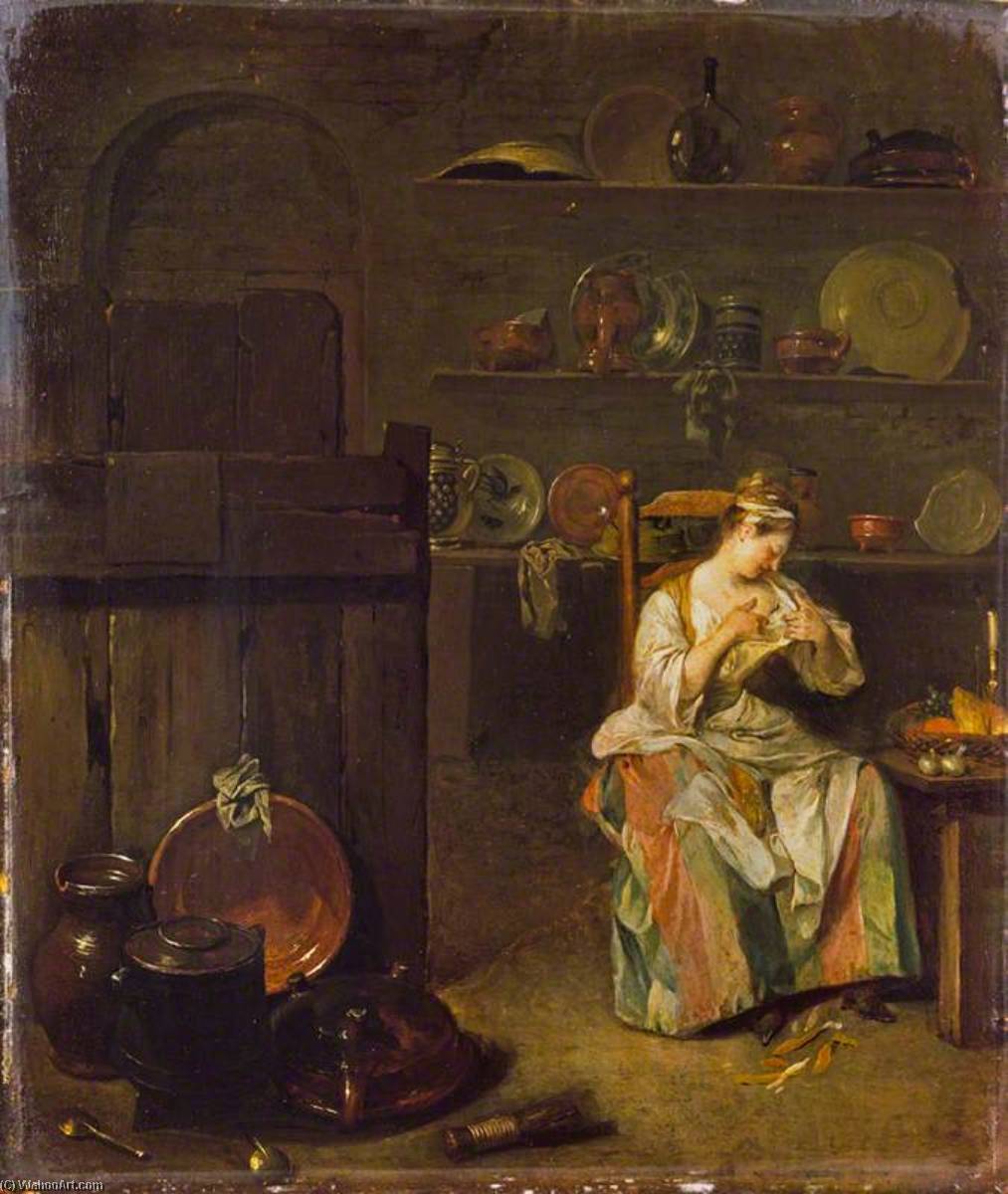
A Glimpse into Domestic Grace: Analyzing "A Girl in a Kitchen"
To stand before Nicolas Lancret's "A Girl in a Kitchen" is to be transported not merely to a room, but to a moment suspended in the warm, amber glow of Rococo domesticity. This painting, dating from 1730, offers us an intimate tableau vivant, far removed from grand mythological scenes or royal portraits. Instead, Lancret directs our gaze toward the quiet industry and gentle presence of daily life. The composition centers around a young woman seated at a sturdy table, surrounded by the tangible evidence of domestic activity—bowls brimming with untold ingredients, scattered cups hinting at shared conversation, and an elegant bottle resting near the edge.
The scene is rich with implied narrative. One can almost hear the gentle clinking of porcelain or smell the mingled scents of spices and baking bread. It speaks to a time when the domestic sphere was not merely functional but was itself a subject worthy of high art, capturing the subtle rhythms that underpin civilized existence.
The Allure of Rococo Intimacy
Lancret’s mastery is deeply rooted in the spirit of the Rococo era. While his training connected him to the grand gestures of history painting, his genius blossomed when he turned his brush toward the pleasures and quotidian moments of Parisian life. This work embodies that characteristic shift—a move from public spectacle to private grace. The palette itself contributes to this feeling; expect soft transitions, delicate highlights catching on glazed ceramics, and a general atmosphere imbued with lighthearted charm. It is art designed not for solemn contemplation alone, but for the gentle enjoyment of memory.
The arrangement of objects—the carefully placed cups and bowls—is almost meticulously composed, guiding the viewer's eye across the surface in a pleasing, meandering path. This attention to decorative detail elevates the mundane into something beautiful, a hallmark of the period’s aesthetic sensibility.
Technique and The Art of Still Life Integration
Examining the technique reveals Lancret’s skill as both portraitist and still-life painter. The handling of textures is particularly noteworthy; one can almost feel the smooth curve of the porcelain against the rougher grain of the wooden table. The way light interacts with these varied surfaces—the sheen on a liquid, the matte finish of linen—demonstrates a sophisticated understanding of optics. The inclusion of so many disparate objects means that the painting functions as a masterful study in arrangement, where every cup and bowl contributes to the overall harmony rather than existing as mere props.
For those considering a reproduction for an interior space, this technical finesse is key. A high-quality print allows one to bring this depth of texture and light into a modern setting, echoing the sophisticated taste of 18th-century Parisian drawing rooms.
Symbolism of Sustenance and Society
Beyond its immediate charm, "A Girl in a Kitchen" carries subtle symbolic weight. The kitchen, historically, was the heart of the home—the place where sustenance was prepared and community was nurtured. By painting this scene, Lancret celebrates not just food preparation, but the very act of caretaking and domestic connection. The woman herself, though perhaps engaged in an activity, embodies a quiet poise; she is both participant and subject. She represents the gentle backbone of society—the grace found within routine.
This painting invites us to pause our own hurried modern lives and appreciate the beauty inherent in simple acts: sharing a meal, preparing ingredients, or simply being present with one another around a well-used table. It is an enduring meditation on comfort.