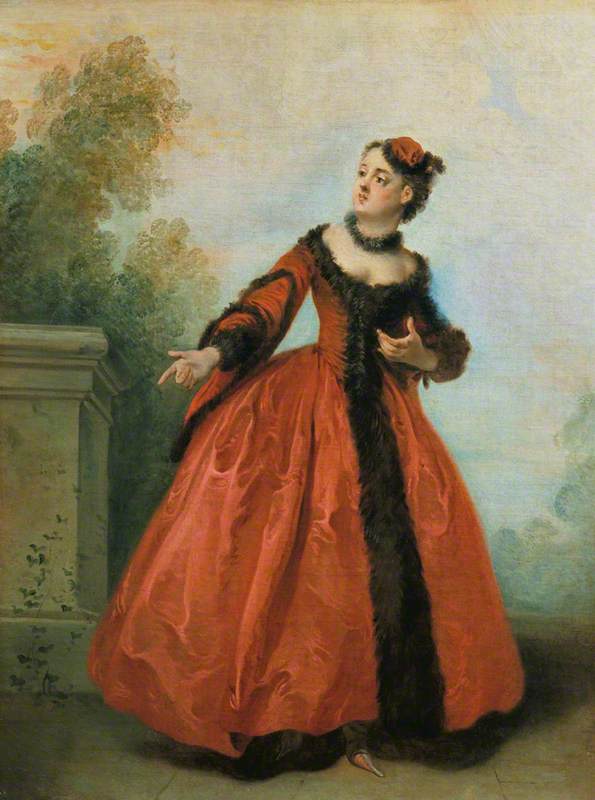
Admire Nicolas Lancret’s ‘The Beautiful Greek’ (1732), a stunning Rococo portrait of aristocratic beauty. Explore this exquisite oil painting's elegance, diffused light & classical details.
Explore the charming world of Nicolas Lancret (1690-1743), a French Rococo painter known for his delightful scenes of Parisian life, fêtes galantes & lighthearted social gatherings. Discover 'Le Déjeuner de Jambon' and more!
Step back to Georgian elegance at The Wallace Collection! Explore stunning French art, exquisite furniture & arms in a historic townhouse – a jewel box of 18th-century London.
A Celebration of Grace: Exploring Nicolas Lancret’s “The Beautiful Greek”
Nicolas Lancret's "The Beautiful Greek," painted circa 1732, stands as a quintessential emblem of Rococo artistry—a movement that prioritized elegance, ornamentation, and an idealized vision of beauty within the aristocratic circles of Louis XV’s France. More than just a portrait, it embodies the spirit of *fêtes galantes*, elaborate outdoor celebrations designed to showcase refined taste and social prestige. This captivating artwork resides in The Wallace Collection, offering visitors a glimpse into a period defined by opulent displays of wealth and artistic innovation.
Subject Matter and Composition
The painting depicts a young woman bathed in diffused sunlight, positioned amidst a hazy landscape dotted with trees—a deliberate choice reflecting the Rococo fascination with atmospheric perspective and creating an illusion of serene tranquility. Lancret skillfully focuses on capturing her gaze, conveying a sense of contemplative beauty and inner grace. Her pose is subtly asymmetrical, mirroring the flowing drapery that dominates the composition – a hallmark of Watteau’s influence and Lancret's own stylistic signature. The central figure commands attention while simultaneously inviting contemplation of the surrounding environment, reinforcing the overarching theme of harmonious balance.
Style and Technique: Rococo Refinement
Lancret expertly employs oil paint on canvas with delicate brushstrokes—a technique that achieves remarkable luminosity and softness. Texture is meticulously crafted to mimic the tactile qualities of fabric and skin, enhancing the illusion of realism despite the stylized aesthetic. The artist’s masterful use of curvilinear lines – prevalent throughout the painting – underscores the movement's characteristic elegance and contributes to its overall decorative appeal. Shapes are predominantly organic, mirroring the natural world and aligning with Rococo ideals of beauty rooted in nature. Lancret’s palette leans towards muted tones—primarily greens and browns for the landscape—contrasting subtly with the vibrant reds and blacks adorning the woman’s gown.
Historical Context: Fêtes Galantes and Aristocratic Society
“The Beautiful Greek” emerged during a period of considerable artistic ferment in France, coinciding with the reign of Louis XV. *Fêtes galantes*, formalized outdoor gatherings featuring music, dance, and elaborate costumes, served as expressions of aristocratic patronage and social ambition. Lancret’s depiction captures this cultural milieu perfectly—celebrating beauty, leisure, and refined manners within a framework of established social hierarchies. The inclusion of a classical column adds to the painting's historical resonance, referencing ancient ideals of proportion and harmony – concepts central to Renaissance thought and subsequently adopted by Rococo artists.
Symbolism: Beauty Idealized
Beyond its aesthetic qualities, “The Beautiful Greek” carries symbolic weight. The woman’s attire—particularly her crimson dress embellished with fur trim—represents wealth and status, mirroring the aspirations of the aristocratic elite. Her serene expression embodies the Rococo ideal of composure and inner peace – a deliberate contrast to the turbulent political landscape of the time. Lancret's portrayal elevates the female figure to an archetype of beauty, reflecting the broader cultural preoccupation with idealized femininity during the Baroque and Rococo eras.
Emotional Impact: Tranquility and Refinement
Ultimately, “The Beautiful Greek” evokes feelings of tranquility, sophistication, and understated elegance. Its luminous surface and harmonious composition invite viewers into a realm of refined aesthetic pleasure—a testament to Lancret’s artistic skill and his ability to capture the spirit of an era defined by opulent grandeur and intellectual curiosity. It remains a captivating example of Rococo painting, continuing to inspire admiration for its beauty and conveying timeless notions of grace and refinement.