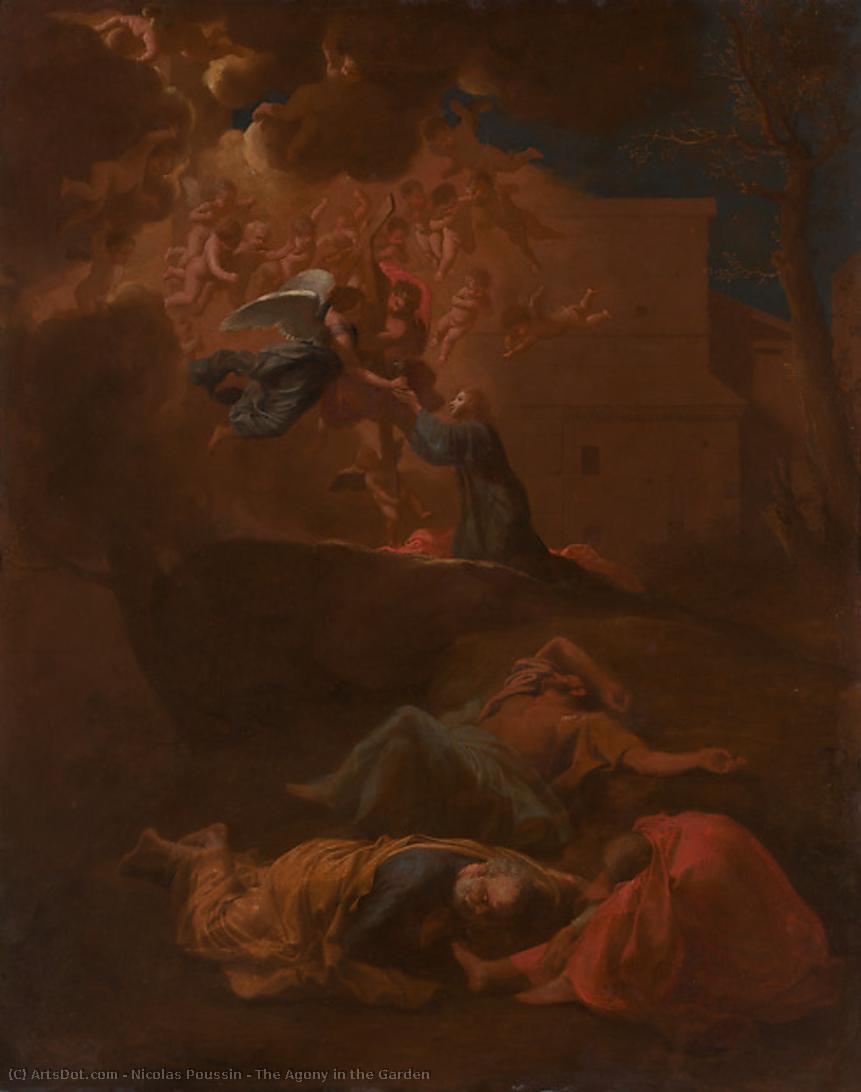
Admire Nicolas Poussin's masterpiece "The Agony in the Garden," an iconic oil on copper painting showcasing classical influences and Venetian artistry—a testament to Baroque brilliance.
Explore Nicolas Poussin's masterful Baroque paintings—renowned for serene landscapes and mythological narratives inspired by classical antiquity. Discover iconic artworks at ArtsDot.
Explore The Metropolitan Museum of Art: 5,000 years of art from around the world! Discover masterpieces, ancient artifacts & immersive exhibitions – a global art destination awaits.
The Agony in the Garden: A Masterpiece of Baroque Serenity
Nicolas Poussin’s “The Agony in the Garden” transcends mere depiction; it embodies a profound meditation on faith, doubt, and human vulnerability—a cornerstone of Baroque art that continues to resonate with audiences today. Executed in 1626, this oil on copper painting stands as an exceptional achievement in artistic innovation and technical mastery, reflecting Poussin’s unwavering devotion to classical ideals while simultaneously embracing the expressive dynamism characteristic of Venetian Renaissance influences.
Composition and Symbolism: A Zigzag Journey Through Suffering
The artwork's distinctive zigzag composition immediately draws the eye, uniting two distinct scenes—Christ contemplating his impending crucifixion and his disciples wrestling with despair—within a single frame. This deliberate structuring technique underscores Poussin’s masterful command of perspective and spatial illusion, mirroring the conventions established by artists like Andrea Mantegna and Leonardo da Vinci. Monumental figures dominate the foreground, anchoring the scene in earthly reality while simultaneously emphasizing the solemn gravity of the moment. The architecture – reminiscent of Roman temples – serves as a visual symbol of divine authority and reinforces Poussin’s commitment to classical aesthetics. Notably, the pervasive use of light—a hallmark of Venetian painters like Titian—creates an ethereal atmosphere that contrasts sharply with the darkness surrounding Christ and his companions, symbolizing hope amidst sorrow. The cascade of putti adorning the upper register adds a layer of mythological allusion, referencing biblical narratives about divine compassion and redemption.
Artistic Influences: Copper’s Glow and Venetian Light
Poussin's selection of copper as a support was no accident; it represented a significant advancement in artistic technique during his time. Unlike canvas, copper offered unparalleled smoothness, resistance to corrosion, and longevity—factors that ensured the painting’s preservation for centuries. This medium allowed Poussin to achieve an astonishing level of tonal subtlety and luminosity, capturing the nuances of nocturnal light with breathtaking precision. Furthermore, Poussin's stylistic choices – particularly his incorporation of Venetian Renaissance principles – demonstrate his intellectual curiosity and willingness to synthesize diverse artistic traditions. The painting’s luminous quality owes much to the influence of Venetian painters who skillfully employed glazing techniques to achieve similar effects.
Historical Context: Rome and Cassiano Dal Pozzo’s Patronage
Poussin undertook this ambitious project shortly after arriving in Rome, where he was brimming with innovation and enthusiasm but had yet to establish himself as a prominent figure within the city's artistic milieu. Recognizing his talent, Cassiano dal Pozzo—a celebrated antiquarian and connoisseur—became Poussin’s most influential patron, fostering an environment conducive to experimentation and intellectual discourse. This patronage profoundly shaped Poussin’s artistic vision, propelling him toward groundbreaking achievements that would solidify his legacy as one of the foremost painters of the Baroque era. The painting quickly entered Cassiano dal Pozzo's collection—a testament to its immediate recognition by a discerning eye attuned to the highest standards of artistic excellence.
Comparative Works: Rembrandt and Kano Tansui Moritsune
For a richer understanding of Poussin’s stylistic trajectory, consider juxtaposing “The Agony in the Garden” with other notable artworks from different eras and cultures. Rembrandt Peale's *Self-Portrait* (80 x 67 cm) exemplifies the introspective gaze characteristic of Dutch Baroque painting—a focus on psychological depth and emotional vulnerability that contrasts sharply with Poussin’s monumental grandeur. Similarly, Kano Tansui Moritsune’s *Mount Penglai with Eight Views of Xiao and Xiang* (187.0cm x 53.7cm) showcases the serene beauty of Japanese landscape painting—a stylistic approach rooted in Zen Buddhism that prioritizes contemplation and harmony with nature. These comparative works illuminate the diverse artistic traditions that shaped European art history, providing valuable context for appreciating Poussin’s singular contribution to Baroque aesthetics.