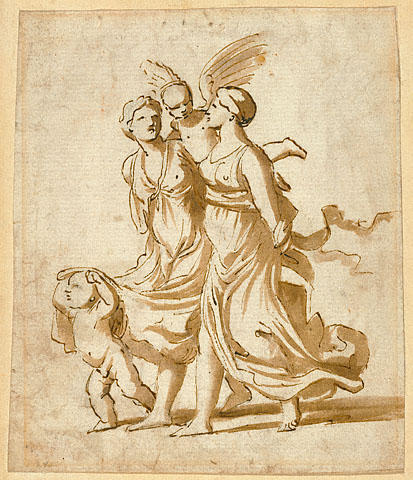
The painting depicts two women accompanied by Cupid, embodying classical ideals of beauty and innocence. Nicolas Poussin's masterful composition captures the serenity of the outdoor setting and celebrates maternal tenderness.
Explore Nicolas Poussin's masterful Baroque paintings—renowned for serene landscapes and mythological narratives inspired by classical antiquity. Discover iconic artworks at ArtsDot.
A Vision of Innocence and Divine Grace: Exploring Nicolas Poussin’s “Two Girls Accompanied by Cupid”
The painting "Two Girls Accompanied by Cupid," attributed to Nicolas Poussin, stands as a cornerstone of French Baroque art—a testament to the artist's mastery of classical ideals blended seamlessly with emotive expression. Completed around 1645-1646, it resides within the Musée du Louvre in Paris and continues to captivate audiences with its serene beauty and profound symbolic depth. This essay delves into the multifaceted layers of this iconic artwork, examining its subject matter, stylistic innovations, artistic technique, historical significance, and enduring emotional resonance.
Subject Matter: A Pastoral Ideal
At first glance, “Two Girls Accompanied by Cupid” presents a deceptively simple tableau: two young women standing amidst lush foliage—specifically olive trees—with one cradling a baby in her arms. However, beneath this pastoral surface lies an intricate tapestry of mythological allusion. The figures embody the Virgin Mary and Saint Anne, representing humility and maternal devotion – concepts central to Christian iconography. Cupid, the Roman god of love, delicately intervenes, showering them with blossoms symbolizing fertility and renewal. This deliberate juxtaposition elevates the scene beyond mere depiction; it speaks to themes of divine grace, spiritual purity, and the promise of eternal life—a hallmark of Poussin’s artistic philosophy.
Style and Technique: Baroque Refinement
Poussin's style exemplifies the Baroque aesthetic – characterized by dramatic lighting, meticulous detail, and a calculated sense of grandeur. Unlike the turbulent dynamism prevalent in other Baroque canvases, “Two Girls Accompanied by Cupid” exudes tranquility through masterful chiaroscuro—the interplay between light and shadow—creating an ethereal atmosphere that draws viewers into the scene’s contemplative mood. The artist employs painstaking brushwork to render textures with astonishing realism, capturing the velvety softness of olive leaves and the delicate folds of fabric. Furthermore, Poussin utilizes pyramidal composition – a technique borrowed from Renaissance artists like Raphael – to stabilize the image and guide the eye towards the central figures, reinforcing their importance within the narrative framework.
Historical Context: Rome’s Artistic Ascendancy
Poussin's artistic journey culminated in his relocation to Rome during the papal patronage of Cardinal Mazarin—a period witnessing an unprecedented flourishing of classical art and scholarship. The rediscovery of ancient texts and sculptures fueled a renewed interest in humanist ideals, prompting artists like Poussin to reinterpret mythological narratives through the lens of Christian theology. “Two Girls Accompanied by Cupid” reflects this intellectual climate, embodying the Baroque conviction that beauty could elevate the soul and inspire contemplation—a sentiment deeply resonant with the spiritual fervor of the era. It stands as a powerful emblem of Rome’s artistic dominance during Mazarin's reign, showcasing the transformative influence of classical antiquity on European art.
Symbolism: Blossoms of Hope and Divine Intervention
The olive trees themselves symbolize peace and prosperity—traditionally associated with Jerusalem and representing divine blessing upon Mary and Saint Anne. The blossoms raining down upon the women signify fertility and rebirth – mirroring the Virgin Mary’s conception and foreshadowing the arrival of Christ. Cupid's presence underscores the notion that love, guided by divine grace, is instrumental in achieving spiritual fulfillment. Each element within the painting contributes to a complex symbolic system designed to convey profound theological truths—a testament to Poussin’s erudition and artistic ambition.
Emotional Impact: A Balm for the Soul
Ultimately, “Two Girls Accompanied by Cupid” transcends mere visual representation; it evokes an emotional response rooted in contemplation and reverence. The painting's serene beauty inspires feelings of tranquility, compassion, and spiritual aspiration—capturing the essence of Christian piety. Its masterful technique – particularly chiaroscuro – creates a palpable sense of atmosphere, transporting viewers to a timeless pastoral landscape imbued with divine grace. As a result, this artwork continues to resonate powerfully with audiences today, serving as an enduring reminder of the transformative power of art to nourish the soul and illuminate the human condition.