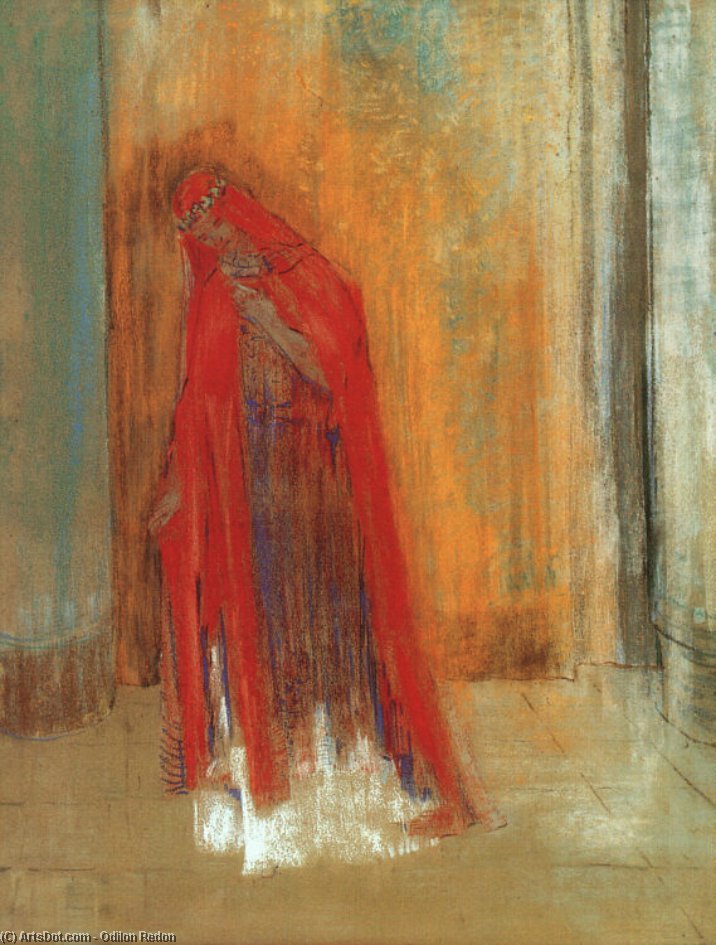
The painting’s composition is intriguing, with smaller figures adding depth to the central portrait. Learn more about Redon's work at ArtsDot.com.
Explore the enigmatic world of Odilon Redon (1840-1916), a French Symbolist known for his haunting ‘noirs,’ dreamlike visions, and influence on Surrealism.
Discover the Musée d'Orsay in Paris! Housed in a stunning former railway station, explore an unparalleled collection of Impressionist & Post-Impressionist masterpieces by Monet, Van Gogh & more.
A Portrait of Mystery: Exploring Odilon Redon’s “Oriental Woman”
The pastel painting "Oriental Woman," created by French Symbolist artist Odilon Redon in 1897, transcends mere representation; it embodies the core tenets of the movement's philosophical quest – a desire to capture truths beyond the visible realm through evocative imagery and suggestive symbolism. Housed within the Musée d’Orsay’s esteemed collection in Paris, this artwork stands as a testament to Redon’s profound ability to distill emotion and psychological complexity into delicate visual form.
The Artist's Vision: Embracing Symbolism
Odilon Redon (1840-1916) emerged from Bordeaux with an artistic sensibility honed by early influences – notably Jean-Léon Gérôme and Rodolphe Bresdin’s instruction in etching and lithography – techniques that would become instrumental in shaping his distinctive style. Unlike the prevailing academic realism of his time, Redon sought to communicate ideas rather than depict reality faithfully. His canvases frequently presented dreamlike landscapes populated by shadowy figures and ambiguous forms, reflecting a preoccupation with subconsciousness and spiritual contemplation. This approach aligns perfectly with Symbolism’s core belief: that art should convey deeper meanings inaccessible to rational thought.
Technique and Aesthetic Considerations
Redon's masterful use of pastel crayons—a medium known for its luminous qualities and ability to achieve subtle tonal gradations—is particularly evident in “Oriental Woman.” The artist meticulously layered delicate strokes of color, creating a velvety surface texture that enhances the painting’s ethereal atmosphere. Light plays an integral role, diffusing softly across the canvas and casting gentle shadows which contribute to the overall sense of intimacy and melancholy. This deliberate manipulation of light echoes broader artistic trends of the period, prioritizing emotional resonance over literal accuracy. The artist's careful attention to detail—particularly in rendering the woman’s face partially obscured by a scarlet scarf—further underscores his commitment to conveying psychological nuance.
Symbolic Layers: Decoding the Image
The painting’s symbolism is rich and multilayered. The woman herself represents an archetype of feminine vulnerability and contemplation, while the red scarf serves as a potent visual metaphor for passion, concealment, and perhaps even danger. Her hooded head adds to the aura of mystery, inviting viewers to ponder upon hidden emotions and unspoken narratives. Considering the Symbolist movement’s preoccupation with exploring the subconscious mind, “Oriental Woman” encourages introspection and invites us to consider themes of solitude, femininity, and the elusive nature of truth.
Emotional Resonance: A Timeless Appeal
“Oriental Woman” continues to captivate audiences today due to its ability to evoke profound emotional responses. The painting’s melancholic beauty—captured with remarkable precision by Redon's technique—resonates with viewers who appreciate art that transcends superficial appearances and delves into the depths of human experience. Its quiet contemplation speaks to a universal yearning for connection and understanding, cementing its place as an enduring masterpiece of Symbolist art.