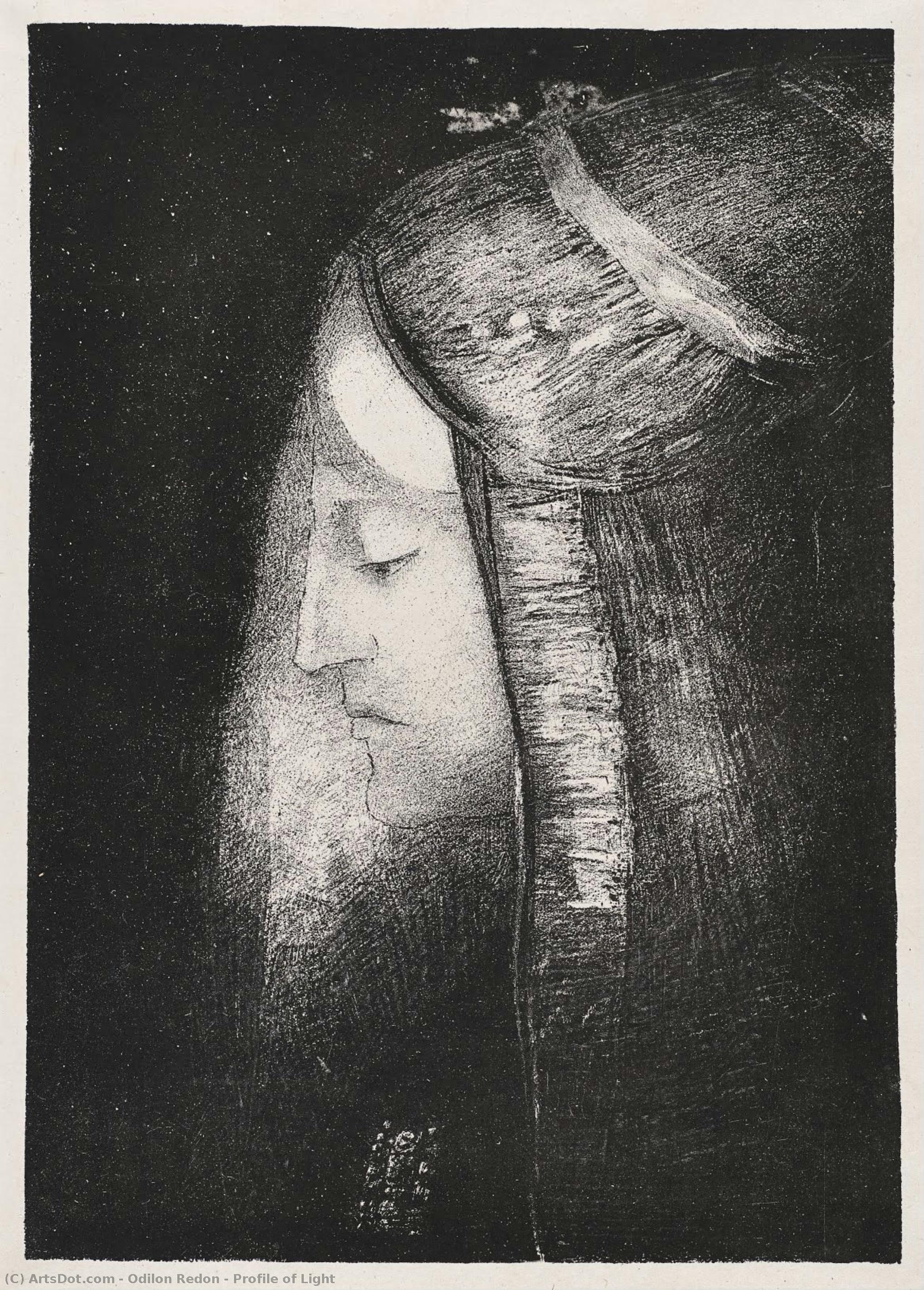
Haunting black and white lithograph by Odilon Redon, 1886, captures a solitary figure in a desolate landscape reflecting Symbolist themes of introspection and metamorphosis. Explore this evocative artwork and bring its dreamlike beauty into your collection.
Explore the enigmatic world of Odilon Redon (1840-1916), a French Symbolist known for his haunting ‘noirs,’ dreamlike visions, and influence on Surrealism.
Explore Scottish art at the National Gallery of Scotland! Discover masterpieces by renowned artists like Titian & Monet in a stunning neoclassical building on Edinburgh's Mound.
Profile of Light: An Exploration into Odilon Redon’s Symbolism and Technique
Odilon Redon's "Profile of Light," created in 1886, stands as a cornerstone of Symbolist art—a testament to the artist’s unwavering commitment to delving beyond observable reality into the realm of subconscious thought and emotion. Captured in stark black and white photography, this lithograph exemplifies Redon’s signature style: hauntingly beautiful depictions of fantastical landscapes populated by enigmatic figures imbued with spiritual significance. The image itself, housed at The Art Institute of Chicago and Musée d'Orsay, invites contemplation on themes of solitude, metamorphosis, and the elusive nature of perception.
The Artist’s Vision: Redon’s Symbolist Journey
Born Bertrand-Jean Redon in Bordeaux in 1840, Odilon Redon emerged from a milieu steeped in artistic tradition yet driven by an urgent desire to forge his own path. Initially influenced by architectural studies—a familial expectation that proved fleeting—Redon swiftly discovered his true vocation within the expressive mediums of etching and lithography. These techniques allowed him to translate inner visions into visual representations, prioritizing mood and suggestion over precise detail. His formative years were marked by instruction from luminaries like Jean-Léon Gérôme and Rodolphe Bresdin, who instilled in him a mastery of tonal shading and compositional arrangement—skills that would become hallmarks of his oeuvre.
A Landscape of Dreams: Composition and Technique
“Profile of Light” presents a solitary female figure positioned against an amorphous backdrop reminiscent of a desolate moorland. The woman’s gaze downward conveys a profound sense of introspection, hinting at a preoccupation with unseen forces and inner turmoil. Redon skillfully employs lithographic printing—a process known for its velvety textures and tonal gradations—to achieve this ethereal effect. The delicate chine appliqué adds to the artwork's textural richness, enhancing the impression of depth and creating an atmosphere of palpable stillness. Careful consideration is given to the interplay of light and shadow, mirroring the artist’s fascination with psychological states and conveying a feeling of profound melancholy.
Symbolic Resonance: Figures and Landscapes in Redon’s Universe
Redon's artistic explorations consistently grapple with concepts of decay, regeneration, and the confrontation between humanity and the natural world—themes powerfully expressed in “Profile of Light.” The woman herself is interpreted as representing feminine vulnerability and spiritual contemplation, embodying a yearning for transcendence amidst an oppressive environment. Recurring motifs throughout Redon’s work—such as stylized landscapes dominated by barren terrain and shadowy forms—underscore his preoccupation with confronting primal fears and anxieties. These images are not merely representations; they are conduits to accessing the subconscious mind and eliciting emotional responses rooted in universal human experiences.
Emotional Impact: Capturing the Sublime
Ultimately, “Profile of Light” succeeds in conveying a profound sense of melancholy and spiritual yearning—characteristics central to the Symbolist movement’s aesthetic goals. Redon's masterful manipulation of tonal shading creates an atmosphere of haunting beauty that lingers long after viewing, prompting viewers to consider questions of mortality, faith, and the hidden dimensions of existence. Like many of his works, this lithograph invites contemplation on the sublime—that elusive feeling of awe and terror experienced when confronted with forces beyond human comprehension. It remains a poignant reminder of Redon’s ability to transform psychological anxieties into enduring artistic masterpieces.