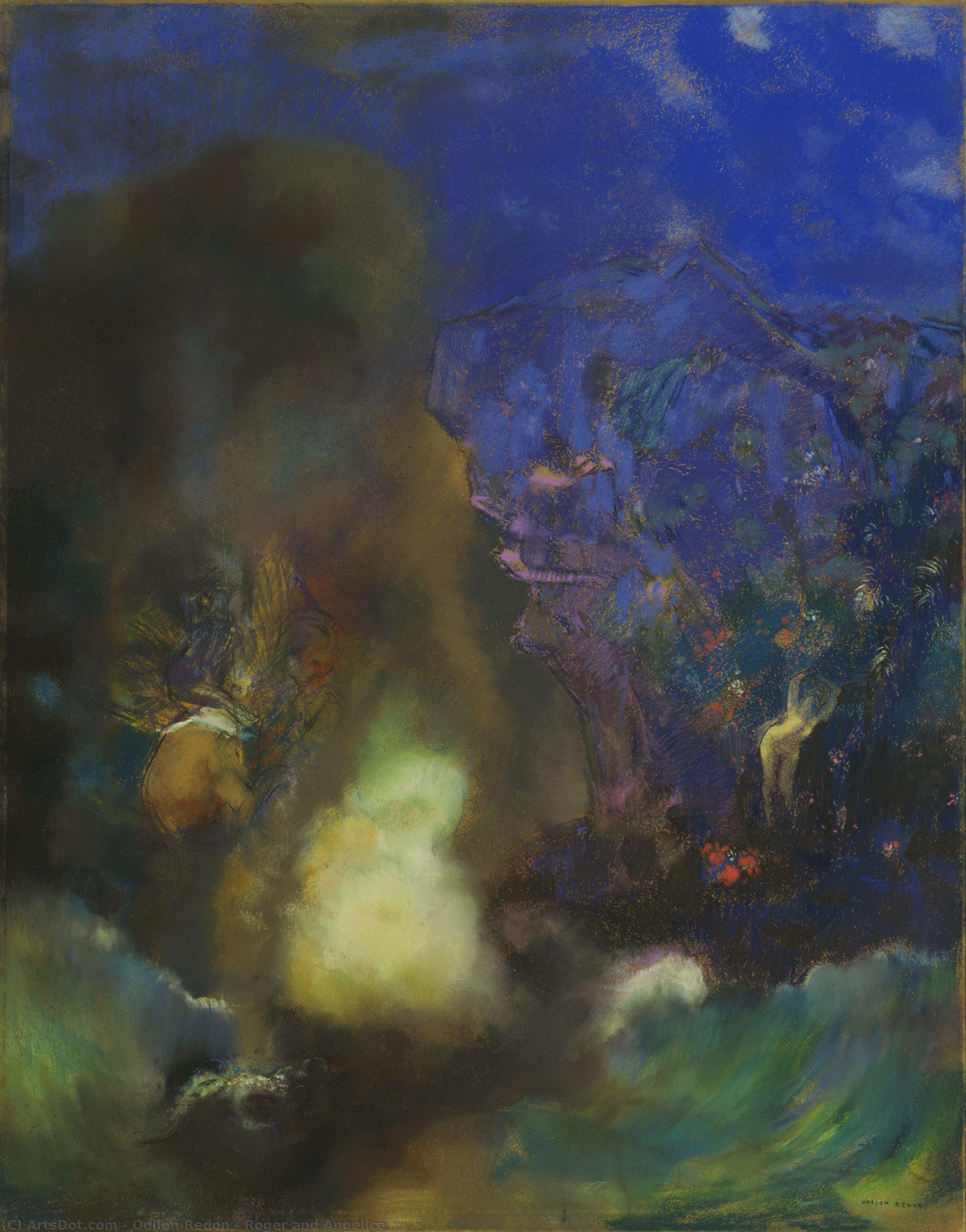
Unveiling the Dreamscape: Odilon Redon’s “Roger and Angelica”
Odilon Redon's "Roger and Angelica," painted in 1910, is not merely a depiction of a scene; it’s an immersion into a profoundly unsettling and beautiful dream. This work, emerging from the artist’s lifelong exploration of the subconscious and the realms beyond perception, embodies the core tenets of Symbolism and foreshadows the anxieties of Expressionism that would dominate much of the 20th century. The painting immediately commands attention with its dominant palette of deep blues and browns, colors traditionally associated with melancholy, mystery, and the depths of the ocean – a fitting backdrop for the unsettling narrative unfolding before us.
- Subject Matter: The composition centers around a solitary figure emerging from turbulent waves, seemingly adrift in a landscape dominated by an imposing architectural structure. This pairing—the vulnerable human form against the rigid and potentially oppressive architecture—immediately establishes a tension between individual struggle and societal forces.
- Style & Technique: Redon’s brushwork is deliberately loose and expressive, eschewing photographic realism for a focus on conveying emotion and atmosphere. The impasto technique – thick application of paint – adds to the textural richness and reinforces the sense of instability and movement within the scene. It's clear that he was working with oil on canvas, utilizing the medium’s capabilities to create a palpable sense of depth and drama.
A Symphony of Symbolism
“Roger and Angelica” is rich in symbolic resonance, inviting multiple interpretations. The turbulent waves represent chaos, disruption, and perhaps even the overwhelming forces of nature – challenges that threaten to engulf the individual. Conversely, the looming architectural structure suggests power, authority, or perhaps a decaying civilization. The flattened perspective further enhances this dreamlike quality, blurring the boundaries between reality and illusion. Redon’s use of ambiguous forms—the indistinct figure, the blurred lines—forces the viewer to actively participate in constructing meaning, mirroring the experience of navigating one's own subconscious.
- Waves as Metaphor: The waves are not simply a natural element; they symbolize emotional turmoil, uncertainty, and the relentless passage of time.
- Architecture’s Ambiguity: The building could represent societal constraints, oppressive institutions, or even the artist's own anxieties about artistic recognition.
Historical Context & Redon’s Vision
Created in 1910, “Roger and Angelica” reflects a pivotal moment in art history. Redon was working at the cusp of significant stylistic shifts, influenced by the Symbolist movement's emphasis on subjective experience and emotional expression. His early training in etching and lithography – techniques that allowed him to explore shadowy forms and ambiguous narratives – profoundly shaped his artistic vision. Born in Bordeaux in 1840, Redon’s life was marked by a persistent pursuit of the unseen, a desire to translate the hidden landscapes of the imagination onto canvas. His work anticipated many of the concerns explored by later Expressionist artists, demonstrating a remarkable prescience regarding the anxieties of the modern age.
Emotional Impact & Artistic Legacy
The overall emotional tone of “Roger and Angelica” is undeniably melancholic and somewhat ominous. It evokes a sense of isolation, vulnerability, and perhaps even dread. Redon’s masterful manipulation of light and shadow, combined with his expressive brushwork, creates a powerfully evocative image that continues to resonate with viewers today. This painting stands as a testament to Redon's unique ability to tap into the deepest recesses of the human psyche, offering a glimpse into a world beyond the visible—a legacy that continues to inspire artists and captivate art lovers worldwide.